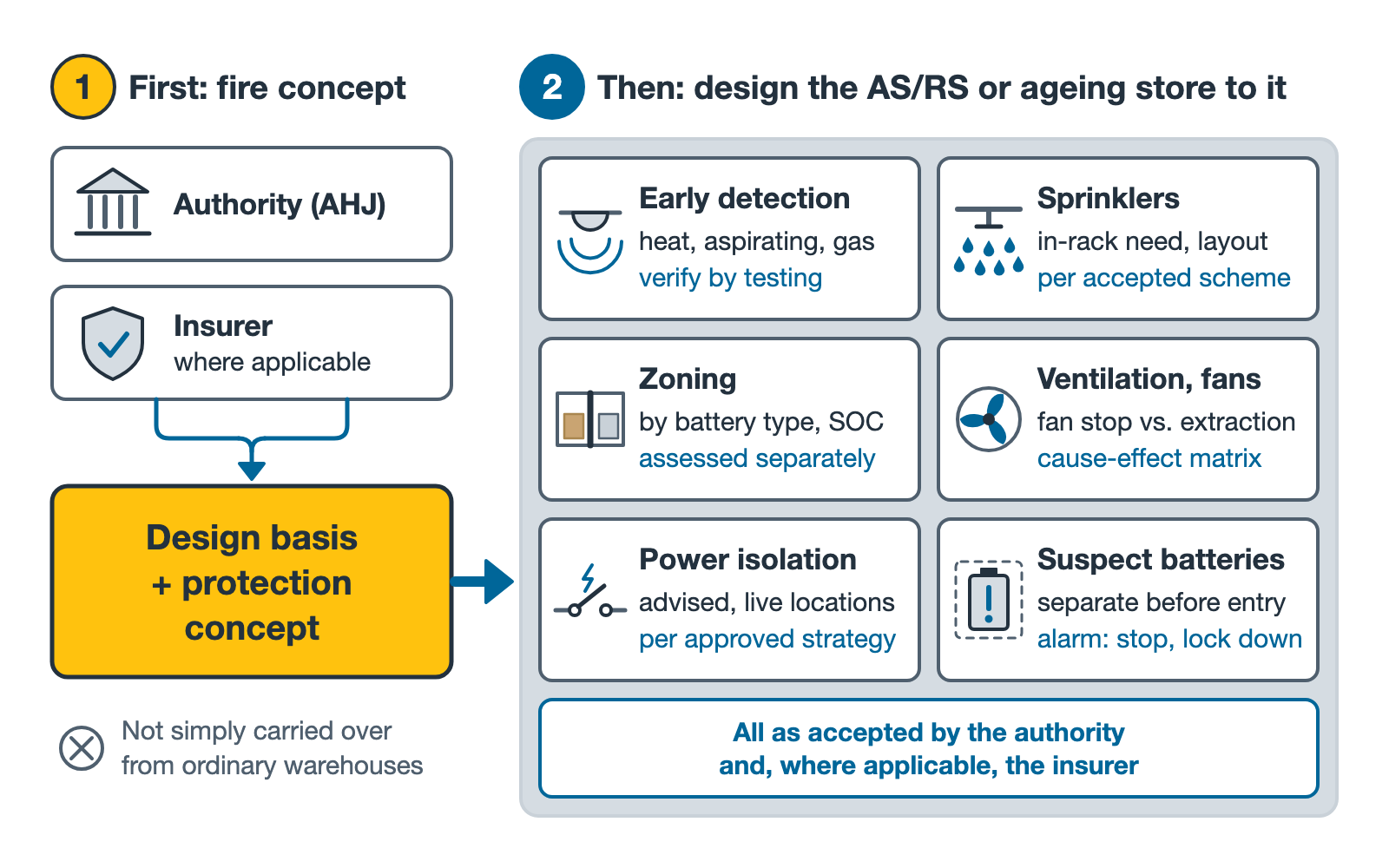
Lithium-ion cells, modules, battery packs and energy storage products can be stored in an automated warehouse, but the usual order of work has to be reversed. First agree the fire design basis and protection concept with the local authority having jurisdiction (AHJ), and get the insurer's acceptance where it is needed; only then fix rack height, equipment type and the storage layout. For an ageing store, the choice between AS/RS, AGV and floor-level storage depends on the product format, the throughput and the maintenance conditions inside the hot zone.
The short answer
- The fire protection concept for a lithium battery AS/RS should be agreed with the AHJ, and accepted by the insurer where applicable, before the racking and equipment are designed; the approach used for ordinary goods warehouses cannot simply be carried over.
- A lithium battery warehouse can combine certified linear heat detection, aspirating smoke detection and gas detection, but whether that combination finds a problem earlier than smoke and heat alarms has to be verified by testing for the target gases and the ventilation conditions.
- Sprinkler parameters from published fire tests hold only under the test conditions; once battery type, state of charge (SOC), packaging or storage height changes, they have to be reassessed.
How a battery fire differs from an ordinary warehouse fire
In an ordinary warehouse, fires usually start from external combustibles. A lithium-ion battery warehouse has that risk too, plus thermal runaway inside the batteries themselves. The 2023 review by the Fire Protection Research Foundation (FPRF) sets it out plainly: thermal runaway in one cell passes heat to neighbouring cells and can propagate through modules and packs, while releasing flammable gases with a risk of explosion. Energy left in the batteries can make the fire reignite anywhere from minutes to days after it has been put out. This is why a battery warehouse needs more than sprinklers: early detection, isolation of suspect batteries and a pre-approved emergency strategy are part of the concept.
In 2016 FM Global ran a sprinklered fire test on 20 Ah lithium iron phosphate (LFP) pouch cells packed in cartons. With an external ignition, the cartons and plastic dividers burned first and the cells only became significantly involved later. In that tested configuration, the cartons and plastic dividers were a substantial early fire load, and that finding is tied to the cell chemistry, format, SOC and packaging method. In the same building, low-SOC cells in cartons and fully charged energy storage cabinets carry entirely different levels of risk, so they should be zoned and assessed separately.
The design basis: standards and regulations we check
Some background first. Energy storage is growing in the markets we work in. According to the International Energy Agency (IEA), the Middle East added more than 3 GW of grid-scale storage in 2025 (measured as power), more than three times the 2024 figure and almost all of it in Saudi Arabia; Europe added about 6.2 GW. In February 2026 the head of Türkiye's Energy Market Regulatory Authority (EPDK) said that since the 2022 rule change, wind and solar projects with integrated storage totalling about 33 GW had received capacity allocations. That 33 GW is generating capacity, so do not use it to estimate warehouse demand.
For the design basis itself, we usually check four groups of documents.
FM Global Data Sheet 7-112 (Lithium-Ion Battery Manufacturing and Storage) was published in October 2024 and covers battery manufacturing, formation and ageing, and storage. NFPA 855 (Standard for the Installation of Stationary Energy Storage Systems) is current in its 2026 edition and also has a chapter on the storage of lithium batteries. Our summary of both is based on public sources rather than the full standard texts; the current official text governs.
Europe has no harmonised fire design code for battery warehouses. The building fire regulations of the country where the project sits apply, together with the insurer's requirements. VdS 3103 (Lithium-Batterien, lithium batteries) from the German insurance industry is often cited, but it is not mandatory. The new EU Batteries Regulation, Regulation (EU) 2023/1542, has applied since 18 February 2024. It governs battery products, and warehouse design is outside its scope. One provision is still useful to a warehouse operator: from 18 August 2024, the technical documentation for stationary battery energy storage systems has to include instructions for dealing with hazards such as fire and explosion. Ask the supplier for this document before energy storage products come into the warehouse; you will need it when writing the emergency plan.
Türkiye's Regulation on the Fire Protection of Buildings (Binaların Yangından Korunması Hakkında Yönetmelik) states that for matters it does not cover, Turkish standards apply first, then European standards, then internationally recognised standards, and that a project which does not meet the fire requirements does not receive a building permit. We have not found a clause dealing specifically with lithium battery warehouses, so whether FM or NFPA documents are accepted as the basis has to be confirmed with the authority in advance. In the Middle East, each country's own fire code and civil defence requirements apply.
Batteries in an AS/RS: sprinklers, ventilation and detection
Whether in-rack sprinklers are needed, and how they are laid out, depends on battery type, SOC, packaging, rack geometry and the results of accepted full-scale tests. The racking, fire protection and equipment teams are best put round the same drawing at concept stage. Flue spaces and sprinkler pipe routes have to stay clear of the clearance envelopes of stacker cranes and shuttles. Conveyors, platforms and similar obstructions affect water distribution and are placed according to the sprinkler obstruction rules and the approval. When we lay out a battery store we try to avoid conveyors running one above another, for exactly that reason: they block the ceiling sprinklers.
The 2016 FM Global test is a good example of how specific such results are. Its conditions were about 20 Ah LFP pouch cells at about 50% SOC, packed in cartons with plastic dividers, a rack storage height of 4.6 m and a ceiling height of 12.2 m, protected by K320 quick-response pendent sprinklers rated at 74 °C on a 3.0 × 3.0 m spacing at 2.4 bar. The report itself says the results should not be extrapolated from this one test alone. The configuration cannot be copied into a design; what counts is the scheme accepted by the authority and the insurer.
Ventilation cannot be treated as a side issue, because it affects sprinkler performance. In 2011 FM Global tested high-volume low-speed (HVLS) fans over rack storage of ordinary commodities, not batteries. Fans left running reduced sprinkler performance markedly; shutting them down within 1 minute 30 seconds of the first sprinkler operating gave acceptable results in those tests. That is a test finding for ordinary goods, not a design value for a battery store. A battery store also has to deal with flammable gases, and "stop the fans during firefighting" can conflict with "extract when flammable gas is detected". That interlock logic should be written into the cause-and-effect matrix by the fire consultant, submitted to the authority for approval and, where applicable, accepted by the insurer.
On early detection, the FPRF survey of energy storage facilities found that most combine aspirating or gas detection with smoke and heat detection. Common use does not prove effectiveness. Whether a combination raises the alarm before smoke and heat detectors would has to be verified by testing for the target gases under the actual ventilation conditions.
| Method | What it detects | Where | Watch out for |
|---|---|---|---|
| Linear heat detection (including distributed fibre-optic temperature sensing) | Temperature and temperature rise along the line | Rack and storage positions set by certification and approval | Where used as a fire detector, it must meet the applicable national certification requirements; in Europe EN 54-22 covers resettable line-type heat detectors. Alarm zones should match storage location numbering |
| Aspirating smoke detection (EN 54-20) | Very early smoke | High-bay racking, mezzanines | Detecting gas or electrolyte vapour is limited to certified models; sampling pipes are constrained by equipment envelopes |
| Gas detection | Flammable gases released before and after thermal runaway | Positions set by target gas type, ventilation and dispersion tests | Fix the logic with sprinklers and fans before linking it to extraction |
| Battery management data | Voltage and temperature anomalies | Ageing stores with batteries connected | Covers only the batteries connected to it; no substitute for fire detection |
| In-rack sprinklers | Fire control and cooling | As required by the scheme accepted by the AHJ and, where applicable, the insurer | Pipework, clearances and equipment envelopes coordinated early |
Isolating suspect batteries, and ageing storage
Where defective or damaged batteries are kept, and how they are isolated, follows the scheme accepted by the authority and the insurer. The safest approach is to identify and separate them before they enter storage: batteries that fail incoming inspection, or show visual or voltage anomalies, do not go in. If an alarm goes off inside the store, the equipment stops first, the affected area is locked down and the WMS / WCS locks the storage locations. Whether a suspect pallet is moved, and how, follows the pre-approved emergency strategy and the incident commander on site. The system does not decide it automatically.
Reviews of battery storage concepts commonly propose fewer storage locations, in-rack fire barriers, automatic extinguishing devices and fire protection covers on the stacker cranes. Because these components can obstruct sprinkler discharge, their use depends on product certification, the sprinkler obstruction rules, full-scale test data and the approval by the authority and, where applicable, the insurer.
Some ageing processes keep the batteries electrically connected while they rest. In such a live ageing store the storage locations need a power supply, the temperature is generally above ambient, and the protection requirements for formation and ageing areas have to be confirmed separately. On the equipment side, on-board electrical cabinets need air conditioning and components are selected for their temperature rating; it is advisable to make each location individually isolatable and interlocked with the fire alarm, with the details set by the approved fire strategy. Where cell formation and ageing run large batches at a tight cycle, stacker crane AS/RS is sometimes used. Where the store is hot and has many live locations, AGV or floor-level concepts may be easier to accept where the owner wants less motor maintenance inside the hot zone.
AS/RS, AGV or floor storage: which suits a battery warehouse?
A pallet AS/RS with stacker cranes suits large, new-build warehouses holding mainly low-SOC finished products or cells. Staff do not routinely enter the racking, and storage density is high. The trade-off is high-bay racking, where the sprinkler type and fire compartments need specific justification for the battery type, SOC, packaging and rack dimensions. There is also single-aisle dependency: if a crane stops, the goods in that aisle cannot be retrieved automatically until it is back in service.
A four-way shuttle system is denser still, but a single pallet in trouble deep in a lane is hard to reach, and sprinkler coverage needs its own justification. Confirm the storage arrangement with the insurer before using it for lithium batteries.
A forklift AGV with low racking or floor storage keeps storage height low. Ceiling sprinklers alone may only be possible when storage height, ceiling height, SOC and packaging all fall within the conditions the insurer accepts. This concept suits ageing stores, energy storage products and battery packs in moderate volumes; the cost is floor area and density.
Frequently asked questions
Can lithium batteries be stored in an automated high-bay warehouse at all? Yes, but agree the protection concept with the AHJ first, get the insurer's acceptance where applicable, and only then fix rack height and equipment. Sprinkler type, early detection and isolation of suspect batteries are designed specifically for the battery type, SOC and packaging, following the requirements of the insurer and the local fire authority.
Can we use the K320 sprinkler settings from the FM test directly? No. The 2016 FM Global findings apply only to the tested 20 Ah LFP pouch cells at about 50% SOC, in carton packaging, at 4.6 m storage height under a 12.2 m ceiling; if the conditions change, they have to be reassessed. The actual sprinkler design follows the requirements of the insurer and the local fire authority.
For a battery ageing store, is an AS/RS or an AGV system better? Stacker crane AS/RS is used in some cell ageing operations with large batches and tight cycles. Where the store is hot and has many live locations, AGV or floor-level concepts may be easier to accept where the owner wants less motor maintenance in the hot zone. Fire requirements follow the insurer and the local fire authority.
Which fire standards apply to a lithium battery warehouse in Türkiye? For matters not covered by Türkiye's Regulation on the Fire Protection of Buildings, Turkish standards apply first, then European standards, then internationally recognised standards; FM Global data sheets and NFPA standards are often used as a supplement. Statutory compliance is decided by the competent authority, while the insurer sets its own property-protection requirements; confirm both before applying for the building permit.
Experience notes in this article come from our team's past projects and are only a first guide; each project is calculated on its own data. Fire protection design follows what the competent authority and the insurer accept.
References
- FM Global, Development of Protection Recommendations for Li-ion Battery Bulk Storage: Sprinklered Fire Test (2016), FM Global research report library: https://www.fmglobal.com/researchreports
- FM Global, Impact of a High Volume Low Speed Fan on Sprinkler Performance in Rack Storage Fires (2011): https://fm.com/-/media/project/publicwebsites/fm/files/resources/research-technical-reports/hvls_10611.pdf
- Fire Protection Research Foundation, Landscape of Battery Energy Storage System Hazards & Mitigation Strategies (2023): https://content.nfpa.org/-/media/Project/Storefront/Catalog/Files/Research/Research-Foundation/Reports/Electrical/RFBatteryEnergyStorageSystemLandscape.pdf
- Regulation (EU) 2023/1542 concerning batteries and waste batteries, EUR-Lex: https://eur-lex.europa.eu/eli/reg/2023/1542/oj/eng
- Türkiye, Binaların Yangından Korunması Hakkında Yönetmelik (Regulation on the Fire Protection of Buildings), full text on mevzuat.gov.tr: https://www.mevzuat.gov.tr/MevzuatMetin/21.5.200712937.pdf
- International Energy Agency (IEA), Battery storage is scaling up and taking on a larger system role (2026): https://www.iea.org/commentaries/battery-storage-is-scaling-up-and-taking-on-a-larger-system-role
- CNBC-e, report of the EPDK chairman's remarks on storage-integrated wind and solar capacity allocations (11 February 2026): https://www.cnbce.com/enerji/epdk-duyurdusuper-izin-sonrasi-23-projede-208-megavat-kapasite-devreye-alindi-h24798
EMMANUEL Technical Team. You are welcome to send us the battery type, SOC, packaging, storage capacity and building drawings, with your layout and peak-hour throughput, via the contact form; we can then assess the storage concept on your project's data together with your fire consultant and insurer.