In a food and beverage finished-goods warehouse, bottlenecks rarely come from a single machine; they come from the handovers between end-of-line palletising, infeed checks, storage and outbound loading. Whichever stage was sized on an average is where pallets queue up in the high season or during frequent changeovers. We size palletising on the packing lines' peak case rate with a margin (in our team's past projects, usually 1.2 times or more), check every pallet by scanning, weighing and profile control before it enters storage, and put high-volume single-SKU products in dense storage and SKU-rich ranges in a single- or double-deep stacker crane AS/RS. The WMS tracks batch and shelf life down to each pallet and queues outbound pallets in loading order before the truck arrives.
The short answer
- Size palletising robots on the packing lines' peak case rate, and deduct pallet changes, format changes, faults and merge waits from the theoretical pick rate before you call it usable capacity.
- Beverages and bottled water, with few SKUs and large batches, suit shuttle or four-way shuttle dense storage; ranges with many SKUs and few pallets per SKU are better in a single- or double-deep stacker crane AS/RS.
- Calculate design capacity on the peak hour of the high-season peak day, inbound and outbound separately, and keep equipment utilisation at or below 85%.
How many palletising robots does the end of line need?
On site, the first figure we ask for is each packing line's peak case output. Dividing shift output by shift hours only gives an average, and robots sized on an average leave you short at the peak.
Don't copy that figure blindly from the tender either. It is common to find two line-speed tables in the same tender that don't agree. We list the questions before the clarification meeting, go through them one by one, and size the robots only once the upper limit of finished-goods flow is agreed.
The theoretical pick rate of a palletising robot is 3,600 ÷ cycle time in seconds × cases per pick. Cycle time depends on gripper type, stack height and robot model. In our team's past projects, a foam vacuum gripper on standard cartons runs at roughly 15 seconds per cycle and a clamp gripper on plastic crates at about 10 seconds; each case still has to be checked against the actual robot and pallet pattern. At 15 seconds and 2 cases per pick, one robot does about 480 cases/h. Picking a full row of 3 cases gives about 720 cases/h, provided the case and pattern allow it and a row-forming section upstream builds the rows.
A typical worked example with three packing lines, each peaking at 12 cases/min:
| Step | Figure |
|---|---|
| Combined peak | 3 × 12 cases/min × 60 = 2,160 cases/h |
| With 1.2 margin (20% headroom) | about 2,600 cases/h |
| Minimum robots at 2 cases per pick (theoretical 480 cases/h each) | 6 |
| Minimum robots at 3 cases per pick (theoretical 720 cases/h each) | 4 |
The 1.2 margin and the 85% utilisation cap are essentially the same allowance seen from two sides (1 ÷ 1.2 ≈ 0.83, slightly tighter than 0.85), so don't multiply them together. The same holds when you size storage and outbound later on. The 6 and 4 come from theoretical pick rates, so treat them as preliminary minimums. The design count divides by each robot's net rate, after pallet changes, format changes, faults and merge waits have been deducted, with only one allowance applied: either the 1.2 margin or the 85% cap.
Some owners' specifications (URS) go further and require design capacity of at least twice the demand, so read the owner's specification before you quote.
The items most often left out are pallet changes and the number of SKUs running at the same time. On a single-pallet station the robot waits while the pallet is changed, so either that time goes into the cycle or the station gets two pallet positions and a pallet magazine. One robot can serve 2–4 low-speed lines in turn, but every SKU in production needs its own palletising position. A typical case: ten low-speed lines, with the user requirement stating up to 8 SKUs in production at once. The layout then needs 8 palletising positions, whatever the robot count says. Configuration details are on the robotic palletising station page.
Gripper choice follows the carton. A foam vacuum gripper spreads the holding force evenly but is sensitive to carton thickness, strength, porosity and deformation. Cartons that pick up moisture go soft and lose compression strength, and their porosity and surface change too, so the vacuum starts to leak. Grippers with individual suction cups (often called octopus-style) are more tolerant of carton quality but swing at high speed, so the cycle has to slow down. Which one holds better can't be read off a datasheet; it depends on carton porosity, surface and gripper design. We therefore specify pick tests with real cartons from the dampest season of the year, written into the FAT. Shrink-wrapped bottle packs and cartons with handle holes tend to leak air and normally get a clamp or fork gripper.
Where row forming, wrapping, labelling and checks belong
Row forming (case conditioning) sits in front of the robot: conveyors, turners, stops and side guides, with servo pushers and stoppers building the rows the robot will pick. The turner can also make sure the label face ends up on the outside of the stack.
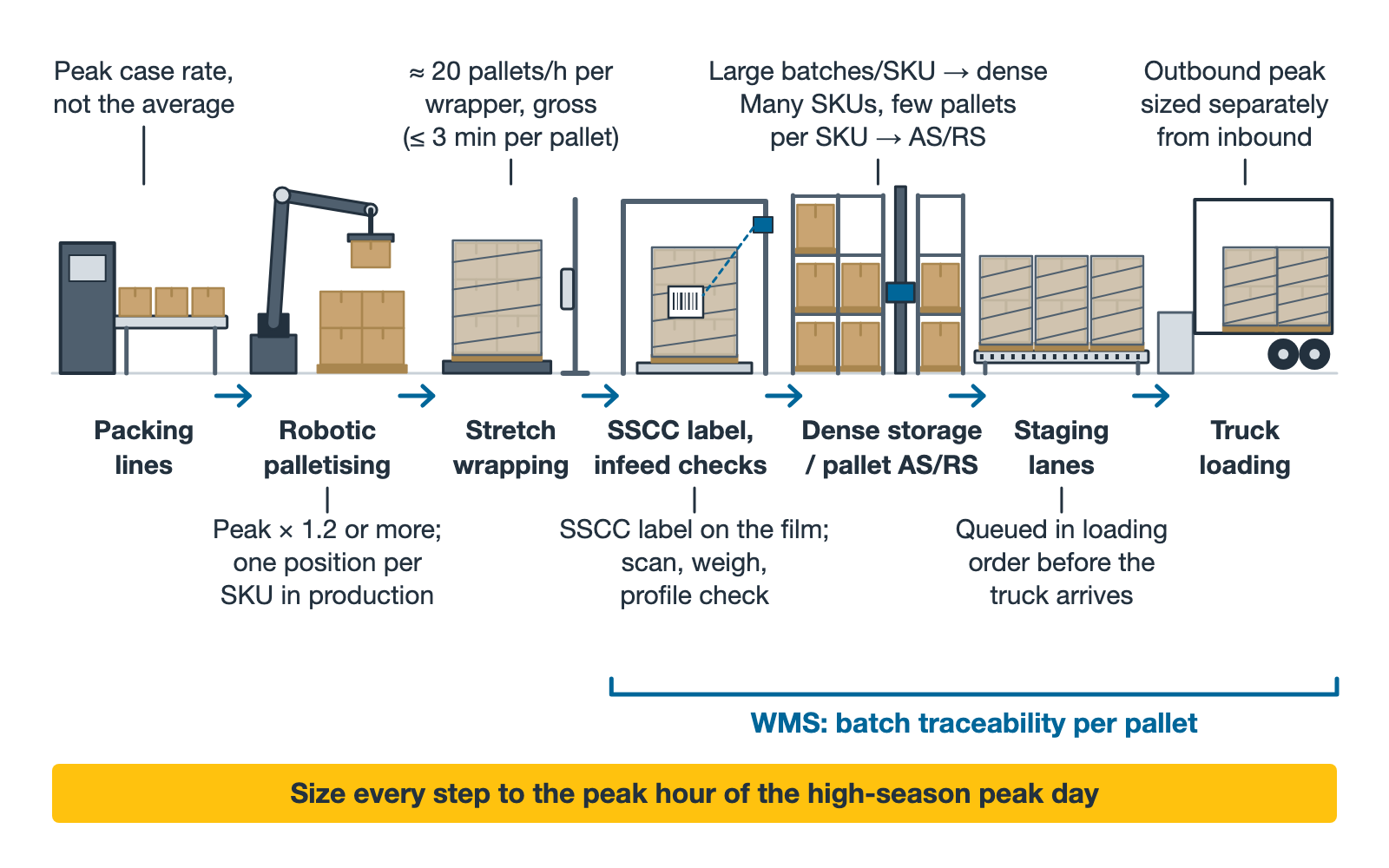
Stretch wrapping comes after palletising. In our team's past projects, with the wrapping cycle specified at 3 minutes or less per pallet, we plan on roughly 20 pallets/h per wrapper. That is a gross figure; film changes and pallet transfers take some of it away. If the merged flow of full pallets from several robots exceeds that, run two wrappers in parallel or wrap on separate lines. Export pallets can get a top sheet and extra wraps; confirm the settings with transport tests on real pallets.
Labelling comes after wrapping, with the label on the film. Pallet labels are normally printed to the GS1 Logistic Label Guideline, with the SSCC (Application Identifier 00) carried in a GS1-128 barcode and the batch and production or best-before date printed alongside. The GS1 guideline recommends one label on each of two adjacent sides; barcode height and position follow the guideline text and the consignee's requirements.
Weighing and profile checks go at the storage infeed, together with the barcode scanner. The profile check catches over-height, over-width and front or back overhang. Weighing catches overweight pallets and, where pallet tare and case weight are stable, missing cases. Damaged bottom boards usually need a separate check. Rejected pallets go back to a manual handling station.
A stacker crane AS/RS is also particular about the pallets themselves. We normally specify pallet deflection of no more than 6 mm under rated load, measured on the rack's actual support arrangement, and dimensional tolerance of no more than 5 mm. These are our project values, not limits from a standard, so the load, support span and test method go into the specification (ISO 8611-1 describes the usual pallet tests). Wooden pallets in open circulation vary a lot in quality, so one option is captive pallets inside the warehouse and a pallet exchanger at dispatch that swaps loads onto shipping pallets.
Dense storage or stacker crane AS/RS for a beverage plant
| Situation | Suitable storage | Check first |
|---|---|---|
| Large batches of single SKUs, tens to over a hundred pallets per SKU (common for beverages, bottled water, beer) | Dense storage with stacker cranes and lane shuttles, or multi-deep four-way shuttle lanes | As a stock rule each lane normally holds one SKU and one batch (the equipment does not force this); lane depth follows batch size, and lanes that are too deep leave many half-empty lanes |
| Many SKUs, few pallets per SKU (snacks, condiments, multi-flavour dairy) | Single-deep stacker crane AS/RS with random access to any location | Peak-hour inbound and outbound pallets against the crane's dual-cycle capacity; a FEM 9.851 cycle figure is a comparison value, so derate it for the real layout |
| Storage density first, medium SKU count | Double-deep stacker crane AS/RS | Lower handling efficiency than single-deep, by experience about 15% lower (same aisle length and level height), to be calculated per project |
| Chilled dairy and similar | Cold-store four-way shuttle or stacker crane, no people inside the store | Temperature range, high-speed doors, low-temperature versions of control cabinets and sensors, frost-heave protection under the floor |
| Existing building with limited clear height, or phased construction | Four-way shuttle | Clear height, floor, number of lifts |
The two can share one building. A typical worked example: a freezer store running below −20 °C, with just over half the locations as shuttle dense storage and the rest as double-deep stacker crane locations.
Beverages and bottled water are normally stored at ambient temperature; beer and wine are stored at whatever temperature the product requires. Dairy needs a closer look: UHT milk and aseptically packed dairy can be stored at ambient, while chilled products are kept at the temperature set by their label and the HACCP plan.
On the cold chain, EU food hygiene rules (Regulation (EC) No 852/2004) say that for foods which could support the growth of pathogenic micro-organisms or the formation of toxins, the cold chain is not to be interrupted. Limited periods outside temperature control are permitted to accommodate the practicalities of handling, including during transport and storage, provided this does not result in a risk to health. Türkiye's Food Hygiene Regulation also states that the cold chain must not be interrupted; check the current consolidated text rather than the 2011 original. In the warehouse this means palletising, buffering and dock areas for such products either sit inside the temperature-controlled zone, or the time they spend at ambient is limited and assessed. Parameters for both storage types are on the pallet AS/RS and four-way shuttle system pages.
Batch traceability and FIFO, managed by the WMS per pallet
EU food law (Regulation (EC) No 178/2002) requires food businesses to identify who supplied them and to which businesses they supplied their products, the principle usually called "one step back, one step forward". Türkiye's Law No. 5996 also requires food business operators to set up a traceability system and to provide the information when the competent authority asks for it. The law requires traceability up and down the chain; it does not say how to achieve it. Our recommended implementation is for the WMS to bind, at pallet level, the SSCC, batch, production line and time off the line, storage location, outbound order and vehicle. In a recall, stock can then be frozen by batch in one step, with a list of customers who have already received it.
FIFO is easiest in a single-deep stacker crane AS/RS. A dense-storage lane with access from one end is last-in, first-out by nature, so the stock rule is one SKU and one batch per lane, with a new batch only after the lane is empty. That is a management rule, not a machine feature. Where strict FIFO is required, build the lanes as flow-through: in at one end, out at the other. Short shelf-life dairy is normally dispatched first-expired, first-out, and customers' minimum remaining shelf-life requirements go into the WMS dispatch rules.
Some products may only ship after quality release. Pallets awaiting release are locked in the WMS, and those days of production have to be counted in the storage capacity.
Leaving enough capacity for loading and the summer peak
Inbound follows production and is fairly even. Outbound bunches into a few windows on the day shift, and its peak is often higher than inbound, so the two are calculated separately. Full-pallet orders go straight to sequencing buffer lanes at the dock; trucks arrive by appointment, and the WMS pulls pallets to the staging lanes in loading order before the truck gets there.
Distributor and retail orders are mostly mixed-SKU pallets. Manual building at a picking station is the simplest route, but a beverage case often weighs over 10 kg, and a full shift of that is heavy work. Layer picking is another option, as is a mixed-case palletising system at about 300–600 cases/h per station, suitable where cases weigh 30 kg or less and upstream can release cases in stacking sequence.
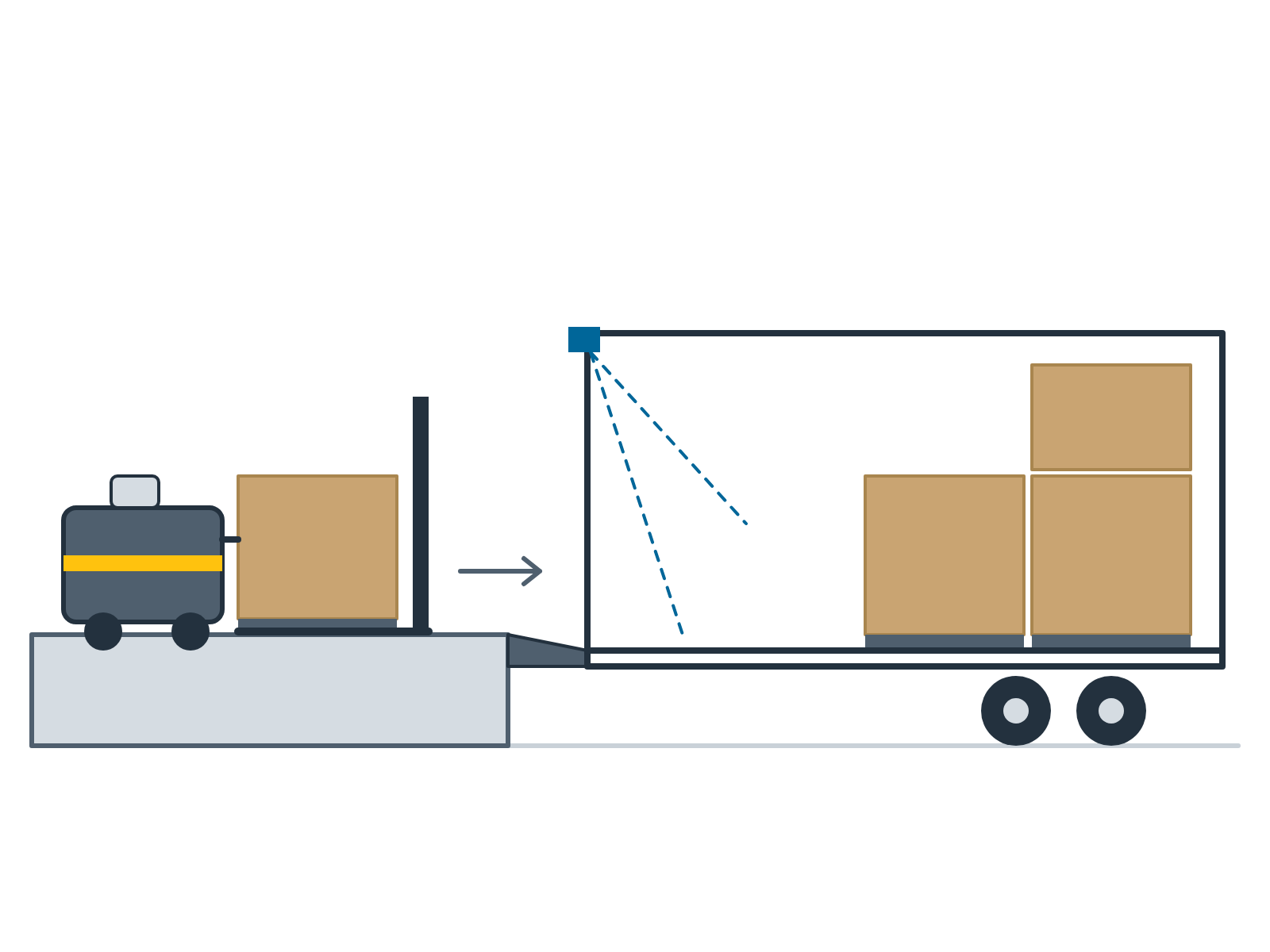
Full-pallet loading can use an automatic truck loading system, suited to docks with consistent truck types and large volumes. Its main saving is forklift drivers or loading staff; loading time per truck is not necessarily shorter than with a skilled driver. For floor-loaded sea containers, a telescopic belt conveyor can carry cases into the container for manual stacking. In our team's past projects that runs at roughly 1,500 cases/h, with a single case type and enough people stacking inside the container.
Beverages peak in summer. Confectionery and snacks often peak around religious holidays, whose dates move every year. Many plants build stock in the low season, so size storage capacity on the maximum stock before the season, not the average. Size throughput on the peak hour of the high-season peak day multiplied by 1.2 or more.
With lift capacity and charging positions reserved, a four-way shuttle system can take extra vehicles before the season. A stacker crane's capacity per aisle is essentially fixed, so it has to be provided at design stage. Overflow can go temporarily to floor storage or a third-party warehouse, and those external locations should be in the WMS as well, or traceability breaks. Türkiye is a major food and beverage producer and exporter, and many plants supply the domestic market, Europe and the Middle East at once. When export orders overlap the domestic peak, calculate the outbound peak on its own.
Frequently asked questions
How many cases per hour can one palletising robot really handle? With a foam vacuum gripper on standard cartons and two cases per pick, theoretically about 480 cases/h per robot. What it achieves in practice depends on pallet changes, format changes, faults and merge waits, so work it out from the actual line rates on site.
Our cartons absorb moisture and the vacuum gripper loses hold. What can we do? Damp cartons go soft and their porosity and surface change, so the vacuum leaks. There is no general answer on whether foam vacuum or octopus-style cups hold better; run pick tests with real cartons from the dampest season and decide from the results. Shrink-wrapped bottle packs usually go straight to a clamp or fork gripper.
Can chilled dairy go into an automated warehouse? Yes. Stacker cranes and four-way shuttles both come in cold-store versions, and having no people inside the store is an advantage. Confirm the temperature range, low-temperature equipment versions, frost-heave protection under the floor and high-speed doors, and keep the time at ambient during palletising and at the dock under control.
The worked examples are typical cases; experience figures come from our team's past projects and are only a first guide. Each project is calculated on its own data.
References
- Regulation (EC) No 178/2002 (General Food Law): https://eur-lex.europa.eu/eli/reg/2002/178/oj/eng
- Regulation (EC) No 852/2004 on the hygiene of foodstuffs: https://eur-lex.europa.eu/eli/reg/2004/852/oj/eng
- Commission Implementing Regulation (EU) No 931/2011 on traceability requirements for food of animal origin, including dairy: https://eur-lex.europa.eu/eli/reg_impl/2011/931/oj/eng
- Türkiye, Law No. 5996 on Veterinary Services, Plant Health, Food and Feed (official current text, Turkish): https://www.mevzuat.gov.tr/mevzuatmetin/1.5.5996.pdf
- Türkiye, Food Hygiene Regulation (Gıda Hijyeni Yönetmeliği), Official Gazette No. 28145 of 17 December 2011, as originally published (Turkish): https://www.resmigazete.gov.tr/eskiler/2011/12/20111217-5.htm
- GS1 Logistic Label Guideline: https://www.gs1.org/standards/gs1-logistic-label-guideline/current-standard
From the EMMANUEL Technical Team: if you would like a second look at palletising, storage and loading capacity stage by stage, send us your packing line rates, SKU and batch data and the building layout through the contact form.