Automated truck loading
Autonomous forklifts load whole pallets by trailer and outbound order, for high-volume shipping docks with consistent vehicle types.
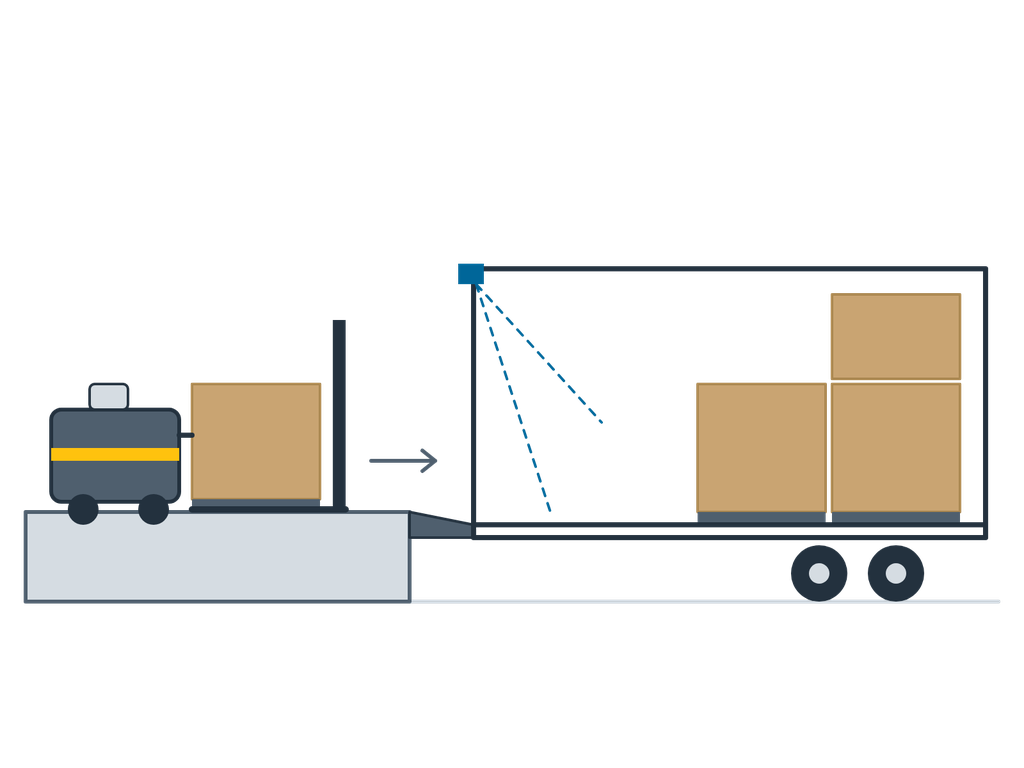
Autonomous forklifts load whole pallets by trailer and outbound order, for high-volume shipping docks with consistent vehicle types.
Autonomous forklifts load whole pallets by trailer and outbound order, for high-volume shipping docks with consistent vehicle types.
An automated truck-loading system combines autonomous forklifts, dock scanning and dispatch software. When the vehicle docks, the system scans the parking position, the trailer's length, width and floor height, and checks that the vehicle is correctly docked and the pallets will fit; loading follows the outbound order and stacking rules. A 3D camera on the forklift fine-tunes the forks as it enters the trailer, loading one or two pallets at a time. It suits finished-goods warehouses and 3PL distribution centres with high outbound volumes and fairly standard vehicles. Automatic unloading of loose cartons depends on the goods and is assessed case by case for your site.
| Loading method | Autonomous forklifts, single or double pallet |
|---|---|
| Pallet load | 1,000–2,000 kg |
| Vehicles | Box trucks and semi-trailers; trailer size range confirmed per project |
| Dock detection | 3D scan of vehicle position, trailer length, width and floor height |
| Positioning | On-board 3D camera fine-tunes the forks inside the trailer |
| Loading time per truck | Calculated per project from pallet count, stacking layers and vehicle. Most projects save driver headcount; time per truck is not necessarily shorter than with a skilled driver |
| Dispatch | Linked to WMS outbound orders, released in loading sequence |
Figures are typical configuration ranges; exact specifications are set per project.