Singulation and automatic induction
Turns a pile of tipped parcels into a single spaced line and feeds the sorter automatically, with fewer people at induction.
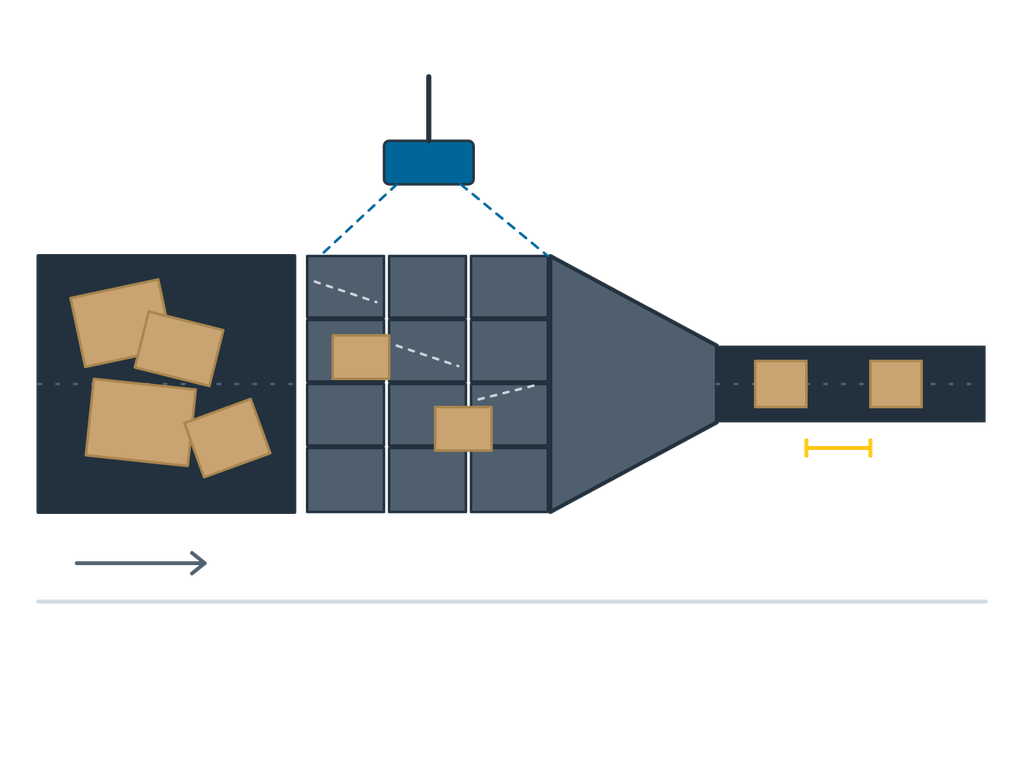
Turns a pile of tipped parcels into a single spaced line and feeds the sorter automatically, with fewer people at induction.
Turns a pile of tipped parcels into a single spaced line and feeds the sorter automatically, with fewer people at induction.
Sorter throughput is often limited at the front end: after unloading, parcels arrive piled up, side by side and touching, and have to be placed on induction stations by hand. A singulation system uses vision and a matrix of independently driven belts to separate piled and side-by-side parcels into a single line with controlled gaps; automatic induction belts then feed them at the carrier pitch onto a cross-belt or narrow-belt sorter. Line throughput is calculated on belt induction; robot-arm induction only suits low volumes. It suits parcel hubs and e-commerce warehouses with high volumes and high manual induction costs.
| Throughput | 4,000–10,000 items/h per line |
|---|---|
| Parcel size | 100×100×20 mm to 800×600×600 mm |
| Parcel weight | ≤ 30 kg |
| Parcel types | Mixed cartons, polybags, sacks and flats |
| Method | Vision plus a matrix of independently driven belts; separates stacked and side-by-side parcels |
| Output gap | Controlled automatically to the downstream sorter pitch |
| Exceptions | Items that cannot be separated are diverted to a manual lane |
Figures are typical configuration ranges; exact specifications are set per project.