Very-narrow-aisle (VNA) pallet robot
Stores and retrieves pallets at height in aisles of about 1.75 m, narrower than an autonomous reach truck needs; for warehouses that want more pallet positions without building more.
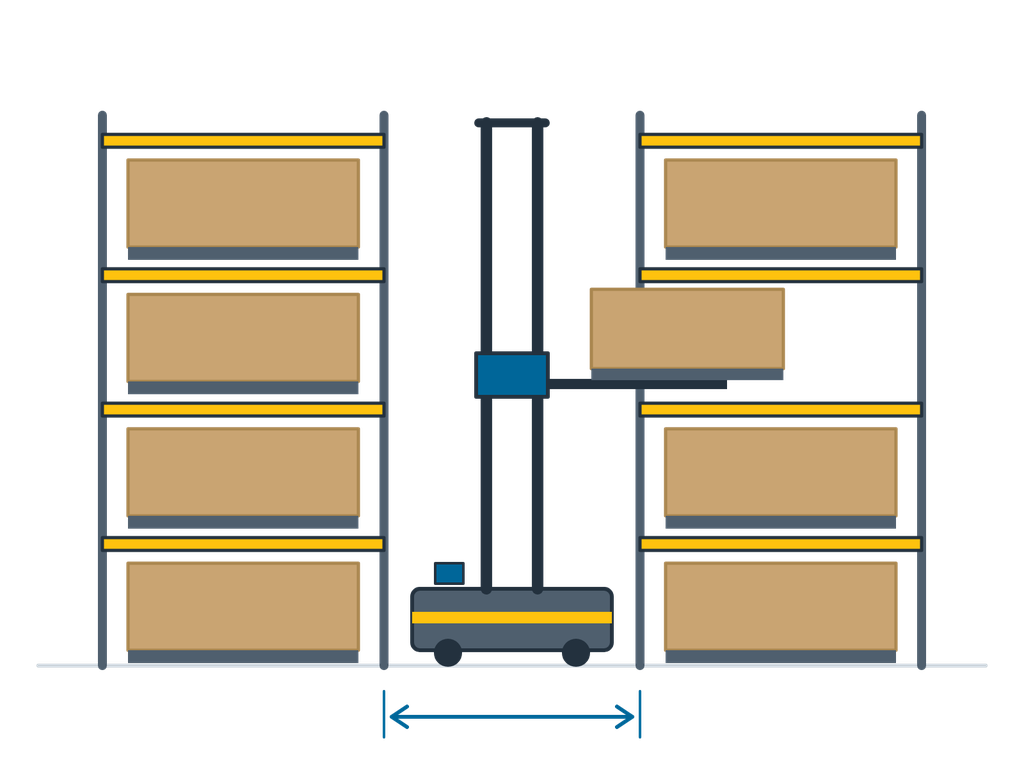
Stores and retrieves pallets at height in aisles of about 1.75 m, narrower than an autonomous reach truck needs; for warehouses that want more pallet positions without building more.
Stores and retrieves pallets at height in aisles of about 1.75 m, narrower than an autonomous reach truck needs; for warehouses that want more pallet positions without building more.
A reach truck usually needs an aisle of 2.7 m or more. A very-narrow-aisle pallet robot uses side forks or a reach mast to store and retrieve pallets at height in aisles of about 1.5–1.8 m. Narrower aisles mean more pallet positions in the same floor area. The robot navigates by laser and runs automatically, working with autonomous forklifts for floor transport and with pallet conveyors for inbound and outbound. Several Chinese manufacturers launched new narrow-aisle models at CeMAT ASIA 2025 in Shanghai. Narrow aisles need a flatter floor and more accurate racking than a standard warehouse, so we measure the site first and then choose the model and the racking layout.
| Aisle width | About 1.5–1.8 m, confirmed by model and pallet size |
|---|---|
| Lift height | Typically about 4.8 m; high-lift models up to about 11 m (load about 600 kg) |
| Load | Per the model's load chart: about 1.5 t at low lift, about 1 t at 4 m |
| Pallets | 1,200×800 / 1,200×1,000 mm; 1.2 m deep pallets confirmed per model |
| Navigation | Laser navigation; vision checks the pallet and the slot when picking and placing (depending on the model) |
| Safety | Safety laser scanners; site risk assessment to ISO 3691-4, people kept out of the aisles |
| Floor | Flatness requirement higher than a standard warehouse; measured on site |
| Dispatch | Multi-vehicle dispatch, linked to your WMS |
Figures are typical configuration ranges; exact specifications are set per project.