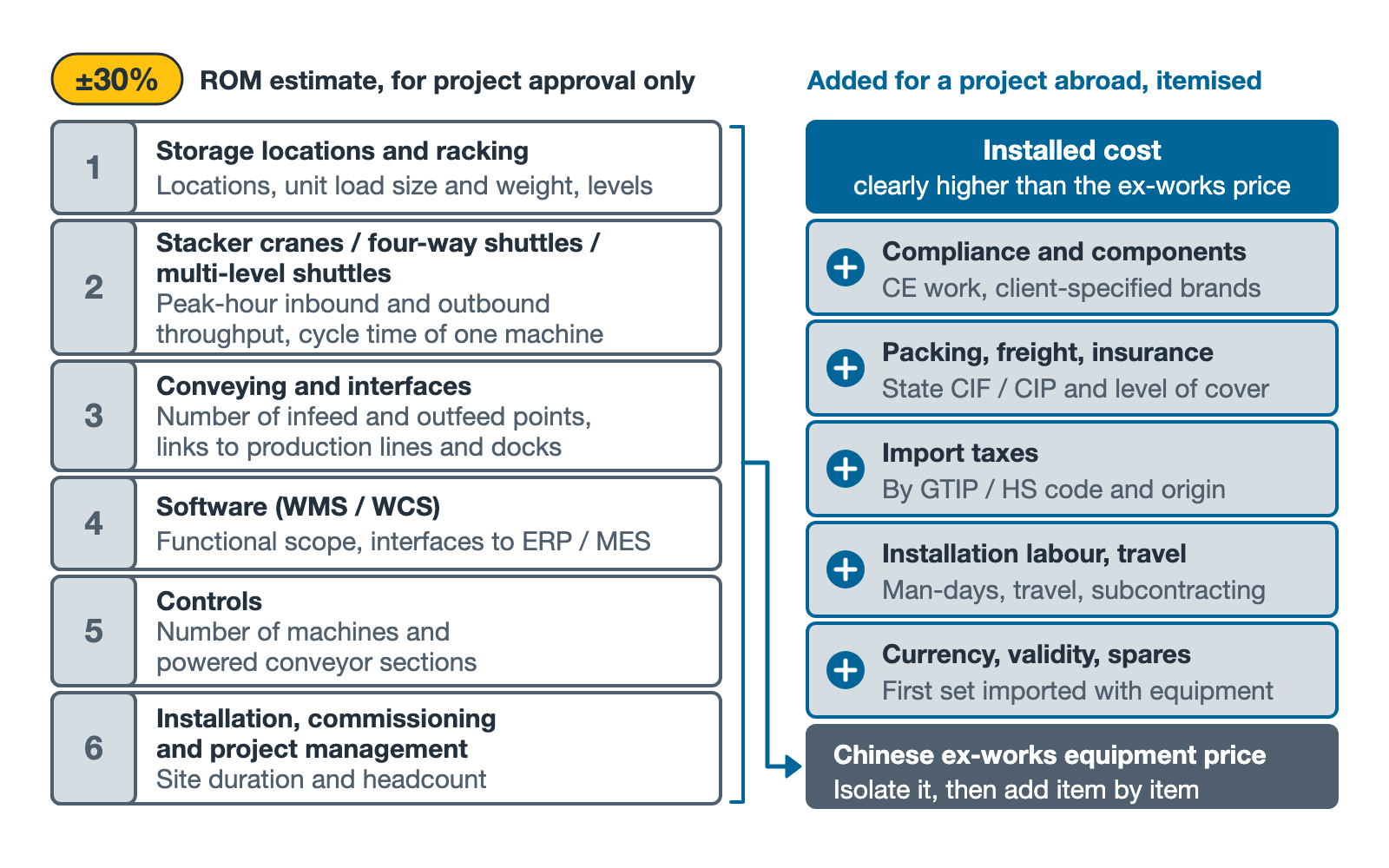
At the project approval stage, a company planning an automated warehouse (AS/RS) needs a rough order-of-magnitude (ROM) figure to request a budget; the formal quotation can wait until the operational data is complete. We build that figure from six cost blocks: storage locations and racking, equipment quantities set by throughput, conveying and interfaces, WMS / WCS software, controls, and installation, commissioning and project management. We present it as a ±30% ROM estimate, marked as being for project approval only. A Chinese ex-works price, or a cost reference from a project in China, cannot be carried over to Türkiye, Europe or the Middle East as it stands: CE compliance, export packing, sea freight and insurance, import taxes, local installation and travel, exchange rates and spare parts all come on top, and the installed cost ends up clearly higher than the ex-works price.
The short answer
- How many stacker cranes or four-way shuttles you need depends on peak-hour inbound and outbound throughput and the cycle time of one machine; the number of storage locations does not directly decide it.
- In our team's past projects, the smaller the system, the heavier the unit load and the more AGVs and robots involved, the higher the all-in cost per storage location; a system of a few hundred locations can cost several times as much per location as one with tens of thousands.
- When Chinese logistics automation equipment goes to Türkiye, Europe or the Middle East, import taxes are assessed on the GTIP / HS code and the country of origin, so a price from the Chinese market cannot be used directly.
Six cost blocks, not a price per square metre
Whether it is a pallet or a tote system, we break the approval-stage estimate into the six blocks below. A price per square metre is not reliable: two buildings with the same floor area can need very different equipment once clear height, unit load weight and handling frequency differ.
| Block | What sets the quantity | What to confirm before estimating |
|---|---|---|
| Storage locations and racking | Number of locations, unit load size and weight, number of levels | Pallet or tote dimensions, heaviest unit load, usable clear height, local seismic parameters |
| Stacker cranes / four-way shuttles / multi-level shuttles | Peak-hour inbound and outbound throughput, cycle time of one machine | Peak inbound and outbound, aisle length, single-deep or double-deep |
| Conveying and interfaces | Number of infeed and outfeed points, connections to production lines and docks | Floor-to-floor connections; whether depalletising, labelling and stretch wrapping are in scope |
| Software (WMS / WCS) | Functional scope, interfaces to ERP / MES | Whether the client already has a WMS, and which party develops the interfaces |
| Controls | Number of machines and powered conveyor sections | Local grid voltage and frequency, component brands specified by the client |
| Installation, commissioning and project management | Site duration and headcount | Local installation crew or staff sent from abroad |
The block most often underestimated is installation and labour. In our team's past projects in China, site installation came to roughly 3–6% of the contract value, and design, commissioning and project management to roughly 7–10%, so 10–16% together. These are our own project statistics; when the scale or the site changes, so do the ratios. They don't hold for projects abroad at all, where the figure has to be rebuilt from actual man-days, travel and local subcontracting. The racking share is not fixed either. In a system with heavy unit loads and few machines, the racking may well be the largest single block.
Sizing stacker cranes and shuttles by throughput
How many cranes a pallet AS/RS needs depends on peak-hour throughput, the cycle time of one crane and any redundancy requirement. The number of storage locations mainly sets how many aisles there are, how long they run and how many levels the racking has. It enters the crane count only indirectly: a conventional crane is bound to its aisle, so the number of aisles is the minimum number of cranes, unless curve-going cranes or a transfer car let one crane serve several aisles.
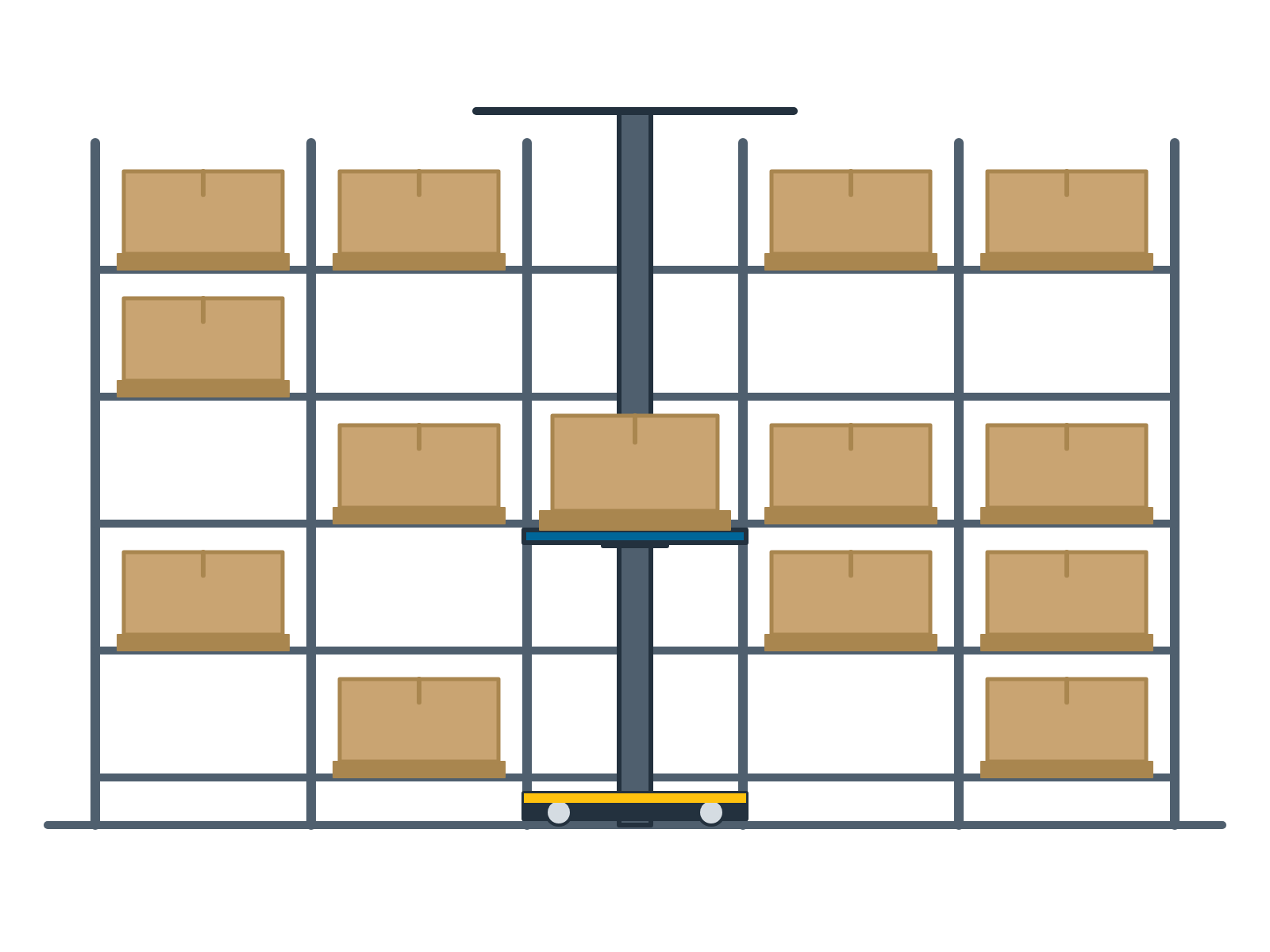
Before calculating, define what one "cycle" means. A single cycle handles one pallet, either in or out. A dual cycle stores one pallet and retrieves another in the same trip, two pallets in all. We list peak inbound and outbound separately, count whatever can be paired as dual cycles, and treat the remainder as single cycles.
The capacity of one crane is worked out from aisle length, rack height and the speed and acceleration of each axis, usually with the FEM 9.851 cycle-time method. That method gives an average cycle time under standard assumptions about which locations are visited; it says nothing about the conveyors and stations around the crane, which are checked separately. In our team's past projects, a single-deep pallet system with fairly short aisles managed about 80 single cycles per hour per crane, or 40–60 dual cycles (80–120 pallets moved); once the aisle stretches to 50–90 m, dual cycles may fall to 15–31 per hour. So when someone quotes a crane count, ask what aisle length and rack height it assumes.
A worked example with assumed figures shows the method. Peak hour: 50 pallets in, 80 out. Pair 50 in with 50 out as 50 dual cycles at an assumed 80 seconds each: 4,000 seconds. The remaining 30 outbound pallets run as single cycles at an assumed 45 seconds each: 1,350 seconds. Total 5,350 seconds, about 1.5 cranes at full load. We typically plan for utilisation of no more than about 85%, which gives 1.75 cranes, so two. Some people add a "1.2 design margin" on top. For throughput that is roughly the same thing as the 85% ceiling (1 ÷ 0.85 ≈ 1.18), so use one or the other; stacking both buys an extra machine. An N+1 redundancy requirement is calculated separately. The final number must also satisfy aisle assignment, traffic distribution and redundancy.
When comparing concepts, these are the points we usually check first:
- Double-deep racking with double-deep telescopic cranes cuts the number or length of aisles, but the crane count is still set by throughput. In our past projects, one double-deep crane lost about 15% of its throughput, more when a lot of reshuffling was needed, so it suits systems with few SKUs and many pallets per SKU.
- Where each aisle sees very little traffic, a curve-going crane can serve two aisles.
- A four-way shuttle system can start with fewer vehicles and add more as volume grows, though the lifts often become the bottleneck first.
- For a tote system, the choice between multi-level shuttles and a miniload crane should weigh throughput, clear height and number of locations together, not height alone.
Conveyor turns, cross-transfers and manual picking stations can also hold the system back, so we normally check their cycle times one by one as well.
What drives the cost per storage location?
The all-in cost per location is racking, equipment, conveying, software and installation added up and divided by the number of locations. It is a convenient cross-check; multiplying it by the number of locations to get a total is where mistakes start. Across one set of past pallet AS/RS projects in China, on a tax-inclusive basis, systems with tens of thousands of locations had the lowest cost per location. Mid-sized systems of 2,000 to 6,000 locations came to about 1.5–2 times that, higher again with heavy unit loads, piece picking or twin-station cranes. Small systems below a few hundred locations, especially those with AGVs, could reach several times the large-system figure.
The reasons are plain. Equipment, software and commissioning are bought as a set, so the smaller the system, the more each location carries. Heavier unit loads push the racking, the cranes and the floor up a class. AGVs and robots are priced per vehicle. That is why we calculate item by item first, machines × unit price + locations × racking unit price + conveying + software + installation labour, and only then compare the result with the cost per location of systems of similar size. If the two are far apart, something has usually been left out or counted twice.
Estimating with a tight budget and incomplete data
When we discuss an AS/RS with a client, we ask early on roughly what the budget is. In our team's past projects, a first quotation far above the client's budget was a common reason for AS/RS projects to be dropped, so we generally test alternatives before presenting a concept well above the stated budget. When the budget is clearly short, we usually prepare several versions at once:
- Phasing: phase one covers storage or the outbound side, and the aisles, floor loading, power and WMS / WCS interfaces for phase two are reserved in advance.
- Lower specification: double-deep instead of single-deep, so fewer aisles and a smaller storage footprint; a more economical controls configuration where the specification allows; carbon steel instead of stainless where the environment is not a clean room; one AGV as a pilot first.
- Client-supplied items: pallets, totes, steel mezzanines, servers and AGVs listed as options the client can benchmark itself.
Two traps are common. The first is that the client treats the estimate as a ceiling. A familiar pattern: an AS/RS budget figure goes up for approval, and by the time of the formal tender the scope has shrunk to a conventional, non-automated warehouse plus palletising. So the estimate must state clearly what it includes and what it does not.
The second is a first proposal loaded with every extra. If AGVs, steel mezzanines and load carriers are all added to version one, the total tends to land far above what the client had in mind. The concept is then revised and the price comes down, and even if talks continue, the client's trust in the pricing has taken a knock and every later round is harder.
We call the approval-stage figure a "ROM estimate for project approval" and, by our convention, write it as ±30%. The range is our own habit; no standard grades estimates this way, and how accurate it turns out depends on how complete the data is. Our estimates normally state three things: the data and assumptions behind them, the scope they exclude, and the sentence "This estimate is for project approval and budget requests only and does not constitute a quotation."
From Chinese ex-works price to installed cost in Türkiye, Europe and the Middle East
Chinese quotations differ in whether they include tax, transport and installation. For a project abroad, we first isolate the ex-works equipment price and then add the other costs one at a time. In this article, landed cost means the cost up to delivery and customs clearance; installation, commissioning and travel are shown separately. These costs should not normally be estimated as a percentage; itemise them and price each one for the project.
Compliance and components
For equipment going into Europe, Regulation (EU) 2023/1230 on machinery applies to machinery placed on the market or put into service from 20 January 2027; before that date, Directive 2006/42/EC applies. Türkiye published its corresponding new Machinery Safety Regulation in the Official Gazette on 16 October 2026. Under its Article 52, some provisions entered into force on the day of publication; the rest, including the obligations of manufacturers and importers, apply from 20 January 2027. Risk assessment, technical file, declaration of conformity and instructions in the local language all take engineering hours. The usual product safety standard for stacker cranes is EN 528, and for unit-load conveyors EN 619. They sit alongside general machinery standards such as EN ISO 12100 on risk assessment and EN 60204-1 on electrical equipment, and no standard replaces the risk assessment itself. CE marking does not in itself require European-brand components, but once the client's specification names a brand, the cost of the controls can rise noticeably.
In seismic zones the racking has to be recalculated with the local site parameters. EN 16681 is commonly used for adjustable pallet racking, and the GCC Standardization Organization has adopted it as GSO EN 16681:2022; whether it is mandatory in a given country depends on that country's authorities and building code. The Saudi grid runs at 60 Hz, so motors and drives have to be checked against that.
Packing, sea freight and insurance
Export packing, splitting long components into sections, sea freight, port charges and inland transport are all extra. Insurance is easy to overlook. Under Incoterms® 2020, CIF is for sea and inland waterway transport only, and by default the seller only has to insure on ICC (C), the minimum cover; under CIP the default is ICC (A). The quotation should state which Incoterms® rule applies and which level of cover is included.
Import taxes
In the EU, customs duty depends on the tariff classification and the origin of the goods, and import VAT is payable on top. In Saudi Arabia, regulated products need a product certificate and a shipment certificate through the SABER platform before they can clear customs. For Türkiye, if the code is uncertain, you can apply to the Ministry of Trade for Binding Tariff Information (Bağlayıcı Tarife Bilgisi, BTB), which is valid for six years from issue. We do not list duty rates here.
Installation labour, exchange rates and spare parts
Travel, visas and work permits for staff sent from abroad, plus local subcontracting, make installation labour and travel clearly more expensive than in China, and every day the schedule slips adds cost.
Exchange rates and quotation validity belong in the offer too. A quotation on the Chinese market is often valid for anywhere from about two weeks to a month, while a project abroad commonly takes several months from approval to contract, sometimes close to a year. If material and labour costs rise a few percent in that time, a good part of the margin is gone. The quotation should therefore state the currency (usually US dollars, euros for European projects), the validity period and the price adjustment conditions.
The first set of spare parts is best imported together with the equipment. Otherwise a single part ordered later has to go through full customs clearance on its own.
Frequently asked questions
What is the real difference between a budget estimate and a formal quotation? The data. An estimate is an order of magnitude built block by block from experience while the data is still incomplete, and it is only good for project approval and budget requests. A formal quotation rests on confirmed data, a layout and an equipment list, with the technical scope and commercial terms agreed, and goes into the contract.
Can we take the cost per location of an AS/RS in China and use it to estimate a project in Türkiye or Europe? We advise against it. A cost per location from projects in China contains no CE compliance work, no client-specified components, no sea freight and insurance, no import taxes and no travel for installation staff, and seismic and grid conditions differ as well. At best, use it as a sanity check on the order of magnitude of the equipment and racking costs.
Which taxes apply when equipment is imported from China into Türkiye? Potential charges include customs duty (which may be zero), additional customs duty (İlave Gümrük Vergisi) where it applies to that GTIP code and origin, and import VAT (KDV). The amounts depend on the GTIP code of each equipment type and its origin, so before ordering, have your customs broker pre-classify each type of equipment.
The worked examples are typical cases; experience figures come from our team's past projects and are only a first guide. Each project is calculated on its own data.
References
- European Commission, Machinery (Directive 2006/42/EC and Regulation (EU) 2023/1230): https://single-market-economy.ec.europa.eu/sectors/mechanical-engineering/machinery_en
- Official Gazette of Türkiye, 16 October 2026, No. 33402, Machinery Safety Regulation (Makine Emniyeti Yönetmeliği (2023/1230/AB)): https://www.resmigazete.gov.tr/eskiler/2026/10/20261016-12.htm
- BSI, EN 528 Rail dependent storage and retrieval equipment, Safety requirements for S/R machines: https://knowledge.bsigroup.com/products/rail-dependent-storage-and-retrieval-equipment-safety-requirements-for-s-r-machines
- GCC Standardization Organization, GSO EN 16681:2022, Steel static storage systems, Adjustable pallet racking systems, Principles for seismic design (based on EN 16681:2016): https://www.gso.org.sa/store/standards/GSO:802847/GSO%20EN%2016681:2022
- International Chamber of Commerce (ICC), Incoterms® 2020 rules: https://iccwbo.org/business-solutions/incoterms-rules/incoterms-2020/
- Ministry of Trade of Türkiye, tariff FAQ (Bağlayıcı Tarife Bilgisi): https://ticaret.gov.tr/gumruk-islemleri/sikca-sorulan-sorular/ticari/tarife
- European Commission, Customs tariff: https://taxation-customs.ec.europa.eu/customs-4/calculation-customs-duties/customs-tariff_en
- International Trade Administration (US), Saudi Arabia, Testing, Inspection and Certification (SABER): https://www.trade.gov/market-intelligence/saudi-arabia-testing-inspection-certification
EMMANUEL Technical Team. If your project is still at the approval stage, send us your layout, number of storage locations and peak-hour inbound and outbound figures via the contact form, and we can discuss an order-of-magnitude estimate on your data, together with the costs a project abroad has to add.