Automated put wall
Items from batch picking are put into order cells automatically, one by one, replacing the manual put wall; for e-commerce order consolidation, store allocation and returns sorting.
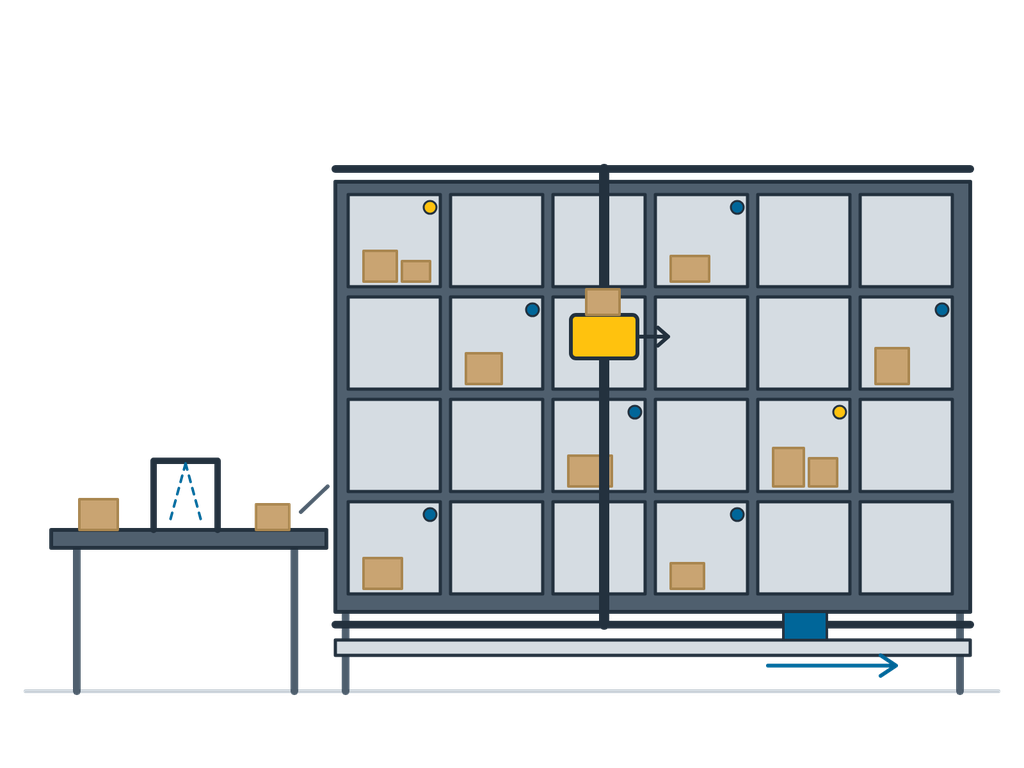
Items from batch picking are put into order cells automatically, one by one, replacing the manual put wall; for e-commerce order consolidation, store allocation and returns sorting.
Items from batch picking are put into order cells automatically, one by one, replacing the manual put wall; for e-commerce order consolidation, store allocation and returns sorting.
In an e-commerce warehouse, items are first picked in batches by SKU and then have to be split into individual orders. Traditionally this is done by hand at a put wall: scan, look for the light, put the item in. An automated put wall does this step with machines: each item is scanned and carried by a put unit to the cell of its order; when an order is complete, the cell signals for packing or pushes the order out automatically. Cells are arranged on several levels, so more cells fit in the same floor area. At CeMAT ASIA 2025 in Shanghai, Chinese manufacturers launched a new generation of put walls covering order consolidation, returns sorting and small-parcel bagging. Throughput depends on item sizes and the number of cells and put units; we calculate it from your order profile.
| Throughput | Configured by the number of put units and cells, calculated from your order profile and item sizes |
|---|---|
| Items | Small items that can be conveyed one by one: apparel, electronics accessories, household goods, books; size and weight limits confirmed per model |
| Cells | Cells on several levels; the number set by orders per wave |
| Identification | Automatic barcode scanning, item-level check |
| Completed orders | Light signal for manual packing, or automatic push-out to a packing conveyor |
| Induction | Manual item-by-item induction or automatic induction |
| Interface | Order waves from your WMS |
Figures are typical configuration ranges; exact specifications are set per project.