Skip to Content

Garment-on-hanger system and pocket sorter

Hanging garments stored, moved and sorted on overhead rails; small items ride in hanging pockets that buffer, sequence and release them by order. Common in apparel and e-commerce warehouses.
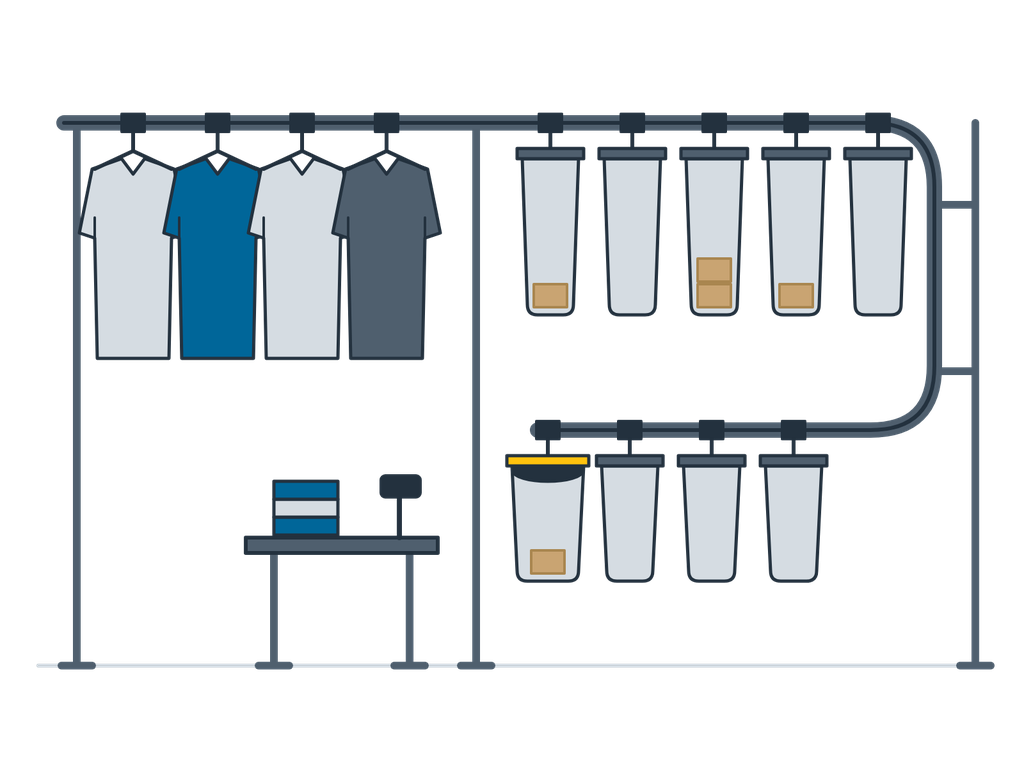
Hanging garments stored, moved and sorted on overhead rails; small items ride in hanging pockets that buffer, sequence and release them by order. Common in apparel and e-commerce warehouses.

A garment-on-hanger (GOH) system keeps clothes on hangers and stores, moves and sorts them on overhead rails, so suits, coats and dresses never need folding and go straight onto store rails. A pocket sorter uses pouches hanging from the rail: each usually holds one item, which are buffered and sequenced in the air and released in order once an order is complete. It suits apparel and fashion e-commerce with many SKUs, small orders and many returns. Both use the space overhead and leave more of the floor for packing and other work.

Typical uses

  • Hanging-garment shipments from apparel retail DCs
  • Order sorting and sequencing in apparel and fashion e-commerce
  • Buffering and re-allocating returns
  • Hanging shipments from apparel exporters to European retailers

How to choose

  • Share of hanging versus flat-packed goods
  • Daily items, SKU count and order profile (how many single-item orders)
  • Returns rate
  • Clear height and the load the roof structure can carry

When it is not the right choice

  • Mostly large or heavy items: pockets and hanging rails have limited capacity
  • Almost no hanging goods, all flat-packed: no GOH; flat small items that need buffering, sequencing and consolidation still suit a pocket sorter, or compare a bomb-bay sorter or put wall
  • Roof cannot carry the load: a floor-standing steel structure is needed; check first

Key figures

Hanging sortingPublished equipment ratings: about 5,000–7,500 items/h per sorting module
Pocket loadingPublished equipment ratings: loading stations about 100–120 pockets/min; with manual loading the rate depends on the operators; usually one item per pocket
HangersAdapted to the customer's hanger type
IdentificationBarcode or RFID
LayoutOverhead rails; support chosen by building capacity, hung from roof steel or on a floor-standing structure

Figures are typical configuration ranges; exact specifications are set per project.

Options

  • RFID identification
  • Returns buffer
  • Automatic pocket unloading stations
  • Systems mixing hanging and flat goods
  • WMS interface for order sequencing

Scope of supply

  • Machine, drives and control cabinet, assembled and dry-run tested before shipping
  • The equipment's own control and fleet software; interfaces to your existing WMS / ERP as the project requires
  • Drawings: general arrangement, foundation and anchor plan, electrical schematics
  • Conformity documents for the equipment and the whole line, the split of responsibilities and the acceptance criteria are set out in the contract according to the project scope
  • Spare-parts list and wear-part recommendation; a first batch can ship with the equipment
  • Factory acceptance (FAT): attend in person or follow by live video
  • Installation, commissioning and operator training can be included in the offer

What we need for an offer

  • Share of hanging and flat goods, daily items
  • SKU count, order-line profile and returns rate
  • Hanger type
  • Floor plan, clear height and roof structure data
  • Upstream system

Related equipment

Request an offer for this equipment