Skip to Content

Bomb-bay sorter

The tray floor opens and the item drops into the chute or bag below: for polybags, bagged and flat items, with destinations packed close together.
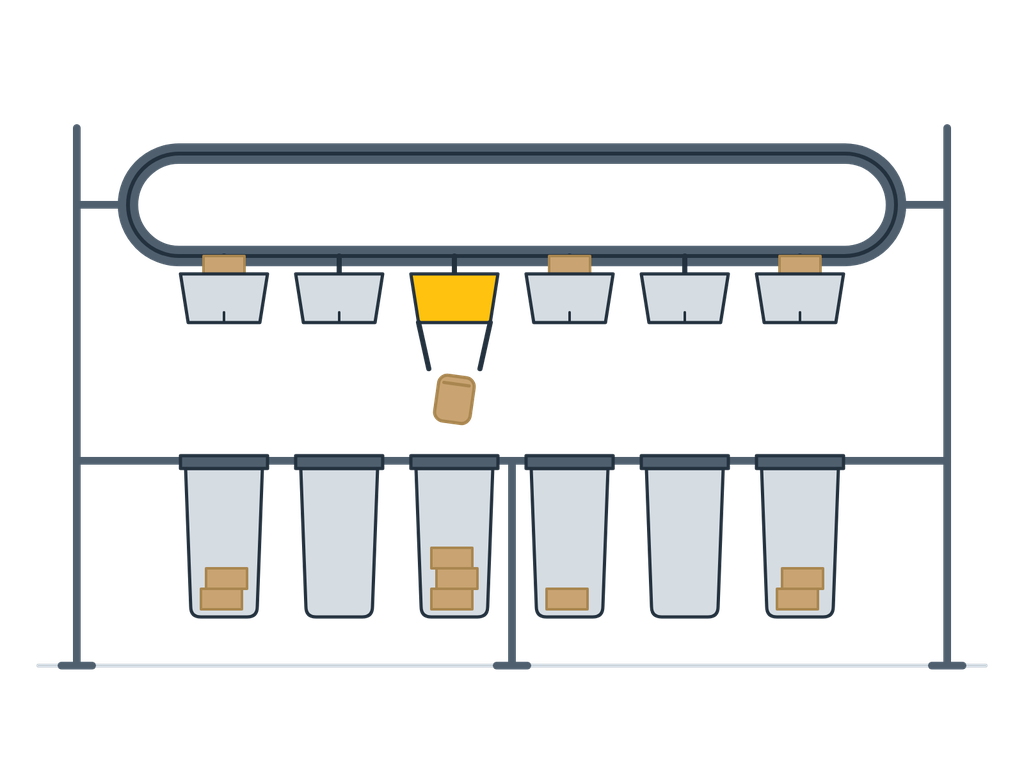
The tray floor opens and the item drops into the chute or bag below: for polybags, bagged and flat items, with destinations packed close together.

A bomb-bay sorter is a continuous loop of trays, each with two doors in its floor. When an item reaches its destination, the doors open downwards and the item drops straight into the chute, bag or cage below. Because the destinations sit directly under the sorter, many of them fit into a given length. It suits polybags, bagged and flat items that roll or drift on belts, and is common in apparel and fashion e-commerce and in small-parcel bagging.

Typical uses

  • Order sorting in apparel and fashion e-commerce
  • Small parcels and polybags sorted into bags
  • Books, cosmetics, accessories and other small items
  • Returns sorting

How to choose

  • Item mix: share of polybags, bagged and flat items
  • Peak items per hour
  • Number of destinations and how densely they must be packed
  • Clear height under the sorter: drop height and how items are collected (bags, cages, chutes)

When it is not the right choice

  • Mostly cartons and heavy items: a sliding-shoe or swivel-wheel sorter fits better
  • Items beyond the tray size or weight: plan a separate sorter suited to large items
  • Fragile goods: assess the drop height first and add cushioning or choose another sorter

Key figures

CapacityAn industry guide gives about 2,000–8,000 items/h per line, an integrator article about 6,000–14,000; vendors rate tray cycles at about 3,000–17,000/h; actual rates depend on item mix, induction and fill rate
Line speedPublished models about 0.9–1.2 m/s
Item weightAbout 0.05–15 kg
Item sizeFrom about 50×50×1 mm; single trays up to about the 600×400×250 mm class, dual trays larger, by model
Suitable itemsPolybags, bagged and flat items, small boxes
DestinationsBelow the sorter, into bags, cages or chutes
LayoutLoop, single or double level

Figures are typical configuration ranges; exact specifications are set per project.

Options

  • Automatic bag hanging under the destinations, full-bag detection and bag-change prompts
  • Automatic induction and singulation at the front end
  • Barcode scanning tunnel and image recognition
  • Two-level design for more destinations on the same footprint

Scope of supply

  • Machine, drives and control cabinet, assembled and dry-run tested before shipping
  • The equipment's own control and fleet software; interfaces to your existing WMS / ERP as the project requires
  • Drawings: general arrangement, foundation and anchor plan, electrical schematics
  • Conformity documents for the equipment and the whole line, the split of responsibilities and the acceptance criteria are set out in the contract according to the project scope
  • Spare-parts list and wear-part recommendation; a first batch can ship with the equipment
  • Factory acceptance (FAT): attend in person or follow by live video
  • Installation, commissioning and operator training can be included in the offer

What we need for an offer

  • Item size and weight distribution, share of polybags
  • Peak hourly and daily volume
  • Number of destinations
  • Floor plan and clear height
  • Upstream system and data interface

Related equipment

Request an offer for this equipment