Skip to Content

Barcode scanning tunnel

A reader frame over the conveyor that reads barcodes on the top, the sides or all six faces, depending on the set-up; the number read decides where the item goes.
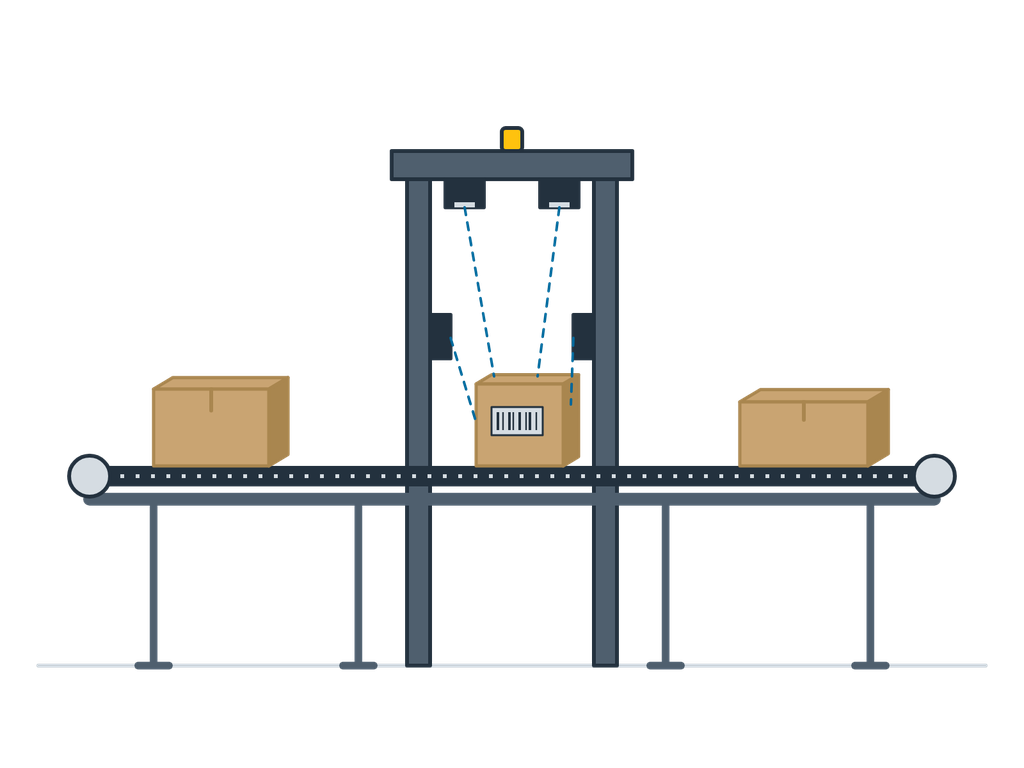
A reader frame over the conveyor that reads barcodes on the top, the sides or all six faces, depending on the set-up; the number read decides where the item goes.

A barcode scanning tunnel is a frame over the conveyor with readers on the top and sides; to read the bottom, the conveyor has a gap and a reader looks up through it. A six-sided set-up commonly uses six readers and reads unobstructed, well-printed barcodes on the outer faces, so items usually need not be aligned. The number read goes to the sorting or warehouse system and decides the destination. Items with no read can be rejected automatically, or handled with image recognition and remote manual keying. It is often combined with weighing and dimensioning into a DWS system.

Typical uses

  • Reading shipping labels ahead of a sorter
  • Automatic identification at receiving
  • Outbound checks
  • Returns identification

How to choose

  • Which sides carry the barcode: top only or any side
  • Conveyor speed and gap between items
  • Smallest barcode size and print quality
  • Item size range, which sets the frame opening

When it is not the right choice

  • Barcode on top only and low volume: one fixed reader or a handheld is enough
  • Dimensions and weight for billing: choose a DWS system
  • Reading many items inside one carton at once: an RFID tunnel, provided every item is tagged and cross-reading has been tested

Key figures

Sides readTop, five or six sides
ReadersTypically six, set by the sides to read
Read rateVendors typically state 99.9–99.99%; confirmed in the acceptance test
Line speedLine-scan camera set-ups commonly up to about 2 m/s, by camera and code size
Codes1D and 2D
OutputNumber to the WCS / WMS; image output optional

Figures are typical configuration ranges; exact specifications are set per project.

Options

  • Weighing and dimensioning to form a DWS
  • Image recognition of the number or address when no barcode is read
  • Remote manual keying
  • Photo archive for every item
  • Automatic reject of no-reads

Scope of supply

  • Machine, drives and control cabinet, assembled and dry-run tested before shipping
  • The equipment's own control and fleet software; interfaces to your existing WMS / ERP as the project requires
  • Drawings: general arrangement, foundation and anchor plan, electrical schematics
  • Conformity documents for the equipment and the whole line, the split of responsibilities and the acceptance criteria are set out in the contract according to the project scope
  • Spare-parts list and wear-part recommendation; a first batch can ship with the equipment
  • Factory acceptance (FAT): attend in person or follow by live video
  • Installation, commissioning and operator training can be included in the offer

What we need for an offer

  • Barcode types and where they are placed
  • Item size and weight range
  • Conveyor speed and items per hour
  • How no-reads should be handled
  • Host system and interface

Related equipment

Request an offer for this equipment