A single turnkey quotation for an automated warehouse often stalls in the client's internal approval: the total sits above what the project lead is allowed to sign, procurement cannot benchmark the line items, and nobody wants to carry the risk of a new technology on one signature. Our advice is to split the offer into a base contract plus priced options, pilot the new equipment or process first, and build in phases. The base contract covers the scope for which the system integrator carries end-to-end performance responsibility; anything that can be benchmarked, deferred or bought by the client directly goes into the options.
The short answer
- The base contract covers the scope where the integrator is responsible for end-to-end performance, including the interfaces to client-supplied items, the test responsibilities and the exclusions; standard, benchmarkable or not-yet-defined items can be listed as options with unit prices and a validity period.
- In a phased automated warehouse, freeze the final-stage design and check it against local structural, seismic and fire requirements first; phase one then reserves space, floor loads and interfaces for the final capacity, power and software licences are added in stages, and the expansion pricing rules are fixed in the contract.
- A pilot with one AGV or one section of line separates "does the technology work here" from "do we buy the whole system" into two decisions; the pilot contract must state the acceptance criteria and the conditions under which the pilot fee is credited against the main purchase.
Why turnkey offers get stuck in approval
The total is the most obvious reason. Clients approve spending in tiers, and a fully bundled price easily lands above the tier the project lead can sign. The project then stalls at the CapEx request stage.
Credibility is the second. A common pattern: the first proposal loads every ancillary item into the price and the total overshoots the client's expectations. The design is then revised and the price drops sharply, and the client's finance team starts wondering how much padding the first version contained. From then on, finance assumes every later quote is padded too.
Procurement is the third. Pallets, totes and servers each have their own benchmarking rules on the client's side, and when they are buried in the system price, procurement may ask for them to be broken out line by line. Add a first automation project, or a first use of a particular vehicle type, signed as a full-scope contract, and all the technical risk rides on one signature.
Drawing the line between base contract and options
We split the scope by asking who guarantees throughput. Whoever stands behind peak-hour throughput, accuracy and availability should have the related equipment, controls and software in the base contract, together with the interfaces, test responsibilities and exclusions for client-supplied items. Everything else can usually become an option, provided its interface and specification are written down.
Do not write a performance target as a single number. The test conditions belong next to it: the product and load-unit mix, the shift pattern, how long the peak lasts, whether planned downtime counts, and how throughput and availability are calculated.
| Item | Suggested place | Reason | What to fix at signing |
|---|---|---|---|
| Stacker cranes, shuttles, conveyors, sorters and other core equipment | Base contract | Directly determines throughput | Performance targets and acceptance method |
| Controls, WCS, interfaces to WMS / ERP | Base contract | Splitting commissioning responsibility across several parties invites finger-pointing | Interface list and quantities |
| Racking and steel structure of a rack-clad building | Base contract | Directly linked to equipment running accuracy | Responsibility for load, tolerance and seismic calculations |
| Pallets, totes / bins | Option | Standard goods; clients often buy and benchmark them directly | Dimensions and tolerances in the base contract's technical annex |
| Servers, network equipment, handheld terminals | Option | Client IT usually has its own purchasing standard | Minimum specification; who installs the system software |
| Steel mezzanines, bridges | Option | Can be fabricated locally; often needs local structural approval | Loads and interface dimensions to the equipment |
| WMS customisation, custom reports | Option | Requirement scope tends to move | Day rate and requirement freeze date |
| Additional vehicles, spare-parts packages, extended service | Option | Grows with business volume | Unit price, validity, last order date |
An option is not "we'll talk about it later". Unit price, quantity and validity should be fixed at signing, with the client invoiced for what it actually orders; the payment milestones can be agreed separately from the base contract.
A safer route is to issue two quotations at the same time, one turnkey and one with the ancillaries bought by the client, so finance can see exactly where the difference lies, and then sign the base contract plus options. A typical worked example: pallets, totes and the steel mezzanine go into options. The AGVs feeding the production floor can also be an option, provided they do not determine the AS/RS throughput and the vehicle type is still open at signing. The client keeps control and can benchmark, and the base price is far easier to hold.
If the client buys its own load carriers, the technical annex has to state the pallet or tote dimensions, tolerances and base design. Otherwise faults caused by the carriers end up as a dispute over who was responsible for the interface.
Splitting out options must not become de-scoping in disguise. Cutting scope can win a bid, but only when what is cut is redundancy or an unreasonable specification. These cannot be cut: the bottleneck elements, backup for critical single points of failure, safety guarding, interface reserves and spare parts. On the software side, agree the delivery of documentation, interface descriptions, program backups and parameter configurations, use source-code escrow where needed, and state who owns the intellectual property. Whenever an item is de-scoped, recalculate peak-hour throughput against the performance targets. If a target can no longer be met, flag it in the proposal together with the mitigation, rather than arguing about it at acceptance.
Phased construction: what phase one has to reserve
Whether phasing saves money depends on what phase one reserves. The precondition is a frozen final-stage design that has been checked against local structural, seismic and fire requirements; where the authorities issue formal approval phase by phase, each phase still needs its own. On that basis, civil works and interfaces are sized for the final capacity, power and licences are added according to the expansion plan, and the expansion pricing rules are locked in. Each phase still has its own acceptance.
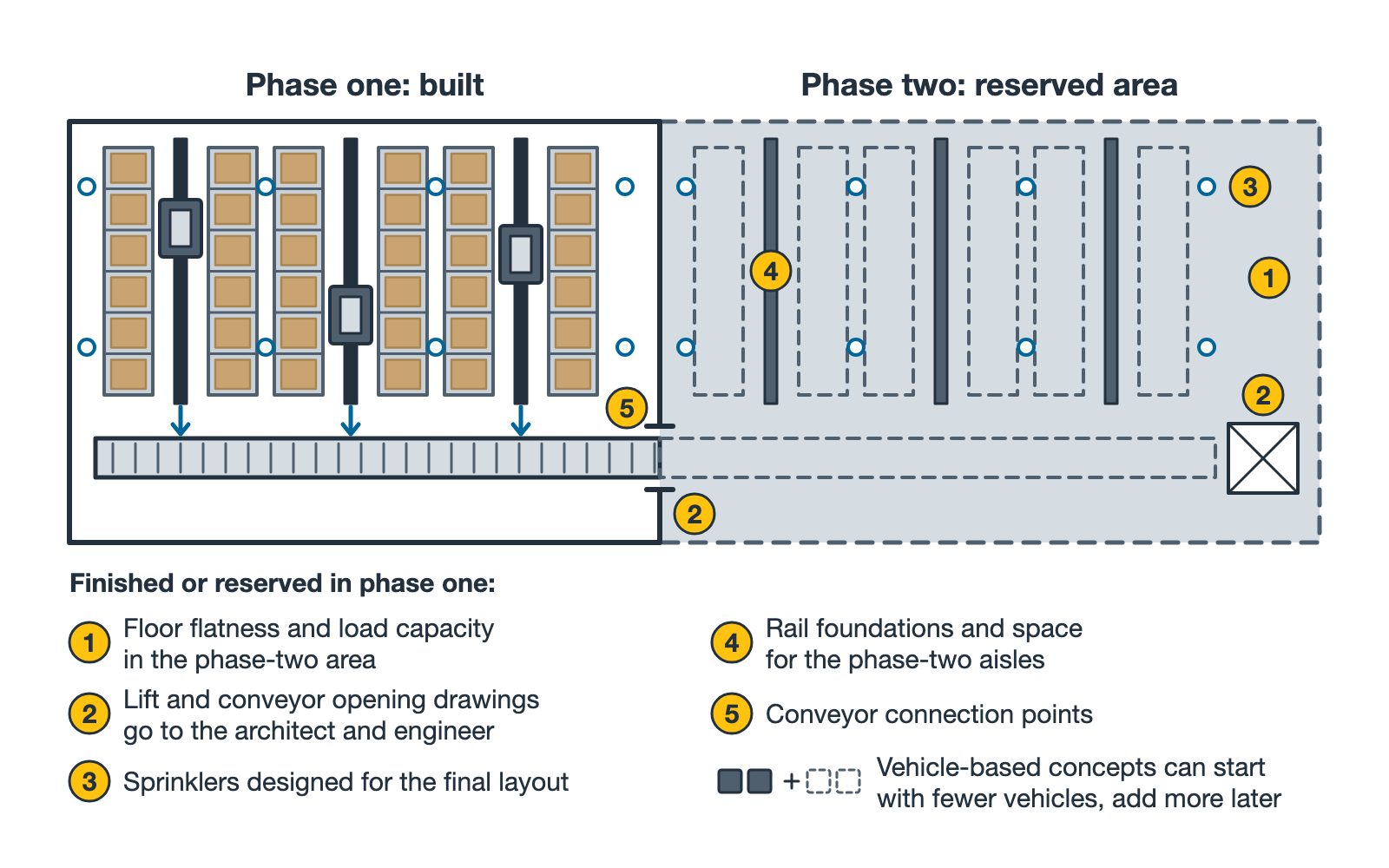
Civil works are best done once. Floor flatness and load capacity in the phase-two area are finished in phase one; drawings for wall openings and slab penetrations for lifts and conveyors go to the architect and structural engineer in phase one; sprinklers are designed for the final layout and storage configuration under the local fire code, so that phase two does not reopen the fire system. Vehicle-based concepts such as the four-way shuttle or tote-handling robots can start with fewer vehicles and add more later. Stacker cranes are different. In a rack-clad building, or a building with no reserved span for expansion, the number of aisles is essentially fixed in phase one. Where neither applies, phase one has to leave the rail foundations and the space for the phase-two aisles.
Interfaces and controls follow the final design too. Conveyors get connection points, the WCS reserves station and equipment numbers for phase two, and the WMS-ERP interface is designed around the final-stage business objects. Switchboard positions, cable routes and circuits are reserved for the final stage; transformers and charging can be sized for the phase-one load, with the upgrade path written down; PLC I/O and switch ports keep spare capacity. Any increase in grid connection is subject to the local utility's approval.
Software licences are another common sticking point in phase two. Fleet management is often licensed per vehicle, a WMS per user or per station. Phase one need not buy the full final-stage licence, but the contract should state the unit price or calculation method for phase-two licences and how long it is valid, and require delivery of interface documentation, program backups and configurations, so phase two is not locked to the original supplier. Handover alone is not enough: the contract should also cover editable project and source files, passwords, the engineering software and its licences, the restore procedure, and the client's right to use and modify all of these. A familiar pitfall in this trade: the supplier of bought-in equipment does not hand over the programs at acceptance, and once the original team disperses, nobody can maintain the machine. Handover of programs and configurations should therefore be addressed explicitly.
How to run a pilot, and whether the pilot fee can be credited
A pilot makes sense for a first automation project, when floor or product conditions are uncertain, or when a new vehicle type or process is involved. It can be a single forklift AGV with fleet software running on a real route, one section of conveyor, a single picking station, or a prototype test at the supplier's factory.

A typical worked example: a plant automating material supply for the first time has a design based on three AGVs, but the budget only covers approval of one pilot vehicle. So the pilot is "software plus one AGV". Before it starts, hold an FMEA risk review. Such a meeting often finds that functions like obstacle detection at the drop-off position are not in the vehicle's standard scope and need to be listed separately. We also recommend checking the floor before committing: survey its flatness against the vehicle maker's tolerances, then run a sample vehicle over the actual route.
The pilot contract should state four things: the test criteria, the test duration, who supplies the test material, and the pilot fee with its credit conditions. The fee can be credited against the main purchase, with a stated validity for the credit and a rule for what happens to the equipment and the fee if no purchase follows. Safety functions such as personnel detection have to be verified under ISO 3691-4 on the basis of a risk assessment; their safety-related control functions must meet the required performance level set under ISO 3691-4, designed to ISO 13849-1 and validated to ISO 13849-2. They are not optional application features. Application functions such as drop-position occupancy detection and obstacle detection are listed separately and written into acceptance.
Do not expect one sample vehicle or one section of line to prove the whole system. It shows that the single machine and the process work. System-level problems such as congestion between vehicles or queuing at peak are invisible in a pilot, and system capacity still has to be demonstrated by simulation and calculation.
Terms to settle before signing
During technical clarification, it pays to issue a change log with every revision of the design. It lists additions, removals and specification changes against the previous version, with the cost impact and where each item belongs: base contract, option, or client's own scope. This helps limit changes to the base price, subject to scope changes and the adjustment clause; most additions go into options and are invoiced as ordered, and the client does not feel surprised by late price increases. The final change log becomes a contract annex. Two or three revisions of the log in the last month before signing are not unusual; as long as additions go into options, the base price usually moves only slightly.
Currency and validity need to be agreed as well. EMMANUEL usually quotes in US dollars, or euros for European projects; that is simply our own practice. Clients, however, often approve in local currency. The quotation should state the currency, the validity period and the price adjustment clause. Where the approval cycle is longer than the validity, agree in advance how validity is extended, and state the price validity of phase-two options separately. Türkiye restricts foreign-currency-denominated or foreign-currency-indexed payment obligations in certain contracts between residents, with exceptions by contract type (sale of goods, services, software) that also depend on the parties' status, so each part of the contract needs checking against the current official text (see References). Have local finance and legal advisers confirm the contract currency for a local contract before signing.
Large projects usually ship in batches following the installation sequence, with shipment payments matched to batches and each batch stating its delivery terms (Incoterms® rule) and the point where risk passes. Where payment is by letter of credit, UCP 600 Article 31 allows partial shipments unless the credit prohibits them, but it is better to state this in the credit.
Local installation subcontracting needs clear boundaries. Who does unloading, moving materials around site, lifting, steel mezzanine fabrication, cable laying and fire-system coordination, and who answers to the client for the quality of local subcontracted installation, all go into the contract.
Frequently asked questions
After splitting into a base contract and options, is the supplier still responsible for overall performance? The supplier is responsible for the performance targets within the base contract scope, provided the items the client buys itself meet the specifications in the base contract's technical annex. That is why each option's interface and specification requirements have to be written down at the time of the split.
Can option prices change after the contract is signed? Within the validity stated in the contract, option unit prices should stay fixed; after that, the price adjustment clause applies. So each option should carry its unit price, validity and last order date together.
If the pilot misses its targets, is the pilot fee wasted? That depends on the pilot contract. A common wording is that the fee is credited if the targets are met and the main purchase goes ahead, is not refunded if there is no purchase, or the test equipment is handled as agreed. All of this should be written before the pilot starts.
What is the risk if we buy our own pallets and totes? The main risk is carriers whose dimensions, tolerances or base design do not match the equipment, so they jam on the conveyor and trigger faults. If you buy them yourself, put the carrier specification into the base contract's technical annex and sample-check deliveries on arrival.
The worked examples are typical cases; experience figures come from our team's past projects and are only a first guide. Each project is calculated on its own data.
References
- ISO 3691-4:2023, Industrial trucks: Safety requirements and verification, Part 4: Driverless industrial trucks and their systems: https://www.iso.org/standard/83545.html
- ISO 13849-1:2023, Safety of machinery: Safety-related parts of control systems, Part 1: General principles for design: https://www.iso.org/standard/73481.html
- ISO 13849-2:2012, Safety of machinery: Safety-related parts of control systems, Part 2: Validation: https://www.iso.org/standard/53640.html
- Official Gazette of Türkiye, 13 September 2018, Presidential Decision No. 85 (amending Decision No. 32 on the Protection of the Value of the Turkish Currency): https://www.resmigazete.gov.tr/eskiler/2018/09/20180913-7.pdf
- Official Gazette of Türkiye, 6 March 2025, Communiqué 2025-32/72 (amending implementing Communiqué 2008-32/34 under Decision No. 32): https://www.resmigazete.gov.tr/eskiler/2025/03/20250306-6.htm
- International Chamber of Commerce (ICC), Incoterms® 2020 rules: https://iccwbo.org/business-solutions/incoterms-rules/incoterms-2020/
- International Chamber of Commerce (ICC), DC Insight queries and responses, UCP 600 Article 31 on partial drawings and partial shipments: https://library.iccwbo.org/content/tfb/dcinsight/DCI_Vol15n1_QueriesAndResponses.htm
EMMANUEL Technical Team. If you would like a second view, send us your layout, peak-hour figures and your internal approval steps via the contact form; we are happy to work through, on your project's data, how to split the base contract, list the options and phase the build.