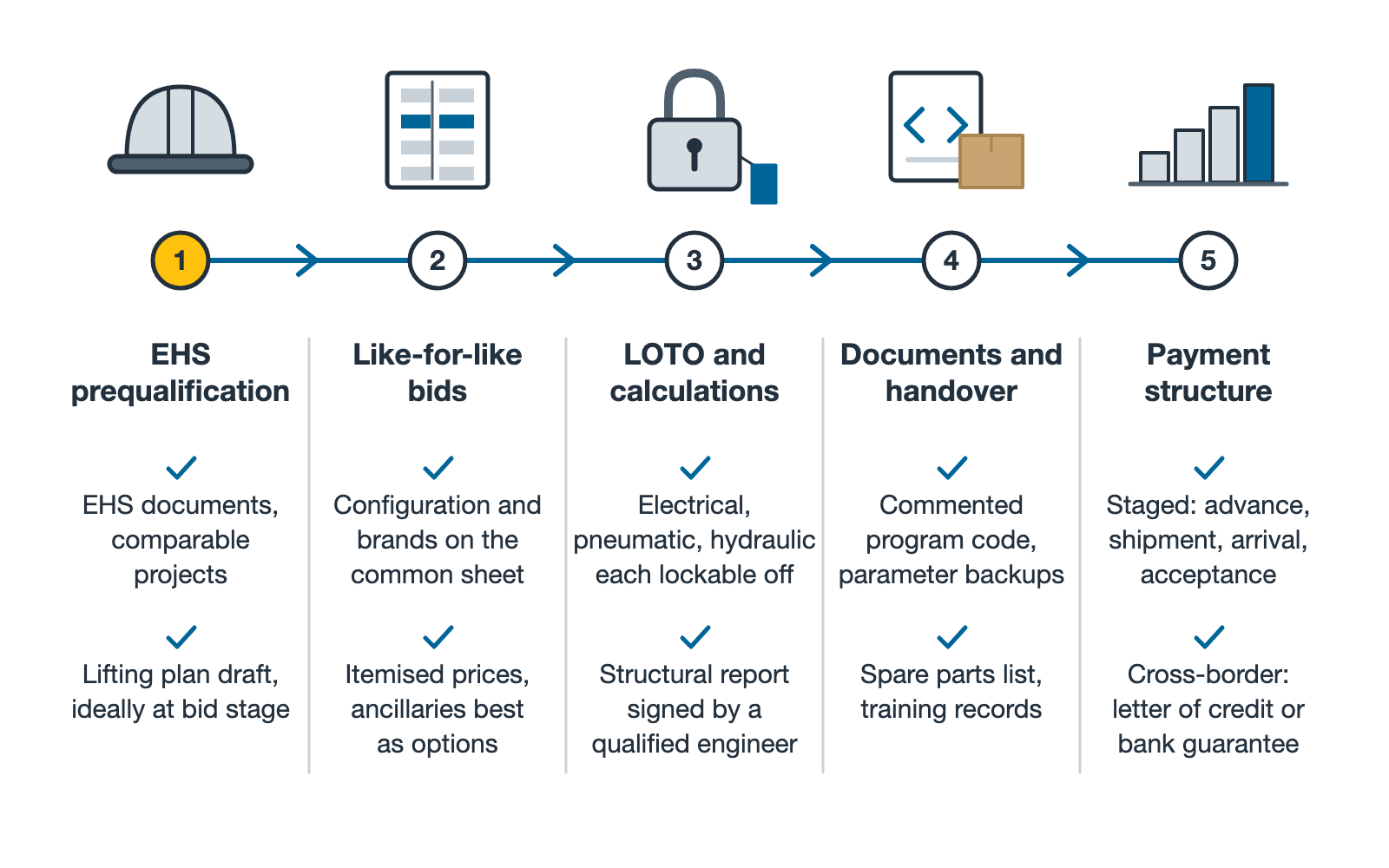
When a multinational plant in Türkiye, Europe or the Middle East buys logistics automation, the order of events is fairly predictable. First the group checks whether a supplier fits its EHS and engineering standards, then it uses a common configuration sheet to bring every bid onto the same basis, and finally it asks whether the risk assessment, calculations, source code and service commitments can be written into the contract. A supplier of Chinese-built equipment that wants to be shortlisted needs these documents ready before the tender, because adding them after award is too late.
This guide is written for both sides of that table: plant engineering and procurement staff deciding what to ask for, and integrators and suppliers deciding what to prepare.
The short answer
- Prequalification usually starts with EHS documents and site safety management, and a supplier with incomplete safety files often never reaches the bidder list.
- Procurement uses a common configuration sheet and an approved brand list to compare bids like for like; only suppliers who fill in the sheet and price item by item end up on the same comparison sheet.
- Risk assessment, LOTO energy isolation, calculations and lifting plans are standard requests; source code handover and on-site attendance within an agreed time may be required by some clients or tenders, and once written as mandatory clauses they become entry requirements.
EHS and group standards come first
Türkiye's Investment Office, citing Ministry of Industry and Technology data, puts the number of companies with foreign capital at 86,926 as of mid-2025. That figure counts companies across all sectors, not plants. The manufacturing plants among them follow local law and also the engineering and EHS standards their group applies. Group standards are usually more detailed than local regulation: drawing numbering and equipment tagging rules, electrical installation specifications, general machine safety rules, and for food plants a hygienic design standard as well. They normally arrive as annexes to the tender. When we receive them, we mark the clauses we cannot meet and raise them at the clarification stage.
Site work requirements are more concrete still. Before work starts, the contractor submits its safety management documents, appoints a site safety lead and carries out a job safety analysis (JSA) for each task. Hot work, work at height, lifting, confined spaces and excavation all run under a permit-to-work system. Some plants require a written lifting plan for any lift above 1 tonne, reviewed and approved with the plant's EHS team. Turkish Occupational Health and Safety Law No. 6331 also requires employers who share a workplace to cooperate on health and safety measures, coordinate prevention and inform each other of risks, so the equipment supplier's site team has to work within the plant's safety management system.
A first draft of the lifting and installation plan is best produced at bid stage. Is the access opening big enough for the lift? Is a temporary platform needed? Which crane or hoist will be used, and how will the work interleave with the civil and fire protection contractors? A plant engineer reading that draft can tell quickly whether the supplier has done this before.
| Stage | Documents to prepare | What the plant looks for |
|---|---|---|
| Supplier prequalification | Company registration, quality system certificates, EHS management documents, list of comparable projects, project team CVs | Whether safety management is systematic; comparable references |
| Tender | Configuration and brand list on the common sheet, itemised price, clause-by-clause technical compliance statement | Whether bids compare on one basis; whether deviations are stated |
| Design review | Project risk assessment (slides or report), throughput calculation, rack and machine structural calculations or finite element analysis | Whether each risk has a countermeasure; whether the throughput method is recognised |
| Design | Layout and electrical drawings to the client's drawing rules, equipment tag list, LOTO point drawing, list of safety functions | Whether the equipment fits the plant's drawing and maintenance systems |
| Installation | Lifting plan, installation method statement, JSA, personnel qualification certificates, inspection records for lifting equipment | Whether work can run under the permit system |
| Acceptance and handover | FAT/SAT records, compliance documents (CE or destination-country requirements), manuals, source code and parameter backups, spare parts list, training records | Whether the plant can maintain the system itself after handover |
CE marking applies in the EU/EEA to products covered by the relevant harmonisation legislation, and in Türkiye to the corresponding products brought under the CE regime; for machinery that is the Machinery Safety Regulation, which transposes Directive 2006/42/EC. For projects in the Middle East, the compliance documents follow the destination country's regulations, and some projects also require or accept CE. For machinery, the manufacturer keeps the technical file for the authorities; the machine is supplied with instructions and the declaration of conformity required by the applicable regime (an EC declaration under Directive 2006/42/EC, an EU declaration under Regulation (EU) 2023/1230). Calculations, drawings and any other documents the plant wants must be listed in the contract. FAT and these documents are covered in our separate guide on FAT, technical files and shipping preparation for Chinese equipment going to a Turkish site.
Making bids comparable: the configuration sheet and itemised prices
The signal that comparison has begun is easy to spot: procurement sends a blank configuration sheet and asks every bidder to fill in key parameters and the make and model of core components in the same format. For a pallet AS/RS with stacker cranes, the sheet usually lists rack specification, stacker crane speeds, motors and drives, PLC, distance measurement and positioning devices, forks and software modules. A low price that comes from a low specification shows up on that sheet at once. Core components should match the client's approved brand list, and any alternative brand should be flagged line by line with evidence of equivalent performance.
Itemised pricing is standard practice at multinational plants: mechanical, controls, software, installation and commissioning, training and spare parts each carry their own price. Ancillary items such as pallets, totes, steel platforms and servers are best listed separately as options, so the client can decide whether to buy them directly. The technical compliance statement should answer the tender clause by clause with "compliant", "exceeds" or "deviation", and each deviation should give the reason and the alternative offered. That usually saves a round of clarification during evaluation.
A typical worked example: the first proposal is drawn up large and complete, with robotic palletising, a high-level tote conveyor and a large AGV fleet, and the price lands far above the budget the client set when the project was approved. The bid nearly drops out. Once the client issues a common configuration sheet, the safer move is to take AGVs, pallets, totes and steel platforms out of the main contract and offer them as options. That reduces the base scope and may bring the base bid closer to budget, the client can tender the ancillary items itself, and the contract can be signed as a main contract plus options. For a first quotation, leave the ancillaries out of the main price.
Risk assessment, safety design and calculations
Machine risk assessment follows the approach of EN ISO 12100: define the limits of the machine, identify hazards, estimate and evaluate the risk, then reduce it in order of inherently safe design, safeguarding, and information for use. Multinational plants also expect a project-level risk assessment, usually presented as slides. It covers simultaneous works with other trades, floor settlement, backup when a single machine fails, loads tipping over, lifting hazards and the boundaries of the software scope, with a countermeasure and an owner for each item.
LOTO (lockout/tagout) gets the closest scrutiny. The EU Machinery Directive requires machinery to have means of isolating it from all energy sources; these isolators must be clearly identified and, where reconnection could endanger people, must be lockable. In Europe the new Machinery Regulation (EU) 2023/1230 replaces the Directive from 20 January 2027 for machinery placed on the market or put into service from that date, and these requirements carry over unchanged. In design terms, every energy source, including electrical, pneumatic and hydraulic, needs an isolation point that can be locked in the off position, normally located near the equipment where it is easy to identify and reach. Stored energy such as gravity or springs needs a release or mechanical locking measure, and EN ISO 14118 is the reference for preventing unexpected start-up. The handover package should include a LOTO point drawing and a lockout procedure for each machine. Many plants check this against a checklist before putting new equipment into service, so a supplier does well to run the same checklist first.
The Machinery Directive also covers guards and emergency stops. A fixed guard may only be opened or removed with a tool, and its fixings must stay attached to the guard or the machine when it is removed; where possible, the guard should not stay in place without its fixings. An emergency stop is a back-up to other safeguarding measures and cannot replace them. Under EN ISO 13850:2015 the emergency stop actuator is red and, where practicable, its background is yellow. Company standards often add a further layer, for example a hard-wired emergency stop circuit or a certified safety fieldbus, manual reset, and at least two fixing points for each fixed guard. Neither wiring choice settles the question on its own: each safety function still needs a required performance level (PLr) or SIL derived from the risk assessment, then designed and validated under EN ISO 13849-1/-2 or IEC 62061.
On calculations: if the tender cites FEM 9.851 from the European Materials Handling Federation, stacker crane cycle times should be calculated with its cycle model and the reference points stated, while throughput assumptions such as availability and congestion are listed separately. For structures, adjustable pallet racking is designed to EN 15512, seismic design follows the principles of EN 16681, site seismic parameters are taken from the local code (TBDY 2018 in Türkiye), and safety requirements for stacker cranes, as rail-dependent storage and retrieval equipment within the scope of EN 528, follow that standard. A structural calculation report should set out load cases, design assumptions, load combinations and verification results, signed by a qualified engineer. Finite element analysis is one way to do part of that work; it is not what "calculation report" means on its own.
Source code, payment, warranty and response time in the contract
Some clients or tenders may require source code handover so that the plant can modify and maintain the system over the long term. The scope should be written down: commented PLC and HMI programs, WCS/WMS source code or scripts developed for the project, parameter backups, and a list of third-party software licences. For a standard WMS product, the usual handover is interfaces and configuration, with the core source held in escrow by agreement. Intellectual property concerns can be handled with a non-disclosure agreement and a "client's internal use only" clause, and the NDA should be signed before any source code is disclosed. Source code for bought-in subsystems has to be agreed with the subcontractor before the purchase order is placed.
A typical cautionary case runs the other way. A stacker crane is bought in from a third party, and at acceptance its supplier refuses to hand over the machine program; soon afterwards that supplier's project team is disbanded. The plant has no specialist maintenance team of its own and, when the machine stops, no contingency plan either. Without the program, the PLC logic cannot be changed, and nobody who knows the machine is left to call. Commented program code, spare parts and training all belong in the contract as handover items.
Payment is normally staged against milestones such as advance, shipment, arrival on site and acceptance. The client may ask for an advance payment guarantee, and some clients work with long payment terms. On cross-border projects, a letter of credit or a bank guarantee can balance the risk between the two sides, and a bank guarantee can also stand in for a retention. Exact milestone percentages and payment terms are set in the quotation and the contract. The financing cost of long payment terms and the fees for guarantees should be built into the price from the start.
The warranty period runs from acceptance, with its length agreed in the contract. Some clients or tenders require on-site attendance within a set time for urgent faults; that response time is binding only as written in the signed service agreement. Committing to it only makes sense with local service staff and common spare parts in the country, either through resident engineers or a signed local service partner, backed by remote support.
Pilot at one plant, then roll out across the group
A common path for bringing a new equipment supplier into a multinational group is a small pilot at one plant, such as a tugger AGV running line-side delivery or a single robotic palletising line. Once the pilot passes, the solution is rolled out to other plants in the group. Some clients use the pilot result as the basis for adding a supplier to the group's approved vendor list, and later plants may reuse the same configuration sheet and document templates. The pilot should therefore be run to the standard of a full project, with the same documents, safety work and acceptance.

A typical worked example: the first order covers only the WMS and one pilot AGV. The order is small, but the proposal still goes through several revisions and an FMEA meeting, where points outside the AGV's standard functions, such as detecting obstacles 0.2 to 1.5 m above the floor and detecting a blocked drop position, are put on the table early.
Frequently asked questions
What should we prepare first for a first tender at a multinational plant?
EHS management documents and a list of comparable projects, because supplier prequalification usually reviews those two before anything else. After that, read the client's engineering standards in the tender annexes carefully.
Why do multinational plants insist on itemised prices instead of a lump sum?
Itemised prices let procurement compare mechanical, controls, software, installation and ancillary items from each bidder on one basis, and let the plant buy ancillaries itself if it wishes. A lump sum hides differences in specification, and that usually works against the bidder at comparison stage.
Is the "FEM calculation" in a tender the same as finite element analysis?
No, not when the tender cites FEM 9.851. There, "FEM" is the European Materials Handling Federation and the calculation means stacker crane cycle times; finite element analysis is a strength and deflection calculation for structures such as racking or stacker crane masts. If no FEM document is cited, ask which one is meant.
The worked examples are typical cases; experience figures come from our team's past projects and are a first guide only. Every project is calculated on its own data.
References
- EU Machinery Directive 2006/42/EC, Annex I, essential health and safety requirements (energy isolation 1.6.3, fixed guards 1.4.2.1, emergency stop 1.2.4.3): https://www.legislation.gov.uk/eudr/2006/42/annex/I
- Regulation (EU) 2023/1230 on machinery, official text (Annex III keeps the requirements above under the same numbers): https://eur-lex.europa.eu/eli/reg/2023/1230/oj/eng
- European Commission, machinery page (Regulation (EU) 2023/1230 applies from 20 January 2027): https://single-market-economy.ec.europa.eu/sectors/mechanical-engineering/machinery_en
- Türkiye, Occupational Health and Safety Law No. 6331 (coordination between employers sharing a workplace, Article 23): https://www.mevzuat.gov.tr/mevzuatmetin/1.5.6331.pdf
- Türkiye Building Earthquake Code TBDY 2018 (Official Gazette): https://www.resmigazete.gov.tr/eskiler/2018/03/20180318M1-2-1.pdf
- Investment Office of the Presidency of the Republic of Türkiye, FDI in Türkiye: https://www.invest.gov.tr/en/whyturkey/pages/fdi-in-turkey.aspx
- ASME STP/SA-030, comparison of FEM stacker crane documents with ASME B30.13 (includes FEM 9.851): https://www.asme.org/getmedia/7d0ed3f2-372f-4bd6-936b-c4010a72a1b8/21579.pdf
If you are preparing a logistics automation tender or purchase for a multinational plant, the EMMANUEL Technical Team can work through the configuration, document list and local service arrangements with you. Send us the tender documents, the layout and your peak-hour figures through the contact form.