Tender specifications for automated warehouses (AS/RS, conveyors, sorters, AGVs) tend to go wrong in the same few places: data nobody verified, a throughput figure with no calculation conditions, and software, program handover, site boundaries and acceptance left out altogether. A sound specification puts on paper the baseline data, the operating condition, the calculation method, the acceptance criteria and who supplies what. Copying one supplier's way of doing things usually has the opposite effect and shuts out sound alternatives.
The short answer
- Every SKU count, tote size and unit load weight in the specification has to be confirmed by the owner, item by item; no template default should survive.
- Stacker crane throughput must state the peak-hour condition, the ratio of single-command to dual-command cycles, and the calculation method, such as FEM 9.851.
- The contract has to say how PLC programs, parameter backups and WCS software are handed over and where source code is held in escrow, or the system may be unmaintainable once the supplier leaves site.
Verify the planning data before writing anything else
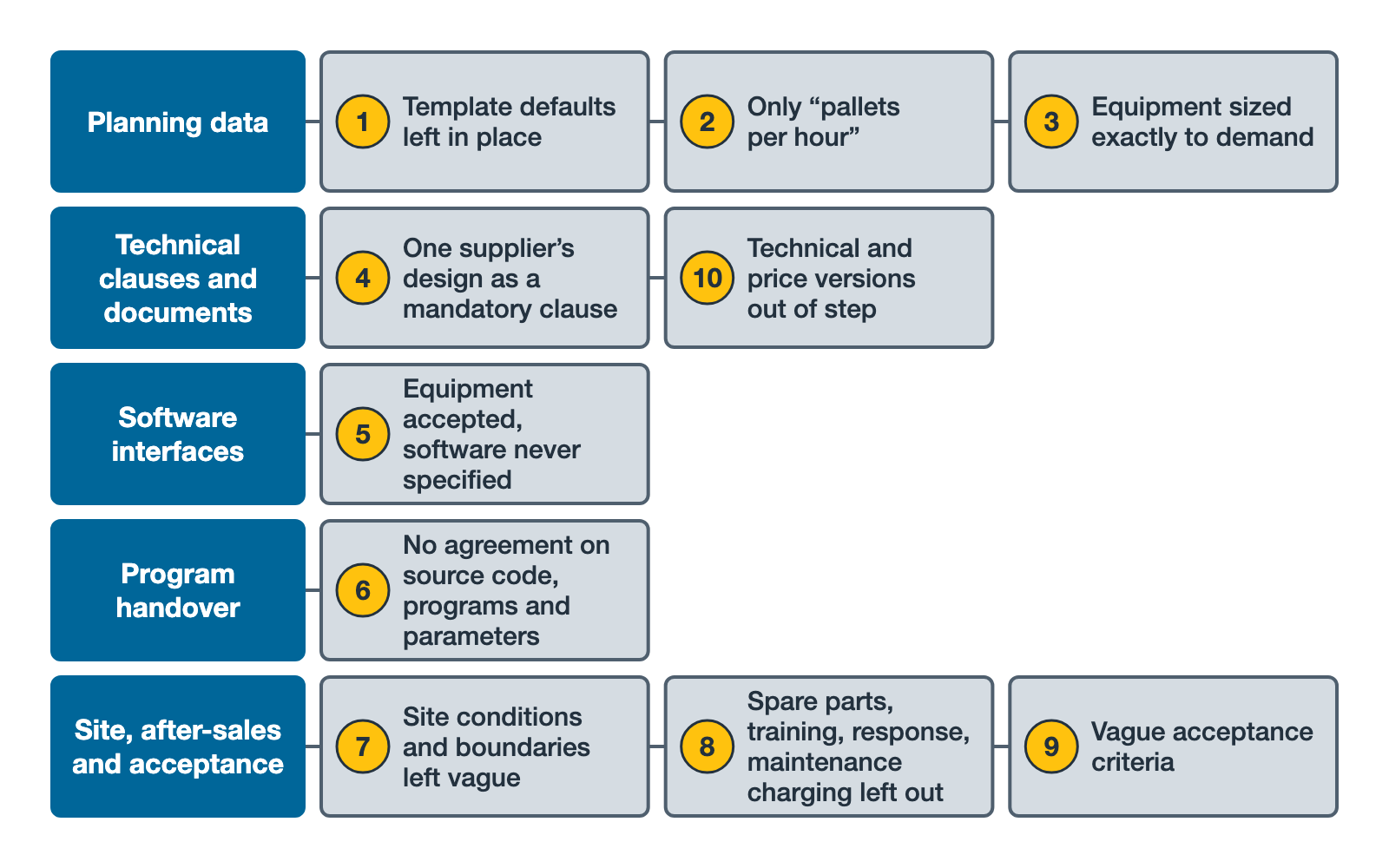
Pitfall 1: Template defaults left in place
Many specifications start life as an old project's document or a request-for-information form, and the SKU count, tote size and unit weight fields often still carry the template values. A common pattern: the RFI template comes with a sample figure in the SKU field, say 8,000, and a sample tote size, and the owner sends the form back with both untouched. Nobody checked them. Bidders design to those numbers, so the slot count, load handling device and conveyor width can all be wrong, and correcting the data after award becomes a variation.
The safer approach is to give the source of every data item (WMS export, measured, or forecast) and the period it covers. For load types, list the smallest, largest and most common sizes. For unit weight, give the maximum and the distribution. Where a figure genuinely isn't available yet, write "to be confirmed by the owner" rather than filling in a guess.
Pitfall 2: Only "pallets per hour"
A bare "pallets per hour" can mean the average hour or the peak hour, inbound only or inbound plus outbound, and the unit itself (pallets or cycles) is often left unstated. When each dual-command cycle stores one pallet and retrieves one, pallets per hour is twice the number of cycles per hour; that does not hold for double-load forks and similar handling. With a mix of single- and dual-command cycles, convert by the ratio: pallets per hour = cycles per hour × (1 + the dual-command share of all cycles), provided each single-command cycle moves one pallet, each dual-command cycle moves two, and cycles per hour is calculated for that same weighted mix. So the specification should give peak-hour inbound, peak-hour outbound and the combined case where both happen at once, followed by the single/dual-command cycle ratio and the calculation method.
For stacker crane AS/RS, cycle times are normally calculated with the FEM 9.851 reference-cycle method, which uses two reference points together with the standard's own assumptions for load transfer and delay times: one at 1/5 of the rack length and 2/3 of the rack height, the other at 2/3 of the length and 1/5 of the height. Under FEM 9.851 a single-command cycle is one storage or one retrieval, and its time is the mean of the two trips from the input/output point to each reference point and back. A dual-command (combined) cycle is a storage followed by a retrieval: from the input/output point to one reference point, on to the other, and back. Vehicle-based systems such as a four-way shuttle have their own guideline, FEM 9.860. State the position of the input/output point as well, otherwise each bidder picks a different one and the results can't be compared. For the detail of reference points and the calculation, see our guide on stacker crane throughput.
Pitfall 3: Equipment sized exactly to demand
If capacity is matched too tightly, one machine stopping causes a jam, and a modest rise in volume means the peak no longer clears. The bottleneck often sits at conveyor right-angle transfers, pop-up transfer units and vertical lifts; see our guide on finding conveyor bottlenecks. Our own rule is a design capacity of at least 1.2 times demand, with no single machine or conveyor node above 85% utilisation at peak. Both numbers come from our team's past projects, not from any standard, and they assume demand is taken at the peak hour with no redundant equipment added. If a single failure in the layout breaks the line, or growth expectations are high, the margin needs to be larger. Write the multiplier into the specification, ask bidders for a node-by-node capacity calculation, and require simulation where it is warranted.
Technical clauses that don't exclude sound alternatives
Pitfall 4: One supplier's design written as a mandatory pass/fail clause
Specifications often lift parameters straight from one supplier's proposal, fix the equipment type and single- or double-deep storage, and mark the clause as mandatory (often with an asterisk), so that any non-compliance means disqualification. Solutions that meet the functional requirement equally well are then locked out. In a low-height tote store, for example, a bidder offering a multi-level shuttle instead of a miniload stacker crane has to argue its way round the clause in the schedule of deviations.
A typical worked example: a bin store with 3.5 m of usable clear height, and a tender written around a stacker crane with mandatory clauses. A bidder proposing a multi-level shuttle had to state in the technical deviation schedule that "the multi-level shuttle is the stacker crane for this project", then recalculate throughput with the reference-point method the tender prescribed, only to avoid disqualification under the mandatory clause. Clauses this rigid also tend to make tenders go round more than once.
Reserve mandatory clauses for hard constraints: throughput, storage capacity, load types, safety, site limits and interfaces. Describe the equipment type as a "recommended solution", accept alternative offers, and require alternatives to submit a capacity calculation on the same basis plus a risk statement. The clarification stage is the right moment to correct unreasonable figures, so don't answer every question with "as per tender documents".
Software interfaces and program handover belong in the specification
Pitfall 5: Equipment accepted, software never specified
Individual machines often pass their standalone tests while the integrated system still fails to work as a whole. If nobody decided in advance whether the WMS or the WCS owns slot allocation, task priority and exception handling, the parties blame each other during integration. The specification should draw the boundaries between ERP, WMS, WCS and PLC, and state who develops and who is responsible for each layer. Between WMS and WCS, give the interface method (web API, message queue and so on, with protocol and data format), the message list, and the exception and retransmission rules. Between WCS and PLC, give the communication method (TCP/IP sockets, for example) and who defines the signal list. Reports should at least cover throughput per machine, number and duration of faults, and availability, with the data retention period stated.
Pitfall 6: No agreement on source code, programs and parameters
When equipment is bought in or subcontracted and the programs are not handed over at acceptance, a change of staff can leave nobody able to diagnose or modify a fault. A bought-in stacker crane whose supplier refuses to release the program at acceptance is a typical case: once the owner's project team disperses, nobody can maintain the machine.
Handover has to protect the owner from lock-in while respecting the supplier's intellectual property. We suggest splitting it in the contract like this. Project-specific PLC application programs are delivered commented and unencrypted. The manufacturer's standard function blocks and third-party software fall under their own licences and may stay encrypted, but come with interface descriptions and fault diagnosis documentation. The HMI project, drive parameter backups, communication configuration, and the name and version of the programming software used, are delivered with acceptance. Commercial software such as a WCS is usually supplied as a licence plus backups; its source code can be placed in escrow with a third party, with the release conditions (the supplier ceasing support, for instance) written down. Delivery is preferably linked to the acceptance payment, and the licence term and renewal arrangements belong in the contract too.
Site, after-sales and acceptance, written so each item can be checked
Pitfall 7: Site conditions and responsibility boundaries left vague
If this part is unclear, everything becomes an extra once the installers arrive. Clear height is measured to the lowest point of beams, sprinkler heads and light fittings. For the floor, specify flatness, local flatness, settlement, load capacity and the requirements in anchor zones. EN 15620, often cited for racking tolerances, does not cover the tolerances of industrial trucks, stacker cranes or the floor itself, so the floor requirements have to come from the equipment supplier and be written separately into the civil works conditions.
On projects designed to European (EN) standards, seismic design of adjustable pallet racking follows EN 16681, used together with the applicable edition of EN 15512, Eurocode 8 (EN 1998-1) and local regulations. Mobile, drive-in/drive-through and cantilever racking are outside its scope. For projects in Türkiye, confirm with the structural engineer and the local authority before tendering how the national seismic code, TBDY 2018, applies to the racking and which rack design standard will be accepted alongside it.
For fire protection, state how sprinkler pipework is routed around the racking, who designs it and who obtains approval. For power, state voltage, earthing and UPS. Whether a large steel mezzanine needs a building permit depends on the local authority, so ask before the tender goes out. Finish with a responsibility (scope split) matrix: civil works, fire protection, power up to which terminal, network, steel platforms and safety fencing, each with an owner.
Pitfall 8: Spare parts, training, response times and maintenance charging left out
Split spare parts into three lists (supplied with the equipment, for the warranty period, and recommended), and say whether they are stocked locally or abroad. Split training into operation and maintenance, with number of trainees, hours, language and completion date. Grade response times by fault severity in three levels (whole operation stopped, partial impact, no impact on operation) and set remote response and on-site attendance times for each. State when the warranty starts (usually final acceptance), whether mechanical and electrical parts differ, and whether post-warranty maintenance is charged as an annual fixed fee, per call-out or by the hour. Known risks, such as grid fluctuations tripping circuit breakers or software licences expiring, should go into the maintenance checklist the bidder submits.
Pitfall 9: Vague acceptance criteria
"Stable operation" cannot be tested. Turn it into durations and fault counts. We cover FAT in a separate guide, but the specification should at least state: which indicators FAT and SAT each test; that SAT uses real goods, a defined mix of load types, peak-hour conditions and live integration with the WMS; how long the continuous run lasts, how many faults are allowed and how availability is calculated (including whether stoppages from external causes are excluded); and how a failed test is repeated and who pays for it.
One more item is easy to miss. Under the Machinery Directive 2006/42/EC, an assembly of machines arranged and controlled so that they function as an integral whole is itself machinery, so the contract should say who acts as manufacturer of the assembly (often the system integrator) and carries out the conformity assessment, technical file, declaration and CE marking where applicable. The contract allocates this role but does not replace the statutory duty. Regulation (EU) 2023/1230 applies to machinery placed on the EU market or first put into service from 20 January 2027; products placed on the market in compliance with the old directive before that date can continue to be made available. Which regime applies depends on when the equipment is actually placed on the market or first put into service in the EU, not on the contractual delivery date.
When the technical documents and the price don't match
Pitfall 10: Technical and commercial versions out of step, deviations mishandled
The design goes through several revisions while the price is still based on an old configuration, the technical documents may even carry text from another project, and at signing each side reads a different scope. The deviation schedule says "fully compliant" while the real deviations are buried in the proposal text, and later turn into disputes over "unlisted deviations".
The owner should require the technical documents and the price to carry the same version number and the same equipment list. The deviation schedule should map clause by clause to the specification's numbering, list positive and negative deviations separately, and state their effect on capacity and price. The clarification log (tender Q&A) becomes an annex to the specification, with each answer stating which clause it replaces. On the bidder's side, the person responsible should check the equipment list, price and document version against each other from start to finish before the bid is submitted.
Before issuing the tender, run through this table:
| Item | The specification should at least state |
|---|---|
| Planning data | Source and period; range and distribution of load types and weights |
| Throughput | Peak inbound, outbound and combined cases; single/dual-command cycle ratio; calculation method |
| Margin | Design multiplier; utilisation limit per machine and conveyor node |
| Mandatory clauses | Limited to function, performance, safety, site and interfaces; alternatives allowed |
| Software | System boundaries; interface method and messages; data retention and reports |
| Handover | Programs, parameters, licences, source code escrow: content, timing and release conditions |
| Site | Clear height, floor, loads, fire protection, power, permits; responsibility matrix |
| After-sales | Spare parts lists, training, graded response, warranty start, maintenance charging |
| Acceptance | What FAT/SAT each test, test conditions, duration, availability formula, retest |
| Documents | Same version for technical and price; deviation schedule mapped clause by clause |
Frequently asked questions
Can we name a brand in the specification? That depends on the procurement rules. For EU public procurement within the scope of Directive 2014/24/EU, Article 42(4) in principle prohibits referring to a specific make or brand, and where a reference is unavoidable it must be followed by "or equivalent"; private projects and projects outside the EU follow their local rules. Even where a brand is listed, allow verifiable equivalents and don't make it a mandatory pass/fail clause.
Which standard requires the 1.2 times margin? None. It comes from our team's project experience and assumes demand taken at the peak hour with no redundant equipment; see Pitfall 3 for how to write it.
Does the supplier have to hand over source code? We recommend listing project-specific PLC programs and parameter backups as unencrypted contract deliverables. For standard function blocks, third-party software and commercial software such as a WCS, a licence and backups are enough, with source code in third-party escrow and released if the supplier ceases support.
Worked examples are typical cases, and experience figures from our team's past projects are a first guide only; each project is calculated on its own data.
References
- FEM 9.851, Performance record for storage and retrieval machines – Cycle times; reference points as cited in Rücker, Rief, Fottner, FME Transactions 48 (2020) 307–312: https://www.mas.bg.ac.rs/_media/istrazivanje/fme/vol48/2/7_a.rucker_et_al.pdf
- FEM 9.860, Cycle time calculation for automated vehicle storage and retrieval systems (VDMA): https://www.vdmashop.de/en/material-handling/fem/377/fem-9.860guideline-cycle-time-calculation-for-automated-vehicle-storage-and-retrieval-systems-english?c=32
- EN 15620:2021, Steel static storage systems – Tolerances, deformations and clearances (EVS): https://evs.ee/en/evs-en-15620-2021
- EN 16681:2016, Adjustable pallet racking systems – Principles for seismic design (BSI): https://knowledge.bsigroup.com/products/steel-static-storage-systems-adjustable-pallet-racking-systems-principles-for-seismic-design
- Regulation (EU) 2023/1230 on machinery (EUR-Lex): https://eur-lex.europa.eu/eli/reg/2023/1230/oj/eng; corrigendum: https://eur-lex.europa.eu/eli/reg/2023/1230/corrigendum/2023-07-04/oj/eng
- European Commission, Machinery: https://single-market-economy.ec.europa.eu/sectors/mechanical-engineering/machinery_en
- Directive 2014/24/EU, Article 42 (technical specifications): https://www.legislation.gov.uk/eudr/2014/24/article/42/data.html
- Türkiye Bina Deprem Yönetmeliği (TBDY 2018), Resmî Gazete: https://www.resmigazete.gov.tr/eskiler/2018/03/20180318M1-2.htm
We are the EMMANUEL Technical Team. If you are preparing a warehouse automation tender, you are welcome to send your planning data, layout, peak-hour figures and draft specification via the contact form, so we can look at the throughput and the clauses together.