Stacker crane throughput is usually estimated with the FEM 9.851 reference-cycle method: within the method's range of validity, take two reference points in the aisle, calculate the mean single command and dual command cycle times, and convert them to cycles per hour. When the pallets per hour in a quotation don't materialise on site, either the bidders were counting on different bases, or the bottleneck was never the crane at all but a conveyor node, the input/output point or a picking station. When we compare several AS/RS proposals side by side, we ask every bidder for a calculation on the same set of conditions and then check it node by node.
The short answer
- Under FEM 9.851, a dual command cycle starts at the input/output point, stores one pallet at P1 (1/5 of the aisle length, 2/3 of the lift height), retrieves one at P2 (2/3 of the aisle length, 1/5 of the lift height) and returns, so it handles two pallets, one in and one out.
- For a single-deep pallet stacker crane with a 60 m aisle, 20 m lift height, 160 m/min travel, 50 m/min hoist, 0.5 m/s² acceleration on both axes, about 7.8 s per load handling and 1 s allowance per stop, the dual command cycle comes to about 88 s: in theory about 41 cycles/h, or 82 pallets/h.
- What the whole AS/RS can deliver is set by its bottleneck resources together with system scheduling; right-angle transfers, pop-up transfer units, vertical lifts, RGVs and manual picking stations can each be slower than the crane, and each has to be checked.
The FEM 9.851 two-point method and the two cycle types
FEM 9.851 is a technical guidance document, not an EN or ISO standard, published by the European Materials Handling Federation (FEM) under the title "Performance data of storage and retrieval machines – Cycle times"; the edition listed on the FEM website is from 2003. It covers automatically controlled stacker cranes handling unit loads. The method estimates the mean cycle time from two reference points, on the assumption that all storage locations are accessed with equal probability over the period considered. If the input/output point is not at the end of the aisle, or access is clearly uneven (fast movers grouped near the front in an ABC zoning, for instance), the two-point result is no longer the real mean. In that case you calculate location by location or simulate.
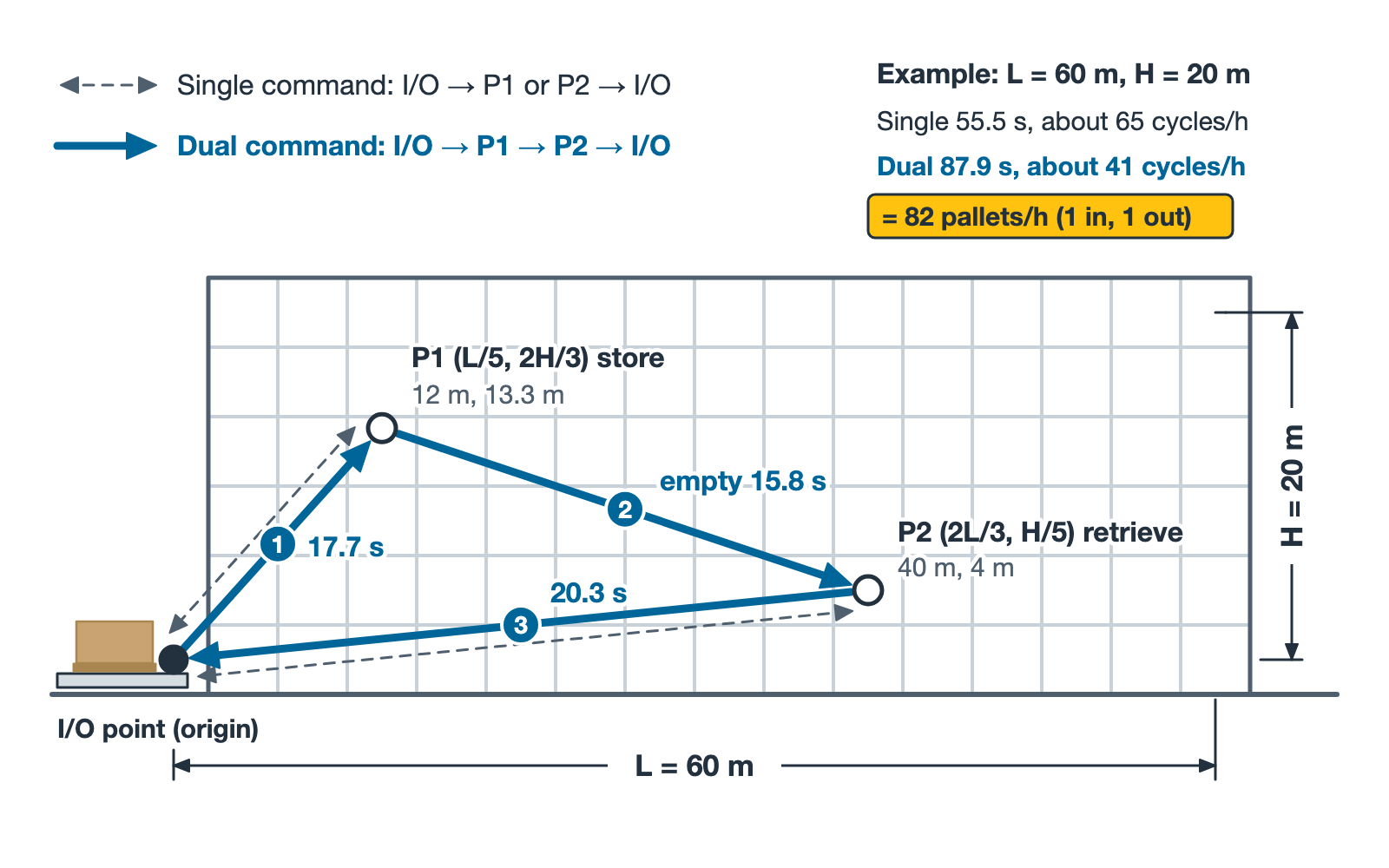
The origin of coordinates is the input/output point. L is the travel distance from the input/output reference to the centre of the farthest location included in the calculation; H is the effective lift height from the input/output reference to the centre of the highest location included, not the overall rack height. P1 lies L/5 from the input/output point at a height of 2H/3; P2 lies 2L/3 from it at a height of H/5. The exact definitions of L and H, and the range of validity of the two-point method (which depends on the aisle's length-to-height ratio and on the speeds of the two axes), are as given in the FEM 9.851 text itself. It is a paid document, so we don't restate its limit values here. The load handling and delay times in our worked example below are example inputs, not values taken from FEM 9.851; a real calculation uses the times declared for the project.
A single command cycle is one storage or one retrieval: from the input/output point to the location and back. FEM 9.851 takes the mean of two single command cycles, one to P1 and one to P2. A dual command cycle combines one storage and one retrieval: pick up the inbound pallet at the input/output point, set it down at P1, travel empty to P2, pick up the outbound pallet and bring it back to the input/output point.
So "40 dual command cycles per hour" means 80 pallets per hour, on two conditions: each dual cycle stores one pallet and retrieves one (single-load forks), and at peak hour inbound and outbound actually happen at the same time in roughly equal numbers. With a mix of cycle types, let d be the share of dual command cycles among all cycles. Then pallets per hour = 3,600 × (1 + d) ÷ [(1 − d) × single command cycle time + d × dual command cycle time], with cycle times in seconds and each single command cycle moving one pallet, each dual command cycle two. Mix up cycles and pallets in a quotation and capacity doubles on paper. When another party's calculation lands on our desk, the first thing we check is whether it says cycles/h or pallets/h.
A full worked example: 60 m aisle, 20 m lift height
Travel and hoist run simultaneously, so each leg takes the longer of the two axis times. Each axis time is an acceleration phase plus a constant-speed phase, with acceleration and deceleration assumed equal and speeds converted to m/s first. If the stroke s ≥ v²/a, the axis reaches rated speed and t = s/v + v/a. If s < v²/a, it never reaches rated speed and t = 2√(s/a). Here s is in m, v in m/s, and a is the acceleration in m/s².
Besides the travel, every cycle carries two fixed blocks of time. One is load handling: the telescopic forks extend, lift or lower slightly, and retract, counted once per pallet stored or retrieved. The other is a delay allowance for precise positioning, location confirmation and communication at each stop, taken here as 1 s per stop. A single command cycle has 2 load handlings and 2 stops; a dual command cycle has 4 load handlings and 3 stops.
Example conditions: single-deep pallet stacker crane, L = 60 m, H = 20 m; travel 160 m/min, acceleration 0.5 m/s²; hoist 50 m/min, acceleration 0.5 m/s²; forks 40 m/min, acceleration 0.5 m/s², single-deep stroke 1.2 m, plus 1.5 s for the small lift or lowering, giving about 7.8 s per load handling; input/output point at the bottom of the aisle end.
| Leg / item | Travel | Hoist | Governing |
|---|---|---|---|
| I/O point → P1 (12 m, 13.3 m) | 9.8 s | 17.7 s | 17.7 s |
| I/O point → P2 (40 m, 4 m) | 20.3 s | 6.5 s | 20.3 s |
| P1 → P2 (28 m, 9.3 m) | 15.8 s | 12.9 s | 15.8 s |
| Single command cycle = (2×17.7 + 2×20.3) ÷ 2 + 2 load handlings + 2 s | 55.5 s, about 65 cycles/h | ||
| Dual command cycle = 17.7 + 15.8 + 20.3 + 4 load handlings + 3 s | 87.9 s, about 41 cycles/h (82 pallets/h) |
As the P1 row shows, the hoist governs that leg; travel takes only 9.8 s, so raising the travel speed saves nothing there. The P2 leg is the opposite and is governed by travel. All figures in the table are theoretical, with no utilisation factor applied, and they have to be recalculated whenever a parameter changes.
How much do long aisles, double-deep storage and curve-going cranes cost?
Same crane as above, one condition changed at a time:
| Condition (otherwise as above) | Single command | Dual command | Notes |
|---|---|---|---|
| Baseline: 60 m × 20 m, single-deep | about 65 cycles/h | about 41 cycles/h | — |
| Aisle extended to 120 m | about 51 cycles/h | about 32 cycles/h | Far legs fully governed by travel; check the two-point method's validity against the FEM 9.851 text |
| Double-deep, rack side 50% front and 50% rear position, no relocations | about 63 cycles/h | about 39 cycles/h | 7.8 s single-deep at the I/O side; 9.6 s average at the rack side |
| Double-deep, rack side all rear position, no relocations | about 61 cycles/h | about 38 cycles/h | 7.8 s single-deep at the I/O side; 11.4 s at the rack side (2.4 m stroke) |
| Curve-going stacker crane | Project-specific | Project-specific | One crane serves several aisles, slows in curves, and its capacity is shared across those aisles |
A longer aisle in a pallet AS/RS gives each crane more locations, but every cycle gets longer too, and models with lower speeds and acceleration lose more. Moving the input/output point to the middle of the aisle shortens the travel, but then the two-point method no longer applies directly; calculate the actual layout or simulate it.
For double-deep storage, the FEM 9.851 two-point method says nothing about how access splits between the front and rear positions, so you weight it with project data: average rack-side load handling time = probability of front-position access × front-position handling time + probability of rear-position access × rear-position handling time + relocation rate × time per relocation, where the time per relocation is the whole extra operation, including travel to a temporary location and the additional load handlings, rather than the fork movement alone. A relocation is needed when the pallet to retrieve sits in the rear position with another pallet in front of it, which has to be moved first. The relocation rate depends on the SKU profile and on the WMS slotting strategy. The "all rear-position" row excludes relocations, so it is not a lower bound on real capacity; with frequent relocations, actual capacity drops further. When we lay out a double-deep scheme ourselves, our habit is to calculate every retrieval as a rear-position access and add relocations on top.
A curve-going (aisle-changing) stacker crane runs in several aisles and suits stores with many aisles and low frequency per aisle. Its capacity can't be taken from a straight-aisle model: it slows down in curves, the switch adds a fixed time, and one crane's capacity is shared by every aisle it serves. We simulate these with the number of aisles, switching time and peak demand distribution rather than forcing a formula onto them.
The cranes are sufficient, so why does the store still fall short?
FEM 9.851 covers the stacker crane alone. Parallel lines, routing and shared equipment are outside it.
On pallet conveyors, node capacity = 3,600 ÷ the time each pallet occupies the node (in seconds). In our team's past projects, typical nodes came out roughly as follows, each taken as one pallet at a time with no queuing. A right-angle transfer or pop-up transfer unit on a pallet chain conveyor is occupied 24–33 s per pallet, about 110–150 pallets/h. A single-station vertical lift between floors takes 36 s per round trip, about 100 pallets/h. A single-station RGV shuttle takes 60–72 s per round trip, about 50–60 pallets/h. Actual occupancy times vary with stroke, load and dispatching, so they belong in the calculation. Where an RGV or lift is shared between several lines, check it against the combined demand.
Tote systems are more likely to run out of capacity at the people than at the crane. We usually plan a manual picking station at 60 totes per person per hour (the number of order lines per tote makes a big difference), and on that basis the stations can top out before a miniload stacker crane does. A typical worked example: a parts store one floor above ground, 4.5 m clear height, served by multi-level shuttles. With 9 vehicles it calculates out at about 938 totes/h on single command cycles, yet with only 6 manual picking positions the stations handle 360 totes/h between them. Adding vehicles achieves nothing at that point. The fix lies on the picking side, for example compartmented totes and inbound and outbound batches planned around production orders.
A pallet AS/RS can also stall at peripheral equipment. Another typical worked example: stacker cranes calculated on double-deep, rear-position access with an 85% factor deliver about 299 pallets/h against a demand of 215 pallets/h (282 pallets/h in the long term), which is enough. A single machine such as a finished-goods pallet changer, though, manages only 24 pallets/h against a demand of 30. A gap like that should be stated plainly as not met in the proposal, together with an alternative; far better than the customer finding it at acceptance.
Design margin and utilisation are easily confused, so agree how each is defined before compounding them. Utilisation is the share of the peak hour a machine is occupied; we usually take 85%, leaving time for positioning retries and scheduling waits. Design margin is an uplift on forecast demand; we usually take 1.2. Compound them only when each is defined separately: a peak demand of 100 pallets/h × 1.2 = 120 pallets/h, divided by 0.85, needs a theoretical capacity of about 141 pallets/h. If the client's 1.2 already includes operating losses, don't divide by 0.85 as well; a theoretical 120 pallets/h is enough. The two readings differ by about 18%, and the contract should say which one applies. One more condition: dual command cycles can only be assumed when inbound and outbound happen at the same time at peak. In periods of concentrated dispatch with almost no inbound, only single command cycles count.
What to make bidders state in their calculations
When pallets per hour don't match the site, the cause usually sits in one of these places: dual command cycles counted as pallets, or single command capacity presented as peak capacity; reference points taken at mid-aisle or near the input/output point instead of FEM 9.851's P1 and P2; rated speeds used on short strokes that never reach them; double-deep calculated on the front position only, leaving out rear-position access and relocations; load handling and positioning times left out, or no utilisation factor applied; the stacker crane calculated while conveyor nodes and the input/output point were not.
So we require every bidder to submit a calculation on the same set of conditions, stating at least:
| Item | What the calculation should state |
|---|---|
| Geometry | Definition and value of L and H; position and height of the input/output point; single- or double-deep |
| Drives | Travel, hoist and fork speeds and accelerations; whether empty and loaded values differ |
| Fixed times | Load handling time, and positioning and communication time per stop, listed separately |
| Cycles | P1 and P2 coordinates, time per leg, single command and dual command cycle times |
| Double-deep | Access probability for front and rear positions; relocation rate |
| Factors | Utilisation and design margin values, and whether they are compounded |
| System | Capacity and peak load of each conveyor node, lift, RGV and picking station; simulation results with simultaneous inbound and outbound |
The client's own targets can be unrealistic too. A common case: the first tender draft asks for 200 pallets/h inbound and outbound plus double-deep storage, while the actual equipment cycle times can only sustain about 150 pallets/h and the site isn't wide enough for double-deep racking anyway. This needs to be said at the clarification stage, with the target split into a mean and a peak (say, 120 pallets/h mean and 150 pallets/h peak) and the design changed to single-deep. Leave it until the bid and write a deviation, and you are on the back foot.
The acceptance method belongs in the contract as well. Under FEM 9.221, cycle times in the performance test are determined as described in FEM 9.851. During the test, locations should be accessed with the same even distribution used as the basis for the cycle-time calculation; concentrated operations such as initial filling of the store or peak periods are not suitable for this test. The reliability and availability test runs between 1 day and 1 working week, depending on the size of the installation. The contract should also say whether single or dual command cycles are measured, and at which locations.
Frequently asked questions
If the crane does 40 dual command cycles per hour, does it only move 40 pallets? No. Each dual command cycle brings one pallet in and takes one out, so 40 cycles/h is 80 pallets/h. That only holds when inbound and outbound both happen at peak, in similar numbers.
Every bidder offers double-deep storage. How do we compare them fairly? Ask each one to state front-position and rear-position access probabilities and the relocation rate, weight the handling time by those three, and recalculate everything on one data set. This step is not part of the FEM 9.851 two-point method, so the tender documents have to define it.
How much margin should a stacker crane have? It depends on how design margin and utilisation are defined. We usually take 1.2 and 85%, and compound them only when they are defined separately; if the 1.2 already includes operating losses, don't divide by 0.85 again. The two methods differ by about 18%, and the calculation should say which one it uses.
Worked examples are typical cases. Experience figures come from our team's past projects and are a first guide only; each project is calculated on its own data.
References
- FEM (European Materials Handling Federation), technical guidance list, including FEM 9.851 (2003), FEM 9.221 and FEM 9.222: https://fem-eur.com/technical-guidance/
- FEM 9.851 (EN) Performance Data of Storage and Retrieval Machines: Cycle Times, catalogue page: https://standards.globalspec.com/std/2054853/FEM%209.851%20(EN)
- FEM 9.221 Performance Data of S/R Machines: Reliability, Availability (first edition 1981; performance test in section 3.1): https://www.fem-eur.com/wp-content/uploads/2016/03/FEM-9_221_Englisch.pdf
- Rücker, A. et al., energy consumption calculation for stacker cranes, FME Transactions Vol. 48 No. 4 (2020); Figure 5 shows the FEM 9.851 dual command cycle reference points: https://www.mas.bg.ac.rs/_media/istrazivanje/fme/vol48/4/4_a_ruecker_et_al.pdf
- UNE 58912:2004 Storage and retrieval machines – Cycle times (Spanish standard): https://www.en-standard.eu/une-58912-2004-storage-and-retrieval-machines-cycle-times/
We are the EMMANUEL Technical Team. If you have several bidders' calculations to compare, or want to check how many aisles a project needs, you are welcome to send us your layout, rack height and peak-hour inbound and outbound figures via the contact form so they can be checked against your project's data.