Die and mould AS/RS
Heavy-duty cranes store and retrieve press dies and injection moulds and bring them to the transfer point at changeover, replacing searching and craning; capacity is set by the heaviest die.
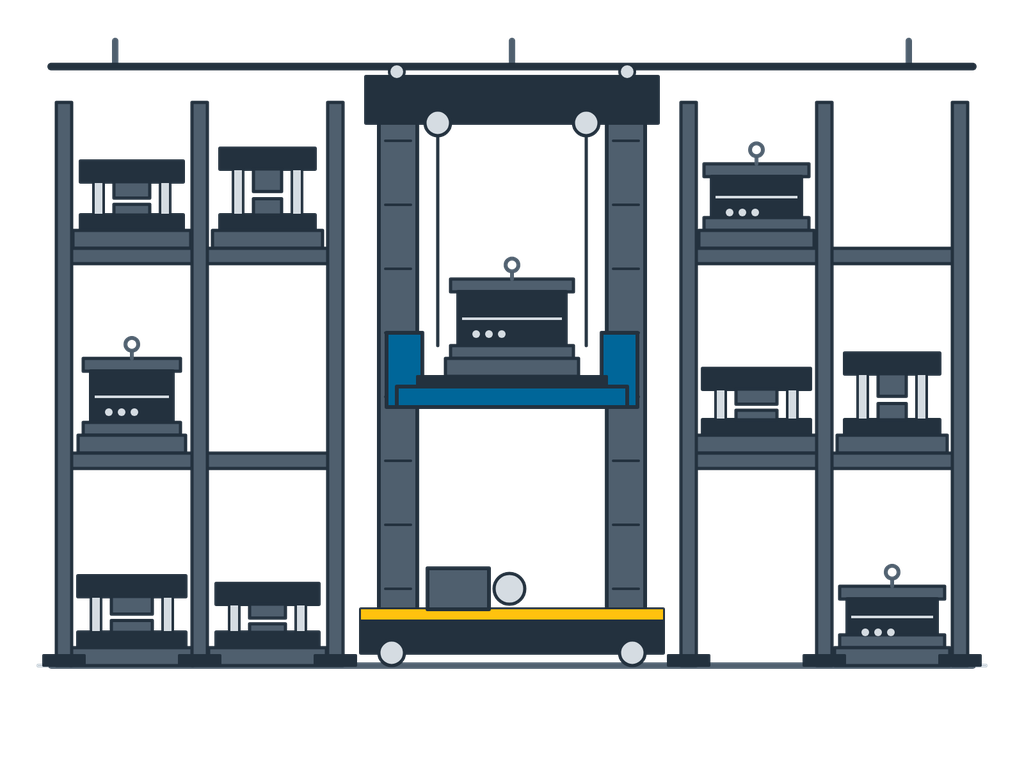
Heavy-duty cranes store and retrieve press dies and injection moulds and bring them to the transfer point at changeover, replacing searching and craning; capacity is set by the heaviest die.
Heavy-duty cranes store and retrieve press dies and injection moulds and bring them to the transfer point at changeover, replacing searching and craning; capacity is set by the heaviest die.
A die and mould AS/RS uses heavy-duty stacker cranes to place press dies and injection moulds on load plates in high-bay positions and, at changeover, bring them to the transfer point, where the shop crane or a transfer car takes them to the machine. Compared with floor storage it saves space, finds dies faster, stops dies being stacked on each other, and keeps the register in line with the real positions. Capacity is set by the heaviest die, with published cranes commonly around 5 t and the heavy-duty class of the Chinese association standard reaching 30 t, confirmed per project; the floor, the transfer arrangement and the building are designed together.
| Capacity | Set by the heaviest die; published cranes commonly about 5 t, heavy-duty class up to 30 t; press-die cases about 9–13.6 t per die |
|---|---|
| Crane | Mainly heavy-duty twin mast |
| Load carriers | Dies sit on load plates sized to the dies |
| Transfer | Crane opening or transfer car at the store end, linked to the shop crane |
| Management | Die number and location kept by the control system delivered with the equipment (WCS), connectable to your WMS / MES / ERP |
| Retrieval time | Vendors state about 2.5 min per die; cases average under 5 min or about 4–6 min; depends on layout |
| Size | Cases range from a few dozen to several hundred positions |
Figures are typical configuration ranges; exact specifications are set per project.