Pallet stacker crane (single and twin mast)
The core machine of a pallet AS/RS, available on its own: single-mast cranes are light, fast and economical; twin-mast cranes are stiffer for taller, heavier stores.
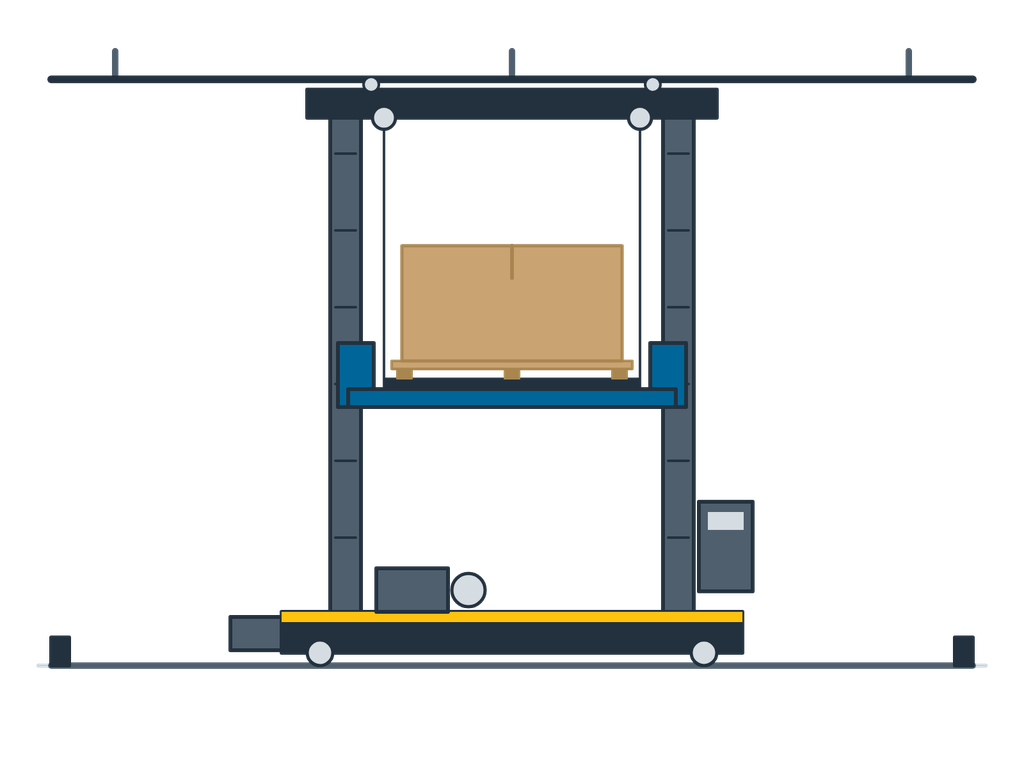
The core machine of a pallet AS/RS, available on its own: single-mast cranes are light, fast and economical; twin-mast cranes are stiffer for taller, heavier stores.
The core machine of a pallet AS/RS, available on its own: single-mast cranes are light, fast and economical; twin-mast cranes are stiffer for taller, heavier stores.
A stacker crane travels along a rail in the aisle; its carriage rises along the mast and a telescopic fork puts pallets into rack positions and takes them out. Single-mast cranes are light, fast and economical, the economy type mostly up to 18 m and about 1.5 t, the high-performance type to about 27–40 m and 2 t; twin-mast cranes, with top and bottom beams, are stiffer and serve taller, heavier stores and multi-deep handling. This page is for integrators who buy the crane on its own and for retrofits that replace cranes or add aisles; for a complete AS/RS see the pallet AS/RS page.
| Type | Single mast, twin mast |
|---|---|
| Load | Single mast: economy about 1.5 t, high-performance about 2 t; twin mast 3 t class, heavier per project |
| Height | Single mast: economy up to about 18 m, high-performance about 27–40 m; twin mast about 15–40 m, taller per project |
| Travel speed | About 160–240 m/min |
| Hoist speed | Typically about 40–60 m/min; higher on high-performance cranes |
| Travel acceleration | About 0.5 m/s² |
| Positioning | Laser measurement or barcode positioning, typically about ±3–5 mm |
| Capacity per crane | Estimated by the FEM 9.851 method: about 40–50 dual cycles/h single deep, 50–60 with dual load handling, 35–45 double deep; long aisles and tall stores often run nearer 25 per hour |
Figures are typical configuration ranges; exact specifications are set per project.