Multi-aisle stacker crane (curve-going or transfer car)
One crane moves to other aisles on a curved rail or a transfer car, so several aisles share it: fewer cranes for stores with large capacity and modest movements.
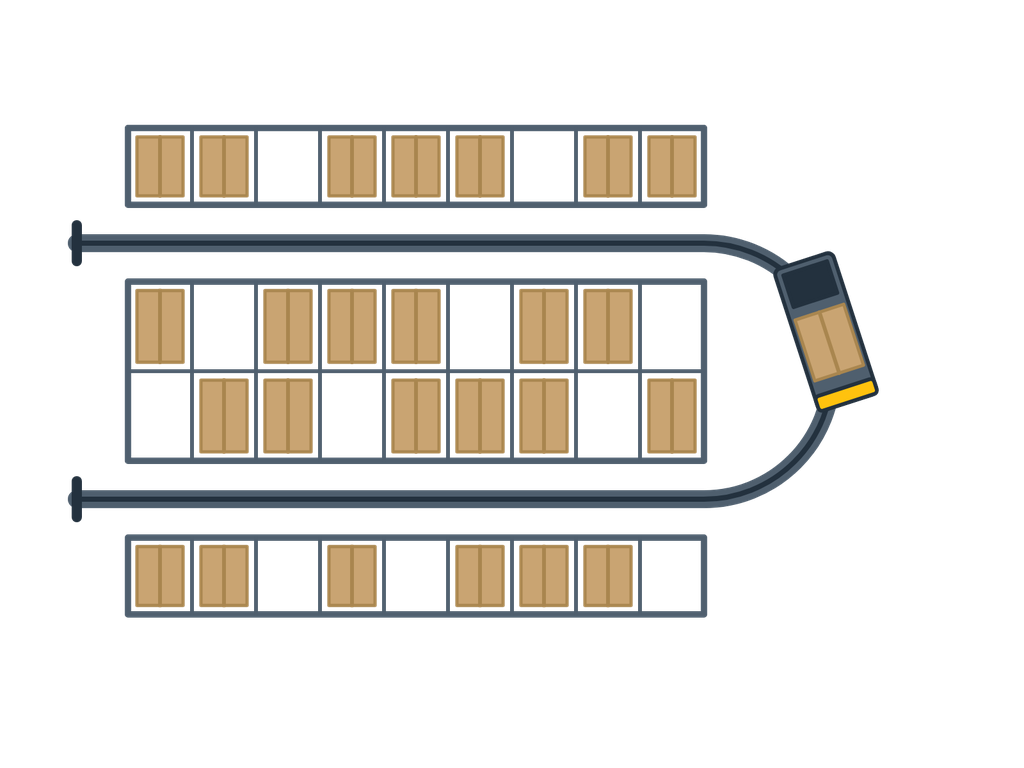
One crane moves to other aisles on a curved rail or a transfer car, so several aisles share it: fewer cranes for stores with large capacity and modest movements.
One crane moves to other aisles on a curved rail or a transfer car, so several aisles share it: fewer cranes for stores with large capacity and modest movements.
A conventional AS/RS has one crane per aisle. A curve-going crane runs on a curved rail laid at the end of the aisles: it leaves one aisle, turns and enters the next, so a curve-going crane typically serves two aisles. In the transfer-car version a car at the end of the store shifts the crane sideways to another aisle, serving three or more. The number of aisles stays the same and fewer cranes are needed; the curve or transfer car costs extra, so total investment is calculated from throughput and the aisle-changing mechanism. The trade-off is that one crane's throughput is shared by its aisles and it slows down in the curve, so it suits stores with large capacity and modest movements, and phased projects that start with one crane and add more later.
| Aisles per crane | Curve type typically 2; transfer-car type 3 or more |
|---|---|
| Mast | Mostly single mast; twin mast available |
| Load | Pallet cranes typically up to 2 t, heavier per project; tote cranes about 100 kg |
| Height | Curve-going cranes mostly up to 15 m; transfer-car multi-aisle cranes up to about 36 m |
| Travel speed (straight) | About 100 m/min class for curve-going cranes, slower in the curve |
| Curve radius | Little published data: a patent example of about 1 m and a US case of about 3.7 m (12 ft), not a general range; designed per project by the manufacturer |
| Hoist speed | About 60–80 m/min |
| Positioning | Barcode positioning (BPS) or segmented laser measurement |
| Reference project | 400 kg load, about 9.8 m lift, about 89 m aisle; travel about 120 m/min, hoist about 30 m/min; positioning about ±3–5 mm; about 20 dual cycles per hour required per crane |
Figures are typical configuration ranges; exact specifications are set per project.