Radio pallet shuttle
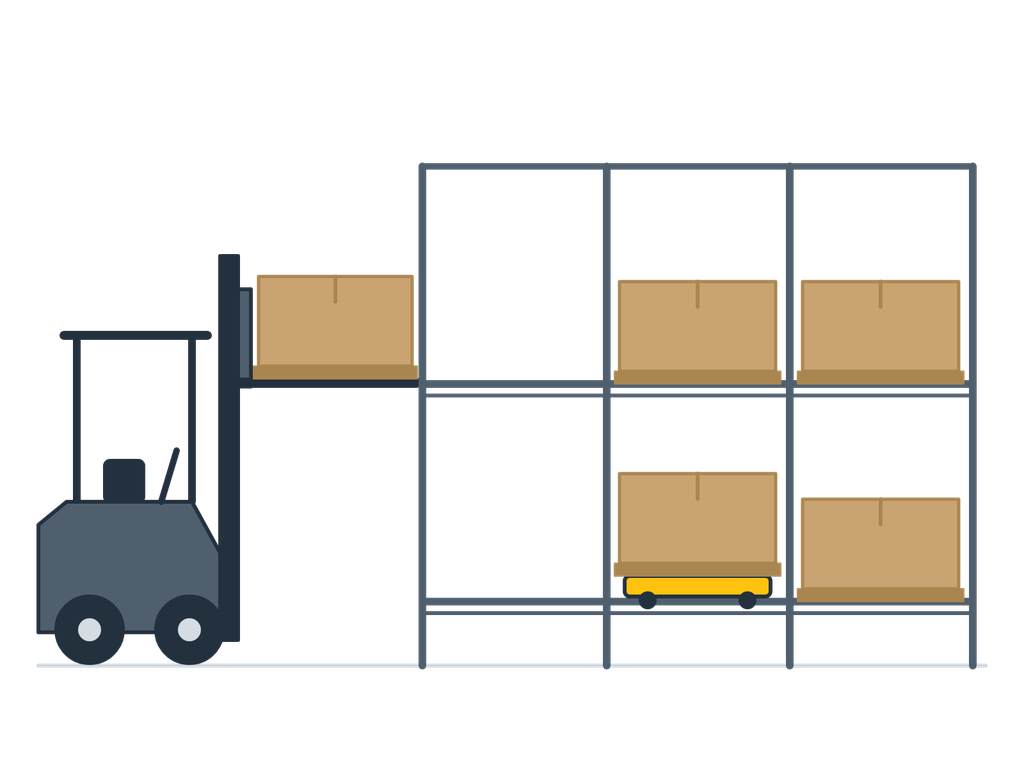
The forklift sets the pallet at the lane entrance and a remote-controlled shuttle carries it deep into the lane. No aisles inside the rack, more pallets on the same floor, and usually a lower initial investment than an AS/RS.
The forklift sets the pallet at the lane entrance and a remote-controlled shuttle carries it deep into the lane. No aisles inside the rack, more pallets on the same floor, and usually a lower initial investment than an AS/RS.
The forklift sets the pallet at the lane entrance and a remote-controlled shuttle carries it deep into the lane. No aisles inside the rack, more pallets on the same floor, and usually a lower initial investment than an AS/RS.
A radio pallet shuttle is a battery-powered cart that runs on rails inside the rack. The forklift places the shuttle in a lane, then sets pallets on the rails at the entrance; the operator gives commands by remote control, and the shuttle lifts each pallet and carries it to the far end, so one lane holds many pallets in a row. The forklift never drives into the rack; only one forklift aisle runs in front of it, so the same floor holds clearly more pallets. It is semi-automated: forklifts still put away and retrieve, and a later move to four-way shuttles needs a new design study, and the existing rack, rails and controls may not be reusable.
| Load | About 0.5–2 t |
|---|---|
| Travel speed | Empty about 1–1.1 m/s, loaded about 0.8 m/s |
| Temperature | Ambient; low-temperature version about −30 to +45 °C |
| Pallets | Built for EUR, industrial and other pallet sizes |
| Operation | Remote control; forklift places and retrieves the shuttle |
| Power | Exchangeable battery; about 10 h at ambient, about 8 h in a freezer, about 3 h to charge |
Figures are typical configuration ranges; exact specifications are set per project.