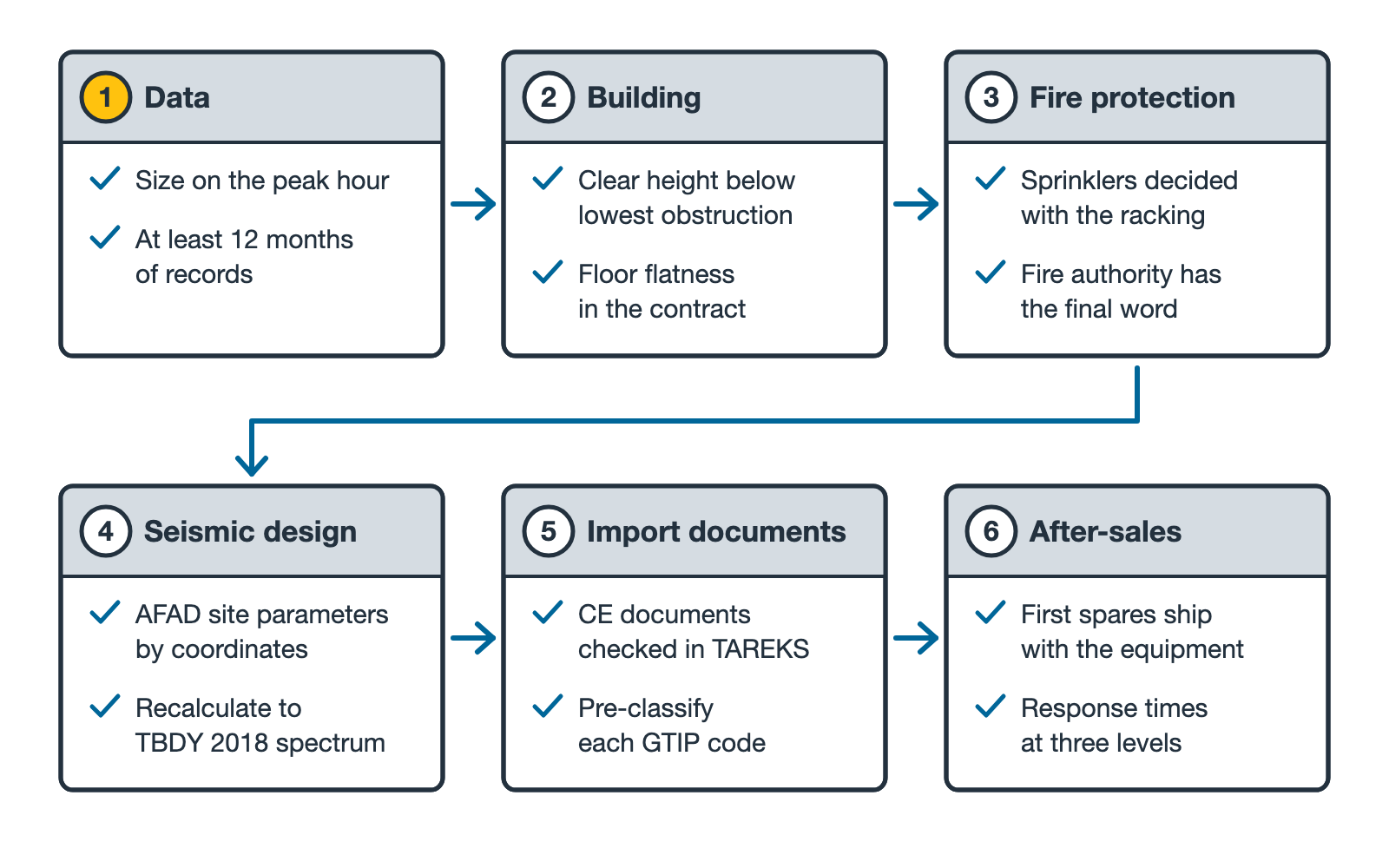
To build an automated warehouse in Türkiye, work in this order: settle the concept from order and SKU data, then use the building's clear height, floor, fire protection and seismic conditions to filter the equipment, and get import documents, installation responsibilities and service response written down before the contract is signed. Phase the project where you can. A good share of the rework we have seen in Türkiye came from things nobody aligned before work started: a leased building whose clear height and floor could not carry high-bay storage, racking checked for earthquakes with Chinese site parameters, sprinkler pipes clashing with the equipment, and missing documents discovered only once the equipment reached the port.
The short answer
- Size the equipment fleet on peak-hour throughput; a design based on daily averages tends to fall short in the busy season.
- Take the site parameters for the racking from the AFAD earthquake hazard map using the project's coordinates and recalculate with the TBDY 2018 design spectrum; drawings made for a site in China cannot be reused as they are.
- From 2026, listed imported machinery goes through a document check in the TAREKS system, and if the CE declaration of conformity or other documents are missing, the equipment will not clear customs.
Start from the data, not the equipment brochure
These are the things we usually ask for first: orders per day, order lines per order and the units-per-line distribution; the number of SKUs and how fast they move; whether the handling units are parcels, cartons, totes/bins or pallets, and their sizes and weights; how inbound and outbound volumes vary by day and by hour; and growth assumptions for the next three to five years.
Take two warehouses with 20,000 locations each. If outbound is mostly full pallets, a pallet stacker crane AS/RS is generally the better fit. If it is mostly each-picking, look at tote systems instead: a miniload AS/RS, a multi-level shuttle or tote-handling robots. Count the machines on the peak hour. For stacker cranes that means dual-cycle capacity; for sorters, items per hour and the number of chutes. The bigger the gap between peak and trough, the more this matters.
If historical data exists, get at least 12 months of inbound and outbound records and mark the peak weeks. In our team's past projects, with less than a year of data the seasonal peak weeks were often invisible. A new operation has to work from the business plan, so write down every assumption and have both sides sign it off. State the design margin explicitly too, or each side will add its own on top of the other's.
What can a leased building take?
In a building you build or have built to suit, clear height, column grid, floor, cast-in anchors and fire protection can all be settled together at the design stage. In a leased building those conditions are given, so check them one by one before signing the lease.
Usable clear height is measured below the lowest obstruction, whichever of the beams or truss bottom chords, sprinkler mains, light fittings and ducts sits lowest, not up to the ridge. The floor has to match the point loads of the rack uprights and the requirements of any rails; if there are no as-built records, core samples are the only way to find out. EN 15620, the racking tolerance standard, no longer specifies floor tolerances as of its 2021 edition, so the equipment supplier has to state the flatness requirement separately, put it in the contract and have it accepted as a separate item. Where the column grid is irregular and the clear height limited, a four-way shuttle system is easier to fit than stacker cranes, though floor and racking accuracy still cannot be relaxed. Ask about the lease itself as well: may you drill and anchor, add a steel mezzanine, alter the fire protection or increase the power supply, and do you have to restore the building when you leave?
Bring fire protection in early. Under Türkiye's fire protection regulation for buildings, two of the mandatory sprinkler cases matter most for warehouses: non-residential buildings whose building height, as the regulation defines it, exceeds 30.50 m; and buildings of more than 1,000 m² in total that produce or store readily flammable and combustible materials. Ordinary cartons and e-commerce parcels do not count under the second case. The regulation also limits the size of fire compartments in warehouses according to hazard class, and the limit falls away where systems such as automatic detection, sprinklers and smoke extraction are installed. Warehouses higher than 6.50 m or larger than 5,000 m² need automatic fire detection. The hazard class depends on what is stored and is set by the fire protection designer.
Whether there are sprinklers at all, whether they go inside the racking, how the pipework stays clear of stacker cranes and shuttles, and whether water supply and pump room are sufficient all have to be decided together with the racking design. The local fire authority's review has the final word.
Which seismic rules apply to racking in Türkiye?
The seismic code in force is TBDY 2018, the Turkish Building Earthquake Code, applicable since 1 January 2019. Site parameters are read from AFAD's earthquake hazard map by coordinates, then amplified for the local soil class to give the design spectrum. The seismic design class also depends on how the building is used, and it goes up for buildings that store hazardous goods.
TBDY requires a seismic calculation for non-structural components and equipment fixed to a building, and their connections may not rely on friction. Buildings in the lowest seismic design class are exempt, and any component weighing more than 10% of the total weight of its storey has to be analysed as part of the main structure. The code has no chapter on steel racking. For structures outside its scope, Turkish standards come first and equivalent international standards may be used, provided they follow the principles of TBDY. What we normally do: design adjustable pallet racking for seismic actions to EN 16681 and for static loads to EN 15512, take the seismic input from the TBDY design spectrum, and have a local structural engineer confirm the result. EN 16681 does not cover mobile, drive-in/drive-through or cantilever racking, or static steel shelving, so those need a different basis.
In practice, racking calculated in China has to be recalculated. Upright sections, bracing and anchor bolts may all change, and a change in the anchors feeds back into the floor requirements. Goods falling off the racking in an earthquake is a risk too, so pallet quality and how the loads are secured belong in the same discussion. A free-standing steel mezzanine needs the same calculation; who draws and signs it, and whether it goes in with the building permit, is for the local authority to decide. One more item that is easy to miss: the fire regulation's requirements for seismic bracing of sprinkler pipework still use the old seismic zone terms, so ask the local fire authority whether they apply to your project.
Which documents does equipment imported from China need?
Power comes first. Türkiye's low-voltage supply is 230/400 V, 50 Hz. Much Chinese equipment is rated 380 V, 50 Hz: the frequency is the same, but the voltage is about 5% higher. Under IEC 60034-1, the voltage tolerance for continuous operation of a motor is ±5%, so a nameplate that only says 380 V should not be assumed to be fine. Check the input ranges of motors, control transformers, brakes and servo drives one by one against the voltage measured on site. In a leased building, confirm the transformer capacity first; any increase has to be applied for with the local distribution company.
Then CE. Türkiye's machinery rules follow the EU's: the Machinery Safety Regulation in force corresponds to the old EU Machinery Directive, and a new regulation corresponding to the new EU Machinery Regulation was published in October 2026, with its main provisions applying from 20 January 2027. Products placed on the market under the old regulation before then can stay on the market; what counts is the date of placing on the market, not the date the equipment arrives on site. The new regulation requires the instructions and safety information in Turkish. Conveyors and stacker cranes are often supplied as partly completed machinery with a declaration of incorporation, so the contract has to say who carries out the risk assessment for the complete line and who, as manufacturer of the complete line, issues the declaration of conformity and affixes the CE marking. Electrical equipment also falls under the EMC and low-voltage regulations, and AMRs, AGVs and handheld terminals with radio modules come under the radio equipment rules as well.
Then customs. Since 1 January 2026, under the machinery import inspection communiqué, machinery with listed GTIP codes is inspected on import through the TAREKS system on a risk basis. Products on some of the lists need an import inspection pre-approval first, and what gets checked is documents such as the EU declaration of conformity. If the documents are not right, the inspection result is negative and the equipment stays in customs. Customs duty, additional customs duty (İGV) and import VAT (KDV) are all assessed on the GTIP code; the relevant decisions are published every year and amended mid-year as well. One system will be split across several GTIP codes, such as racking, conveying machinery, control cabinets and batteries, so it is best to have the customs broker pre-classify the equipment list item by item before the contract is signed.
If the project holds an investment incentive certificate, the equipment listed on it may qualify for support on customs duty and KDV. The certificate has to be in place before import, and the equipment list has to match it; the authority's assessment is what counts.
Installation, commissioning and after-sales: who does what, and where the spares sit
The split we find works best: a local crew does the mechanical installation under the manufacturer's supervision, local electricians do the wiring, and the manufacturer's engineers handle single-machine commissioning and WCS/WMS integration. Foreign technicians coming to install or repair imported equipment, or to give training on it, can apply for a work permit exemption of up to 3 months, which has to be applied for in advance; if commissioning runs longer, a normal work permit is needed.
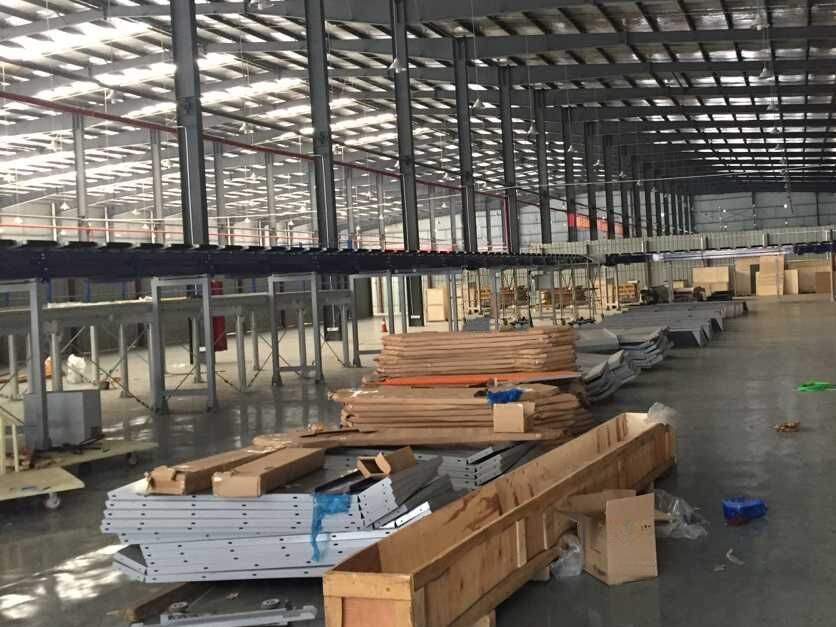
Run FAT at the factory in China for the key equipment wherever possible, both unloaded and under load. Spare parts fall into two groups: wear parts such as belts, rollers and sensors, and long-lead parts such as drives, PLC modules, special motors and key stacker crane components. Put the list in a contract annex and ship the first set with the equipment; otherwise, clearing a single part through customs later means going through the whole procedure.
Decide at the design stage how the VPN for remote support will connect and whether the owner's IT department will allow it. Türkiye is five hours behind China, so the support desk in China has to be scheduled against the shifts on site. Write the response times into the contract at three levels: remote response, arrival on site and return to operation. Whether arrival on site can be promised depends on having people locally, and the local maintenance team should ideally work alongside the installers from the start.
Schedule and phasing
The usual sequence is data analysis and concept, detailed design (including confirmation of the civil, fire and seismic interfaces), manufacturing, FAT, shipping and customs clearance, installation, single-machine commissioning, system integration, trial operation and ramp-up. How long each stage takes is worked out per project. On the projects we have done, the critical path was often held up by building alterations, fire approval, power upgrades and customs documents, not by equipment manufacturing. Civil works and manufacturing can run in parallel, provided the interface drawings are frozen early.
For phasing, put the part with the most certain return into phase one, for example storage or outbound sorting, and reserve the space, floor capacity, power and WMS/WCS interfaces that phase two will need. Vehicle-based systems such as four-way shuttles and tote-handling robots can start with fewer vehicles and add more as volume grows. Stacker cranes do not give you that option, since the number of aisles is fixed from day one. Racking and steelwork are best installed in one go, so you are not building again inside a warehouse that is already running.
For a first discussion, bring the building plan and sections (and say whether the building is leased or your own), at least 12 months of inbound and outbound records or the business plan, SKU master data, the WMS and ERP you use or plan to use, the project location, the target start of operation and a budget range in USD or EUR. That is enough for us to start on a preliminary concept.
Frequently asked questions
Q: Our racking was designed and calculated in China. Can we use the same drawings in Türkiye?
A: Not as they are. Take the AFAD site parameters for the project's coordinates, recalculate with the TBDY 2018 design spectrum, use EN 16681 together with EN 15512 for pallet racking, and have a local structural engineer confirm it.
Q: The equipment ships at the end of 2026 and reaches Türkiye in February 2027. Which regulation should the CE documents follow?
A: It depends on the date the equipment is placed on the market in Türkiye, not the shipping date. If it is first placed on the market after 20 January 2027, preparing the documents under the new regulation is the safer choice; how that date is determined is for the authority and your customs broker to confirm.
Q: How are taxes worked out when a complete system is imported from China?
A: Customs duty, additional customs duty and KDV are all assessed on each item's GTIP code, and one system is split across several codes. Before ordering, have the customs broker pre-classify the equipment list item by item, and confirm at the same time which codes need a TAREKS inspection.
Q: The building we are leasing has no sprinklers. Do we have to add them for an automated warehouse?
A: Not necessarily. The regulation makes sprinklers mandatory only in a few cases, and they can also become necessary when a fire compartment exceeds its size limit. It depends on building height, floor area and what is stored, and the local fire authority's review has the final word.
Experience-based statements in this article come from our team's past projects and are only a first guide; each project is calculated on its own data.
References
- Türkiye, Official Gazette of 18 March 2018, No. 30364 (repeated issue): Türkiye Bina Deprem Yönetmeliği, Turkish Building Earthquake Code TBDY 2018: https://www.resmigazete.gov.tr/eskiler/2018/03/20180318M1-2.htm
- AFAD: Türkiye earthquake hazard map (site parameters by coordinates): https://tdth.afad.gov.tr
- BSI: EN 16681:2016, Steel static storage systems, Adjustable pallet racking systems, Principles for seismic design (scope): https://knowledge.bsigroup.com/products/steel-static-storage-systems-adjustable-pallet-racking-systems-principles-for-seismic-design
- Türkiye: Binaların Yangından Korunması Hakkında Yönetmelik, Regulation on Fire Protection of Buildings, consolidated text, Articles 75 and 96, Annexes 4 and 7: https://www.mevzuat.gov.tr/MevzuatMetin/21.5.200712937.pdf
- Türkiye, Official Gazette of 31 December 2025, No. 33124, 4th repeated issue: Makinaların İthalat Denetimi Tebliği (Ürün Güvenliği ve Denetimi: 2026/32), machinery import inspection communiqué: https://www.resmigazete.gov.tr/eskiler/2025/12/20251231M4.htm
- Türkiye, Official Gazette of 16 October 2026, No. 33402: Makine Emniyeti Yönetmeliği (2023/1230/AB), new Machinery Safety Regulation: https://www.resmigazete.gov.tr/eskiler/2026/10/20261016-12.htm
- Ministry of Trade of Türkiye: mid-year amendments to the 2026 import regime, including the additional customs duty decision: https://ticaret.gov.tr/haberler/2026-yili-ithalat-rejimine-iliskin-ara-degisiklikler-resmi-gazetede-yayimlandi
- Ministry of Labour and Social Security of Türkiye: table of work permit exemptions (Article 48(b), installation, maintenance, repair and training for imported machinery and equipment): https://csgb.gov.tr/Media/nuymdjh4/turkce-tablo.pdf
If you are planning an automated warehouse in Türkiye, send us the layout and your inbound and outbound data through the contact form, and the EMMANUEL Technical Team will work out the concept and phasing for your project.