Skip to Content

Drum motor (motorised pulley)

Motor and gearbox sealed inside the pulley to drive a belt conveyor directly: compact, low-maintenance, wash-down versions for food, supplied with new conveyors or on its own as a spare.
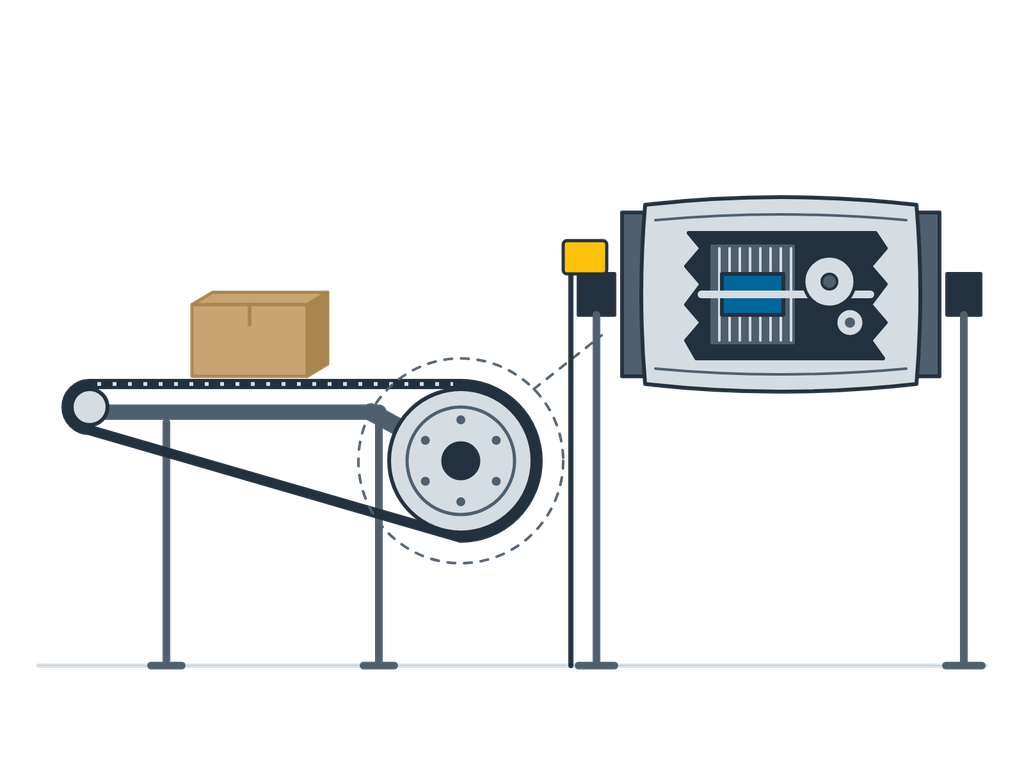
Motor and gearbox sealed inside the pulley to drive a belt conveyor directly: compact, low-maintenance, wash-down versions for food, supplied with new conveyors or on its own as a spare.

A drum motor seals the motor and gearbox inside the pulley, which sits at the end of a belt conveyor and drives the belt directly. Compared with an external gear motor it removes drive parts from the side of the conveyor and has no exposed chains or couplings, so it is easier to clean and guard; packaging and logistics conveyors use it widely, and for food the protection class, corrosion resistance, lubricant and contact-material documents are checked separately. Small diameters drive light belt conveyors, large ones wider and heavier belts. It is supplied with new equipment or on its own as a spare.

Typical uses

  • Belt conveyors in logistics and parcel handling
  • Food, beverage and bakery lines (wash-down type)
  • Conveyor sections of packaging, weighing and inspection machines
  • Replacing drives on existing conveyors

How to choose

  • Belt width, effective tension and wrap angle, which set the diameter and face width
  • Belt speed, load and duty cycle, which set power and ratio
  • Local mains voltage and frequency
  • Whether it is washed down: for food, check protection class, corrosion resistance, lubricant and contact-material documents

When it is not the right choice

  • High-power heavy-duty conveying such as long bulk conveyors: outside this range
  • Frequent speed changes and positioning: confirm the drive and encoder set-up first

Key figures

DiameterPublished model examples: small about Ø50–76 mm, common about Ø110–270 mm
PowerPublished model examples: small about 80–100 W, common about 0.12–2.2 kW
Face widthSet by belt width
SupplyTo local mains, e.g. 400 V 50 Hz
OptionsLagging, stainless wash-down type, built-in encoder or brake (by model)

Figures are typical configuration ranges; exact specifications are set per project.

Options

  • Lagging for more grip
  • Stainless shell and food-grade lubricant
  • Built-in encoder or brake
  • Matching frequency inverter

Scope of supply

  • Machine, drives and control cabinet, assembled and dry-run tested before shipping
  • The equipment's own control and fleet software; interfaces to your existing WMS / ERP as the project requires
  • Drawings: general arrangement, foundation and anchor plan, electrical schematics
  • Conformity documents for the equipment and the whole line, the split of responsibilities and the acceptance criteria are set out in the contract according to the project scope
  • Spare-parts list and wear-part recommendation; a first batch can ship with the equipment
  • Factory acceptance (FAT): attend in person or follow by live video
  • Installation, commissioning and operator training can be included in the offer

What we need for an offer

  • Belt width, speed and tension or load
  • Mains voltage and frequency
  • Wash-down and ambient temperature
  • For replacement: diameter, face width and shaft-end dimensions of the old pulley

Related equipment

Request an offer for this equipment