Skip to Content

Telescopic belt conveyor

Installed at the dock door and extended into the truck or container, so loose cartons and parcels go straight on and off the vehicle without being carried the length of the vehicle.
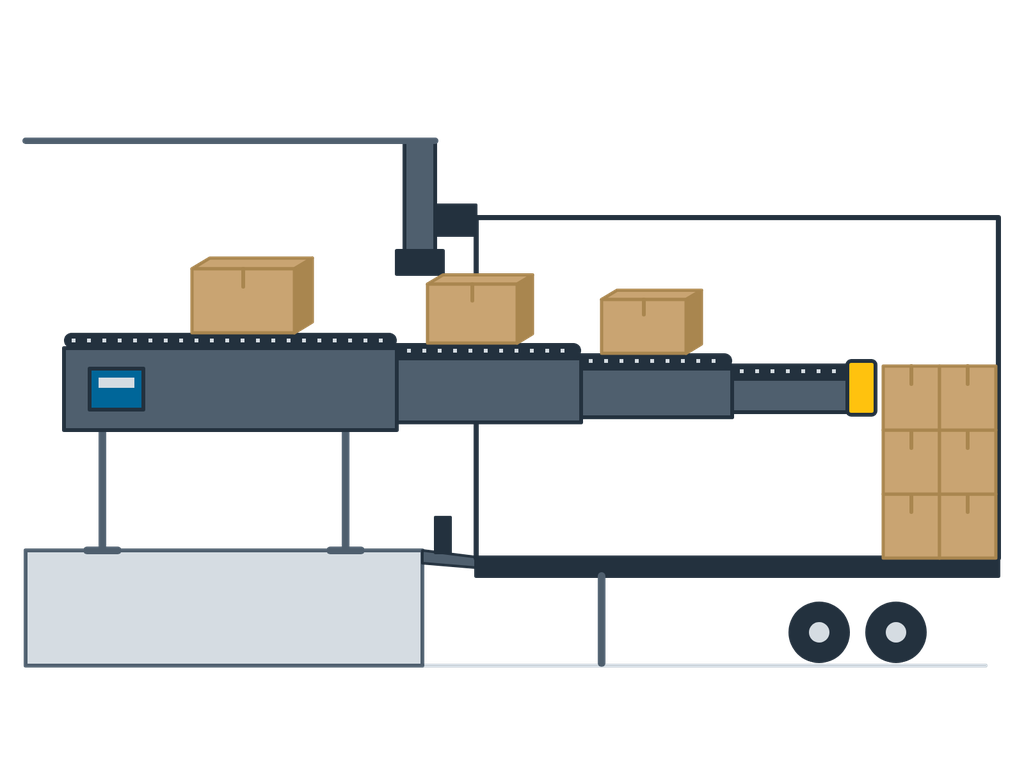
Installed at the dock door and extended into the truck or container, so loose cartons and parcels go straight on and off the vehicle without being carried the length of the vehicle.

A telescopic belt conveyor sits at the dock door; its sections slide out like drawers into the trailer or container. When unloading, the crew stands in the vehicle and puts cartons on the belt, which carries them straight into the warehouse conveyor; loading runs the other way. The boom extends or retracts as the load progresses, so people only handle cartons inside the vehicle. The fixed section joins the in-house conveyor, and an optional lifting and tilting front end suits different floor heights. It is for manual handling of loose cartons; for whole pallets and unmanned loading see the related equipment at the end of the page.

Typical uses

  • Unloading and loading loose parcels in parcel hubs
  • Shipping docks in e-commerce warehouses
  • Export container stuffing, including 40 ft high-cube
  • Receiving returns and supplier deliveries

How to choose

  • The vehicle sets the maximum reach: box truck, 13.6 m semi-trailer, 40 ft container
  • Trucks per day and number of doors: one per door when traffic is heavy, a mobile unit shared between doors when it is light
  • Size and weight range of the cartons
  • How much floor heights vary, which decides whether you need a lifting and tilting front end

When it is not the right choice

  • Whole pallets: use AGV forklift truck loading or manual forklifts
  • Only a few trucks a day and rigid, flat-bottomed cartons: a flexible extendable roller conveyor costs less
  • To automate the carton handling inside the vehicle as well: see the carton loading and unloading robot

Key figures

Belt widthTypically 800 mm
Fixed sectionAbout 6–7.6 m
ExtensionAbout 4–19 m, two to five stages
Belt speedTypically about 15–40 m/min, adjustable, by model
Extension speedAbout 0.25 m/s
Front endOptional lift and tilt, lighting and operator panel
Loading rate (project reference)Manual handling of loose cartons; past projects required about 500–750 cartons/h, depending on cartons and crew

Figures are typical configuration ranges; exact specifications are set per project.

Options

  • Lifting and tilting front end, lighting, operator panel, emergency stops and safety edge
  • Mobile base to share one unit between several doors
  • Runs in both directions for loading and unloading
  • Connection to scanning, weighing and sorting lines
  • Roll-cage tipper for deliveries in cages

Scope of supply

  • Machine, drives and control cabinet, assembled and dry-run tested before shipping
  • The equipment's own control and fleet software; interfaces to your existing WMS / ERP as the project requires
  • Drawings: general arrangement, foundation and anchor plan, electrical schematics
  • Conformity documents for the equipment and the whole line, the split of responsibilities and the acceptance criteria are set out in the contract according to the project scope
  • Spare-parts list and wear-part recommendation; a first batch can ship with the equipment
  • Factory acceptance (FAT): attend in person or follow by live video
  • Installation, commissioning and operator training can be included in the offer

What we need for an offer

  • Vehicle types, inside length and floor height
  • Dock height and number of doors
  • Trucks per day and cartons per truck
  • Carton size and weight range
  • Height and interface of the in-house conveyor

Related equipment

Request an offer for this equipment