Skip to Content

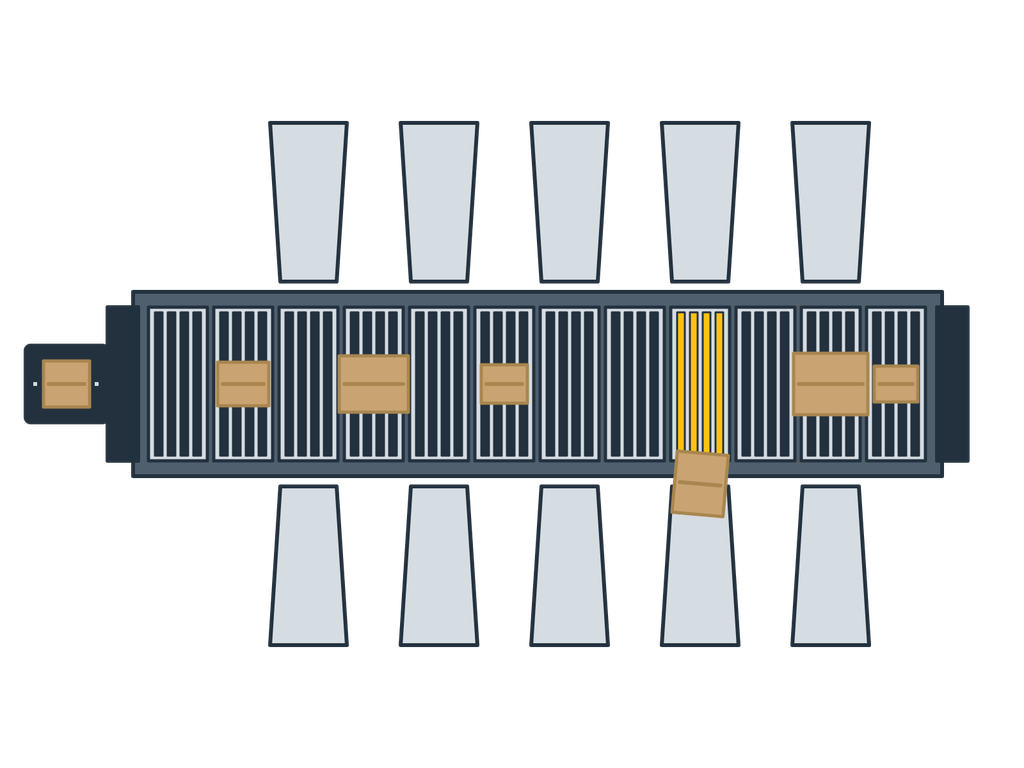
Narrow-belt sorter (linear narrow-pitch cross-belt)

Narrow-pitch carriers in a straight layout with destinations on one or both sides: a small footprint and moderate investment for mid-volume parcel depots and e-commerce warehouses; a Chinese strength.

Narrow-pitch carriers in a straight layout with destinations on one or both sides: a small footprint and moderate investment for mid-volume parcel depots and e-commerce warehouses; a Chinese strength.

A narrow-belt sorter (in China a linear narrow cross-belt sorter, not to be confused with strip-belt pop-up sorters) is a string of narrow-pitch carriers, each with a short cross belt, laid out in a straight line; at the destination the belt turns sideways and puts the item into a chute on one or both sides. Narrow pitch lets items run closer together; the number of destinations depends on chute width and layout, on one or both sides, on a narrower footprint than a loop cross-belt. A Chinese association standard covers it and groups it by induction: manual, gapping automatic, and multi-section side induction. It suits mid volumes from a few thousand to over ten thousand items per hour.

Typical uses

  • Regional parcel depots and mid-sized hubs
  • Outbound sorting in e-commerce warehouses
  • Multi-client sorting at 3PLs
  • Small and medium parcels

How to choose

  • Hourly volume: about 5,000–15,000 items fits best
  • Item length and weight distribution
  • Number of destinations and available length
  • Induction: manual or automatic

When it is not the right choice

  • Very high volume (over 20,000 items/h): a loop cross-belt sorter
  • Mostly cartons and heavy items: a sliding-shoe sorter
  • Short, wide sites that cannot take a straight line: a loop or swivel-wheel layout

Key figures

Carrier pitch≤ 300 mm (association standard)
LayoutStraight, destinations on one or both sides
Line speedVendors state up to about 3 m/s
ThroughputAbout 5,000–15,000 items/h as a first estimate only; actual figure set by item length, induction and destinations
InductionManual, gapping automatic, multi-section side induction

Figures are typical configuration ranges; exact specifications are set per project.

Options

  • Automatic induction and singulation
  • Barcode scanning tunnel, DWS
  • Full-chute detection, bagging chutes
  • Destinations on one or both sides

Scope of supply

  • Machine, drives and control cabinet, assembled and dry-run tested before shipping
  • The equipment's own control and fleet software; interfaces to your existing WMS / ERP as the project requires
  • Drawings: general arrangement, foundation and anchor plan, electrical schematics
  • Conformity documents for the equipment and the whole line, the split of responsibilities and the acceptance criteria are set out in the contract according to the project scope
  • Spare-parts list and wear-part recommendation; a first batch can ship with the equipment
  • Factory acceptance (FAT): attend in person or follow by live video
  • Installation, commissioning and operator training can be included in the offer

What we need for an offer

  • Item size and weight distribution
  • Peak hourly volume
  • Number of destinations
  • Site length, width and clear height
  • Upstream system and interface

Related equipment

Request an offer for this equipment