Skip to Content

Sortation chutes and spiral chutes

Spiral and straight chutes bring items down by gravity, and bagging chutes receive what the sorter sends out; the chutes need no drives, automatic bagging stations have their own.
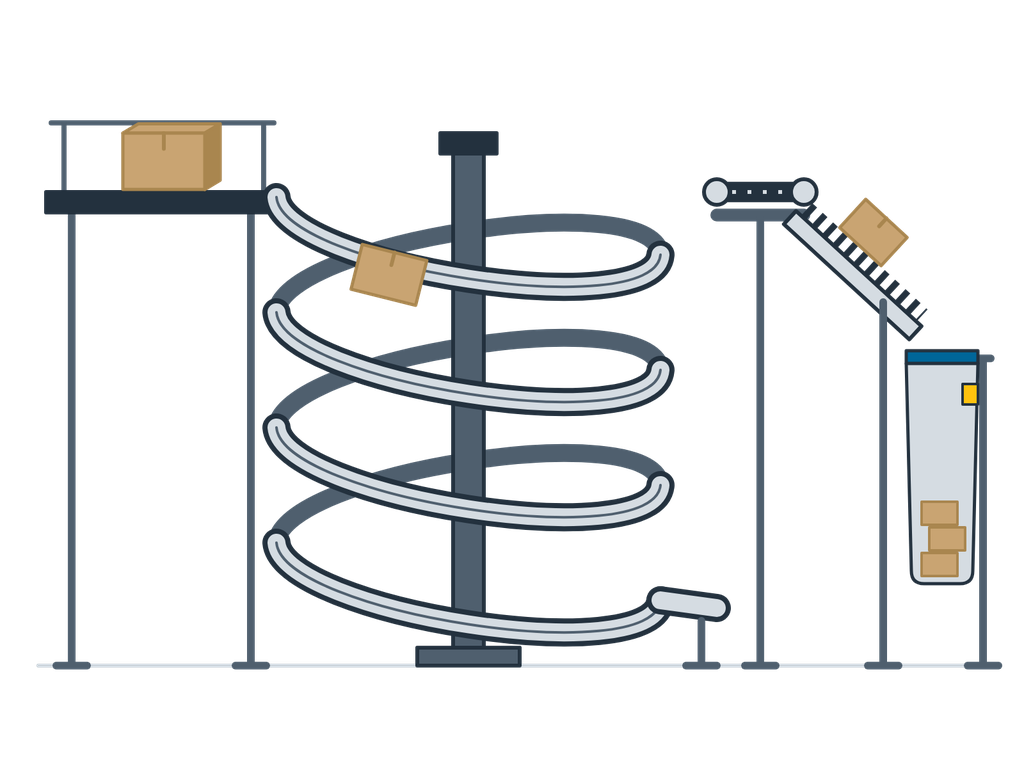
Spiral and straight chutes bring items down by gravity, and bagging chutes receive what the sorter sends out; the chutes need no drives, automatic bagging stations have their own.

What a sorter sends out needs somewhere to land: straight chutes and gravity roller chutes hold a short queue and lead to roll cages, pallets or bags. A spiral chute winds down around a central column and brings items from a mezzanine, steel platform or upper floor to the level below, with no motor and almost no maintenance; flat robot-sorting platforms and multi-level warehouses use it widely. Bagging chutes hang a bag underneath and prompt a change when it is full, so small parcels ship in bags.

Typical uses

  • Drops from flat robot-sorting platforms
  • Downward flow from mezzanines and upper floors
  • Receiving and buffering at sorter destinations
  • Bagging small parcels

How to choose

  • Drop height and space: spiral chutes for floors and platforms, straight or roller chutes for short side drops at a sorter
  • Item weight and fragility: lower slope, cushioning and full-chute sensors for fragile goods
  • What follows: bagging chutes for small items, cage or pallet chutes for larger ones
  • Bag changes: automatic bagging stations if bags must change without stopping

When it is not the right choice

  • Cartons heavier than the chute is rated for, and very wide items: gravity chutes impact and jam; use a spiral conveyor or vertical lift
  • Moving items up: chutes only go down; use an incline belt or spiral conveyor
  • Large cartons going straight into cages or onto pallets: no bagging station; a roller chute with full detection

Key figures

Spiral chute widthAbout 200–600 mm
Item weightSet by the chosen chute; published models cover about 28 g to 23 kg
Infeed heightSingle sections of about 3.66 m appear in published data; multi-level designs per project
SlopeSome published models are about 16–20°; use a gentler pitch for fragile goods
Destination typesStraight chute, roller chute, bagging chute, cage chute, two-level chute

Figures are typical configuration ranges; exact specifications are set per project.

Options

  • Full-chute sensors and lights
  • Cushioning sections and impact liners
  • Automatic bagging stations: clear, change, close and label bags
  • Steel or plastic spiral surfaces

Scope of supply

  • Machine, drives and control cabinet, assembled and dry-run tested before shipping
  • The equipment's own control and fleet software; interfaces to your existing WMS / ERP as the project requires
  • Drawings: general arrangement, foundation and anchor plan, electrical schematics
  • Conformity documents for the equipment and the whole line, the split of responsibilities and the acceptance criteria are set out in the contract according to the project scope
  • Spare-parts list and wear-part recommendation; a first batch can ship with the equipment
  • Factory acceptance (FAT): attend in person or follow by live video
  • Installation, commissioning and operator training can be included in the offer

What we need for an offer

  • Drop height and available diameter or length
  • Smallest and largest item size, weight range, packaging, fragility
  • Number and spacing of destinations; bags, cages or pallets downstream
  • Items to buffer per destination, bag size, full-chute detection or automatic bag change

Related equipment

Request an offer for this equipment