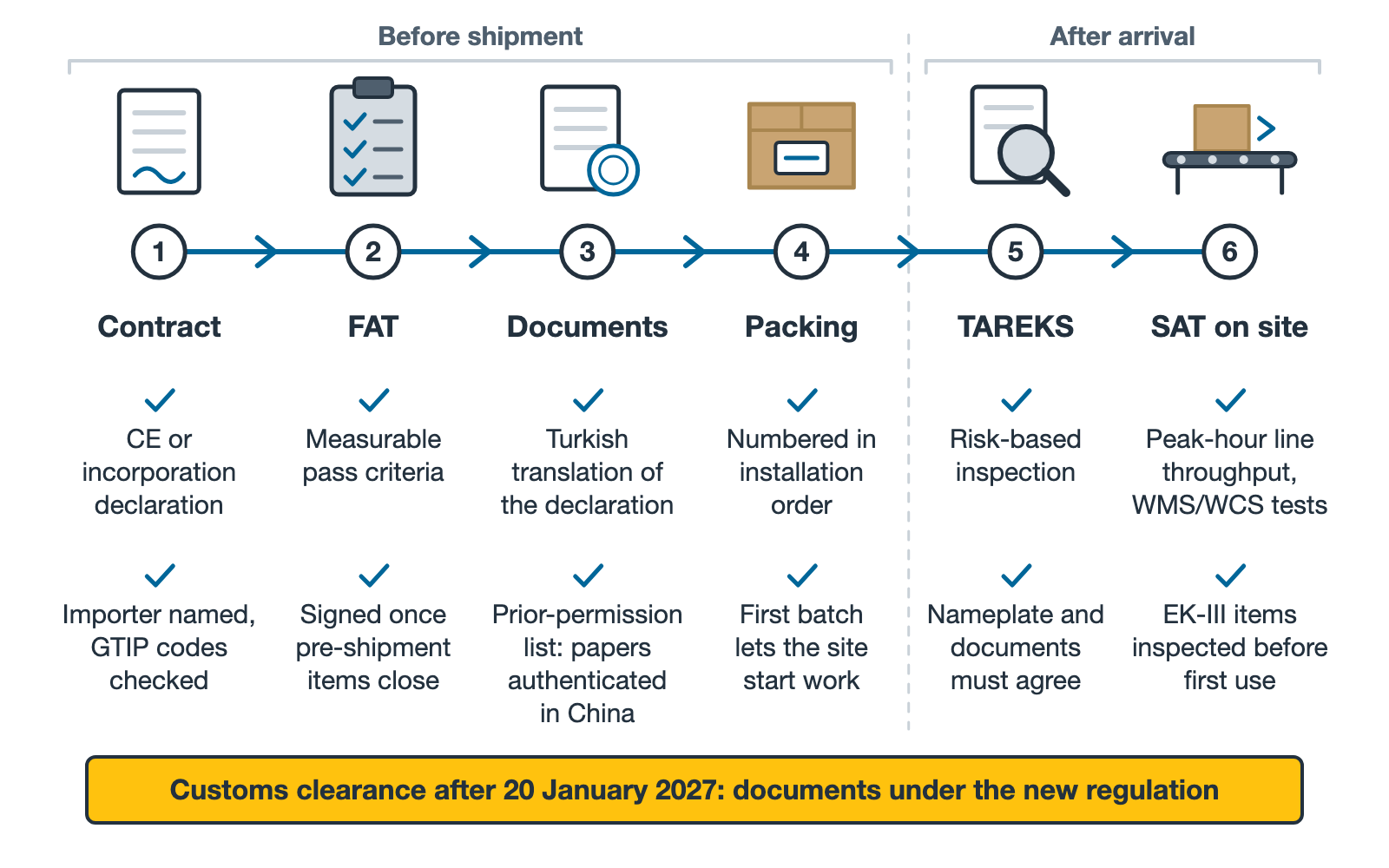
When Chinese-built equipment goes to a site in Türkiye, the problems we see most often come at three hand-over points: the equipment was not tested thoroughly before it left the factory, the documents are incomplete and hold things up at customs or acceptance, and the crates arrive on site but nobody can find the piece that has to go in next. Each has its own answer. Run the factory acceptance test (FAT) against a written test plan until it can be signed off; have the CE declaration of conformity, the Turkish instructions and the documents TAREKS asks for in hand before shipment; and number the packing list in installation order.
The short answer
- Türkiye's new Machinery Safety Regulation, which corresponds to Regulation (EU) 2023/1230, was published in October 2026 and applies from 20 January 2027, so any project whose deliveries run past that date should check its documents against the new rules now.
- Since 2026, imported machinery is inspected through TAREKS under Ministry of Trade notice 2026/32; where the customs code is on the prior-permission list, the declaration of conformity and related documents must be authenticated in the country of dispatch with a Turkish translation, which means doing it before the goods ship.
- FAT pass criteria have to be measurable, the punch items that must be closed before shipment are closed before anyone signs, and the SAT on site uses the same criteria.
Who answers for what: manufacturer, importer, integrator
The Chinese factory is the manufacturer and answers for the compliance of the equipment itself. It carries out the risk assessment and designs to it, compiles the technical file (including the risk assessment, calculations and test reports), issues the declaration of conformity, and marks the machine with its name and address, the model, the year of construction, the serial number and the CE marking. If it supplies only a section of conveyor that someone else integrates, that section is generally "partly completed machinery" in legal terms: it comes with a declaration of incorporation and assembly instructions, and carries no CE marking. Which of the two applies to each machine should be settled in the contract.
The importer is the person or company established in Türkiye that imports the equipment and places it on the market, typically the Turkish subsidiary of a Chinese group or a local trading company. Under the new regulation the importer checks the CE marking, the declaration and the instructions, and puts its own name, address and website or e-mail address on the machine, or on the packaging or accompanying documents only where the machine has no room for it. It keeps a copy of the declaration for at least 10 years. Decide who takes this role when the contract is signed.
Whoever links several suppliers' machines into one line and adds the master control and interlocks is, under the Machinery Directive's definition, dealing with a line that is itself a machine, and normally has to produce a risk assessment and declaration for the whole line. Changes made after the equipment is in use make the modifier a manufacturer only when the change was not foreseen by the manufacturer, creates a new hazard or increases an existing risk, and requires the safety control system to be modified or guarding to be added. Before anyone alters a safety circuit on site, it is worth checking the change against those conditions.
The end user manages the use of the equipment under Turkish occupational safety rules. Equipment listed in Annex EK-III of the Regulation on Health and Safety Conditions for the Use of Work Equipment has to be inspected periodically by authorised persons. That annex was replaced as a whole in December 2025, so hoisting and lifting equipment should be checked against it item by item.
20 January 2027 is the line for document preparation
Türkiye has transposed the EU Machinery Directive 2006/42/EC through its 2009 Machinery Safety Regulation. The new regulation was published on 16 October 2026. Some procedural provisions took effect that day; the rest take effect on 20 January 2027, when the old regulation is repealed. Equipment placed on the market in compliance with the old regulation before then can stay in circulation. On the EU side, Regulation (EU) 2023/1230 also becomes mandatory on that same date.
A few points matter most to equipment suppliers. Instructions may be supplied in digital form, but they must stay accessible online for at least 10 years, and if the buyer asks for paper at the time of purchase, a paper copy must be supplied free of charge within one month. The declaration of conformity can be provided as a web address or a machine-readable code. Control systems and safety-related software must be protected against tampering.
Annex EK-1 of the new regulation lists the machinery that needs a third party involved in conformity assessment. It includes lifting devices that carry people where there is a risk of falling more than 3 m, and components that use machine learning and perform safety functions. Conveyors, sorters and stacker cranes that handle only goods are not on it. If a project includes equipment that lifts people, check that item separately.
What does a proper factory acceptance test (FAT) cover?
The point of a FAT is to find every problem that can be found at the factory, so that time on site goes on the work that can only be done on site.
The test plan is written in advance and signed by both parties: what is tested, how, the pass criteria, and who witnesses it. The pass criteria must be measurable. "Runs normally" is not a criterion.
Load tests use the project's real cartons, totes or bins, or pallets, covering the lightest, heaviest, smallest and largest items and the ones that are hardest to handle. In our past projects, where the FAT was run empty or with standard test loads only, problems with soft packs, off-centre loads and uneven bases often did not show up until site.
Throughput is tested separately for each condition. A cross-belt sorter is usually set up only as one section at the factory, so the FAT measures that section's cycle rate and induction capacity, while peak-hour throughput is measured on the complete line on site. For a stacker crane, the factory test covers single-axis speeds and positioning accuracy, and combined cycle performance is verified in the racking on site. The test plan should say clearly which tests belong to the FAT and which are left for the SAT.
Safety functions are tested one by one: emergency stops, safety door interlocks, light curtains or safety laser scanners, limit switches, overload protection, and the machine's behaviour on power loss and when power returns. Every protective measure in the risk assessment should have a matching test in the FAT record. Record the version number of the control program. If the interface to the WMS / WCS can only be tested on site, at least run the main commands, exceptions and alarms through with simulated messages at the factory.
Each item on the punch list gets an owner and a closing condition, and the list is split into "close before shipment" and "can be handled on site". The FAT is not signed until the first group is closed. A witness who cannot travel to the factory can follow on live video, with camera positions agreed beforehand and readings visible on screen; an edited recording is no substitute.
Documents to collect before shipment
On language: the new regulation requires the instructions and safety information in Turkish, and a declaration of conformity drawn up in another language must come with a Turkish translation. The current regulation requires the official language of the country where the machine is placed on the market. Chinese or English originals can go along as well, but they do not replace the Turkish version.
| Category | Content | Provided by | Check before shipment |
|---|---|---|---|
| Compliance | CE declaration of conformity, or for partly completed machinery a declaration of incorporation with assembly instructions | Manufacturer | Model and serial number match the machine; listed standards fit the equipment; Turkish translation attached |
| Compliance | Technical file (including risk assessment) | Kept by the manufacturer | Not necessarily shipped with the goods, but must be available when the authorities ask |
| Drawings | General layout, foundation and embedded-parts drawings, electrical schematics, pneumatic/hydraulic diagrams | Manufacturer | Final revision, matching the equipment as tested at FAT |
| Instructions | Installation, operation and maintenance instructions | Manufacturer | Turkish version shipped with the goods; digital-only allowed only for equipment placed on the market after 20 January 2027 |
| Test records | FAT report, safety function test records, punch list close-out | Manufacturer and witness | Signed by both parties; open items have an on-site plan |
| Spares and software | Spare parts list, first-fill spares; program and parameter backups for PLC, dispatching software and HMI | Manufacturer | Spare part numbers match the packing list; software versions match FAT |
| Shipping documents | Commercial invoice, packing list, certificate of origin and similar | Exporter | Goods descriptions match the declared GTIP code |
| Marking | Nameplate, CE marking, importer's name and address | Manufacturer, importer | Nameplate data match the declaration and test reports |
TAREKS import inspection and duties: why check the customs code before ordering?
Ministry of Trade notice 2026/32 on the import inspection of machinery has applied since 1 January 2026. Imported machinery is inspected through the TAREKS system on the basis of risk analysis, and the inspection body is the Turkish Standards Institution (TSE). The notice has two lists of GTIP (Turkish customs tariff) codes: one where prior import inspection permission is needed first, and one where physical inspection takes place only if risk analysis selects the shipment.
For codes on the prior-permission list, the importer uploads the invoice and photographs of the equipment and, depending on the equipment, the declaration of conformity, type-approval certificate and noise certificate. Those documents have to be authenticated in the country of dispatch by the Turkish commercial counsellor or commercial attaché, with a certified Turkish translation. In practice, that part has to be done in China. The lists were amended during 2026, so which list a machine falls on depends on the current version and the authorities' requirements; ask your customs broker to confirm.
TAREKS may inspect the equipment physically. If the nameplate, test reports and documents do not agree, the goods are held and storage charges build up. Have the customs broker review the documents before the first shipment leaves.
As for duties, besides customs duty there may be additional customs duty (İGV) and import VAT (KDV), all assessed on the declared GTIP code and the country of origin; your customs broker can confirm. Conveyors, sorters, stacker cranes and control cabinets may fall under different codes, so confirm each type of equipment separately.
Split long parts, pack in installation order, then run the SAT
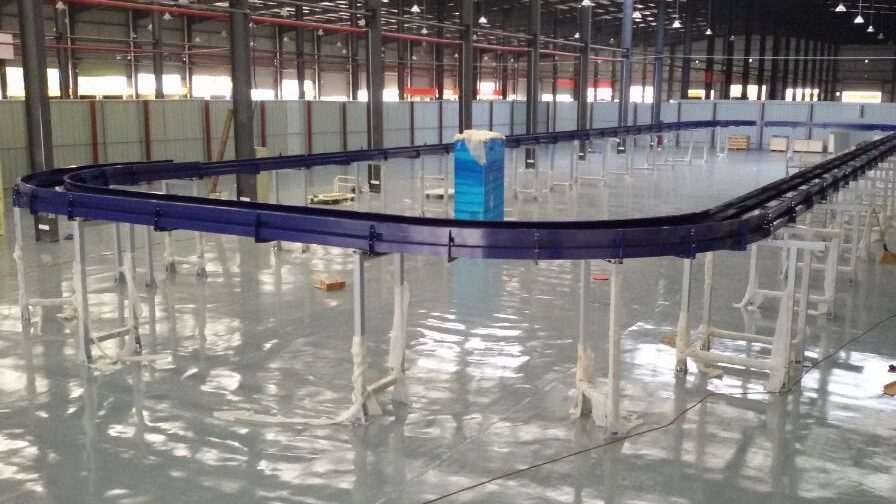
Long parts take the most work: conveyor frames, long sections of a belt conveyor, stacker crane masts, and top and bottom rails. Decide where to split them at the design stage, based on the inside dimensions of the container, rather than cutting them at packing time. Anything still too long is either designed to be joined on site or shipped on flat racks or as break-bulk, with freight costed for the project. Masts and other parts with a straightness tolerance need support along their full length, and should be re-measured on arrival before installation. Electrical cabinets, drive units and sensors are packed separately, protected against moisture and shock, with desiccant.
Every package needs a unique number in an "area-equipment-section" format that matches the installation drawings, and the marking on the crate must match the packing list. Number the packing list in installation order: foundation and embedded parts and the racking or main frames arrive first, then the main equipment, and finally electrical items, safety guarding and spares. When shipping in batches, the first batch must let the site start work; otherwise the installation crew arrives and waits.
The SAT tests what the FAT cannot: peak-hour throughput of the complete line, hand-overs between machines, real integration with the WMS / WCS, long continuous running, and whether the site guarding is complete. Ideally, the SAT plan is finalised at the time of the FAT. Where the integrator is responsible for compliance of the whole line, the line-level risk assessment and declaration are completed before the SAT. Equipment listed in EK-III is inspected by an authorised person after installation and before first use, then periodically after that.
Frequently asked questions
We only supply one conveyor section and a local integrator builds it into the line. Does our section need CE marking?
Generally it is supplied as partly completed machinery, with a declaration of incorporation and assembly instructions and no CE marking; the declaration for the whole line comes from whoever does the integration. Write this into the contract so nobody argues about it at acceptance.
The equipment ships at the end of 2026 and reaches port in February 2027. Old rules or new?
It depends on when the equipment is imported and placed on the market in Türkiye. If customs clearance falls after 20 January 2027, prepare the documents under the new regulation. If in doubt, the authorities' requirements decide, and have your customs broker confirm before shipment.
Does every declaration of conformity have to be authenticated by the Turkish commercial counsellor?
No. Only for codes on the prior-permission list of notice 2026/32 do the declaration, type-approval certificate and noise certificate have to be authenticated in the country of dispatch; for other equipment the documents are uploaded as TAREKS requires. Ask your customs broker to check which list your codes fall on.
The FAT and packing advice comes from our team's past projects and is a first guide only; each project is planned on its own data.
References
- Türkiye, Official Gazette (Resmî Gazete) of 16 October 2026, No. 33402: Makine Emniyeti Yönetmeliği (2023/1230/AB), Machinery Safety Regulation (entry into force and transition: Article 52 and Provisional Article 1; importer obligations: Article 14; Turkish-language instructions: Article 11; translation of the declaration: Article 22): https://www.resmigazete.gov.tr/eskiler/2026/10/20261016-12.htm
- Türkiye, Official Gazette of 31 December 2025, No. 33124, 4th repeated issue: Makinaların İthalat Denetimi Tebliği (Ürün Güvenliği ve Denetimi: 2026/32), notice on the import inspection of machinery (prior permission: Article 5; physical inspection: Article 10; documents to upload: Annex Ek-3): https://www.resmigazete.gov.tr/eskiler/2025/12/20251231M4-73.pdf
- Ministry of Trade of Türkiye, TAREKS: https://ticaret.gov.tr/urun-guvenligi/tareks
- Regulation (EU) 2023/1230 on machinery, official text (EUR-Lex): https://eur-lex.europa.eu/eli/reg/2023/1230/oj/eng
- European Commission, machinery page (Regulation (EU) 2023/1230 applies from 20 January 2027): https://single-market-economy.ec.europa.eu/sectors/mechanical-engineering/machinery_en
- EU Machinery Directive 2006/42/EC, Article 2 (definitions of assemblies of machinery and partly completed machinery): https://www.legislation.gov.uk/eudr/2006/42/article/2
- Ministry of Labour and Social Security of Türkiye, notice on the December 2025 amendment to İş Ekipmanlarının Kullanımında Sağlık ve Güvenlik Şartları Yönetmeliği (Regulation on Health and Safety Conditions for the Use of Work Equipment): https://csgb.gov.tr/isggm/duyurular/24122025/
If you are preparing an equipment purchase or a shipment to Türkiye, send the layout, the equipment list and the delivery schedule to the EMMANUEL Technical Team through the contact form, and we will work out the FAT arrangements, document list and batch shipping plan for your project.