Skip to Content

Power and free overhead conveyor

Drive chain and load track are separate, so carriers can stop, queue and switch tracks; common on paint and assembly lines for cars, appliances and furniture, with a continuous enclosed-track entry model.
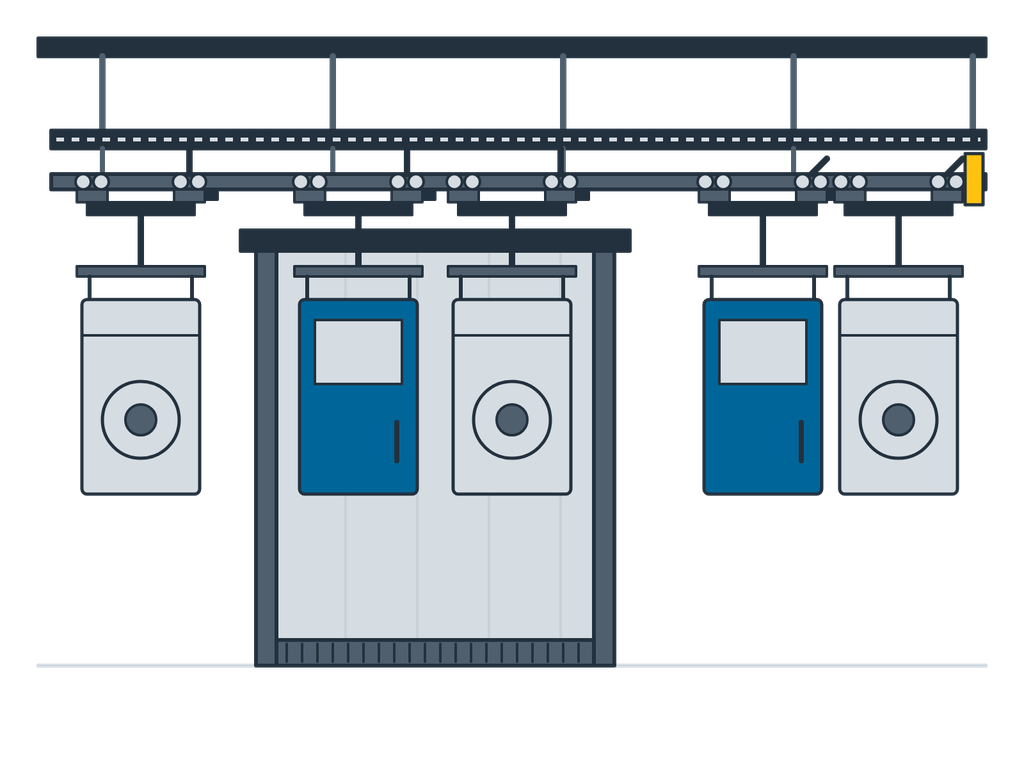
Drive chain and load track are separate, so carriers can stop, queue and switch tracks; common on paint and assembly lines for cars, appliances and furniture, with a continuous enclosed-track entry model.

A power and free conveyor has two tracks: above, a continuously running power chain; below, a free track carrying the load carriers. Carriers can disengage from the chain to stop at a workstation, queue before an oven or switch to another line, so the system follows the process cycle. An enclosed-track overhead conveyor runs its chain continuously inside a closed C-section track: simple and economical where parts move at constant speed without stops. Both keep parts overhead and leave the floor to people and machines.

Typical uses

  • Paint lines for automotive parts and bodies
  • Powder coating and curing of appliance housings and sheet metal
  • Coating furniture and aluminium profiles
  • Transport and buffering between assembly stations

How to choose

  • Whether carriers must stop and switch: independent stops, queues, switches or lifts need power and free; constant continuous flow suits enclosed track
  • Load per carrier and per linked carrier set
  • Whether it passes pretreatment, spray booths and hot ovens, which sets track, chain temperature rating and lubrication
  • Whether the roof steel can carry it, or there is floor space for columns

When it is not the right choice

  • Parts must stop at stations, queue before ovens or take several branches: not enclosed track; choose power and free
  • Garments on hangers or small e-commerce items: choose a garment-on-hanger system or pocket sorter
  • Cartons and pallets in an ordinary warehouse: floor roller, belt or pallet conveyors cost less

Key figures

Power and free capacityPublished light and medium ratings about 91–181 kg per trolley, about 363 kg for one series' four-trolley load bar; heavier duty per project (load bars up to about 9 t appear in published data)
Enclosed track capacityPublished light-medium ratings about 113 kg per trolley, about 454 kg for four linked; heavier duty per project
FunctionsStops, accumulation, switches, lift sections
EnvironmentThrough pretreatment, booths and ovens, specified by temperature and corrosion
SupportHung from roof steel or on floor columns

Figures are typical configuration ranges; exact specifications are set per project.

Options

  • Lift and drop sections
  • Automatic loading and unloading stations
  • Carrier identification and production records
  • High-temperature chain and lubrication

Scope of supply

  • Machine, drives and control cabinet, assembled and dry-run tested before shipping
  • The equipment's own control and fleet software; interfaces to your existing WMS / ERP as the project requires
  • Drawings: general arrangement, foundation and anchor plan, electrical schematics
  • Conformity documents for the equipment and the whole line, the split of responsibilities and the acceptance criteria are set out in the contract according to the project scope
  • Spare-parts list and wear-part recommendation; a first batch can ship with the equipment
  • Factory acceptance (FAT): attend in person or follow by live video
  • Installation, commissioning and operator training can be included in the offer

What we need for an offer

  • Part and carrier size, maximum weight and hanging method
  • Cycle time, dwell at each station, buffer size and number of switches
  • Process zones passed and their temperature and corrosion (pretreatment, booths, maximum oven temperature)
  • Building plans, clear height, level changes, allowed roof loads or column positions

Related equipment

Request an offer for this equipment