Before comparing sorter types, get two sets of numbers right: the parcel mix counted by piece (how many polybags, flats, small items, cartons, heavy and odd-shaped items, and round items) and the peak-hour throughput. Then look at the number of destinations and the clear height of the building. With lots of polybags and small items and a hundred or more destinations, we usually go for a cross-belt sorter. Where cartons and totes dominate and there are a few dozen destinations at most, a swivel-wheel or sliding-shoe sorter fits better. If clear height is limited, destinations change often or volumes swing with the season, that is when matrix and robotic sorting come into the picture.
The short answer
- Size the sorter on peak-hour throughput, not the daily average; in a facility where parcels arrive in a short window, daily volume divided by operating hours can be a fraction of the real peak.
- A swivel-wheel sorter turns parcels by friction between its wheels and the parcel's underside, so it suits cartons and totes with flat bottoms; a site with a high share of polybags should look first at cross-belt, narrow-belt or robotic sorting.
- System capacity is the lowest of unloading, singulation, induction, DWS and the chutes, and quite often the sorter itself is not the bottleneck.
Get the parcel mix and the peak hour right first
Count the parcel mix by pieces, not by weight or by value. We normally ask the client to export at least one peak-season week of line-level data from the WMS or the courier system and split it into polybags (plastic and bubble mailers), flats (document envelopes, thin bags), small items (shortest side around 100 mm, close to the machine's lower limit; anything below the minimum size counts separately), standard cartons, heavy and oversize items, and round or irregular items (tubes, drums, tyres and the like). Each class needs its share and also its range of sizes and weights. An average on its own is not enough.
Throughput means the peak hour. A worked example: 40,000 parcels a day, arriving mostly within six evening hours, with the busiest hour carrying 25% of the day, gives a peak of 10,000 parcels/h. Spread evenly over 20 operating hours, the same day looks like 2,000 parcels/h. Those two figures call for two different classes of equipment. Add growth for the next three to five years and the promotion-peak factor on top of the peak hour, and you have the design throughput.
Three more things need settling before you choose. Destinations: what you sort by (route, depot, store, carrier, order), how many there are today, whether extra ones open in high season, and room for reject and expansion chutes. Site: the layout drawing, column grid, clear height and floor loading; a loop sorter needs length and width, double-deck chutes need height, and a robot platform needs platform area and bagging space underneath. Downstream: after sorting, are parcels bagged by hand, put into cages, loaded straight into trucks, or sent on to palletising? If downstream cannot keep up, the chutes fill. On a loop, parcels then go round again; on a linear sorter they back up at the divert, and the line behind stops.
The German guideline VDI 3619 includes a checklist for sorting systems, and it is a handy way to find gaps in your own requirements sheet.
Which parcel types suit each of the five sorter types?
Cross-belt sorter
Carriers run continuously, each with a short belt mounted crosswise. At the destination chute the belt starts and moves the parcel off sideways. The parcel is carried off by belt friction rather than pushed from the side, so polybags, small items and flats are this machine's strength; round items and very soft bags need a trial.
The number of carrier slots passing one point is set by speed and pitch: carriers per hour = speed (m/s) × 3,600 ÷ pitch (m). At 2.0 m/s and 600 mm pitch that is exactly 12,000 carrier slots per hour. Real parcel throughput is lower than the slot count, because long items take two carriers, no-reads and parcels for full chutes recirculate, and induction never fills every carrier. Adding induction points only fills the same slots; you cannot multiply by the number of induction points. Whole-loop throughput can only exceed the single-point slot count when carriers unload and are loaded again within one lap. So a throughput figure should always come with speed, pitch and the number of loadings per lap.
In our team's past projects, 600 mm pitch at about 2 m/s with one loading per lap stayed within 12,000 items/h; a figure of 15,000 items/h or more needs a higher speed or several loadings per lap to back it up. Shrinking the pitch to 400–500 mm only suits small items, since an item longer than the pitch takes two carriers or may not fit at all; a high throughput target does not automatically mean a small pitch. Linear cross-belt layouts use the same calculation and usually have fewer slots. See cross-belt sorters.
Swivel-wheel sorter
Rows of steerable wheels push parcels at an angle onto chutes to the left or right, usually at 30° or 45°, on one side or both, with modules joined to straight conveyor sections to form a line. It changes direction through friction between the wheels and the parcel's underside, which is why it suits cartons and totes with flat bottoms. Polybags and bagged items have soft, uneven undersides and few contact points, so they slip or fail to divert fully, and round items roll off course. Once the polybag share gets high, sorting accuracy drops noticeably, and that is the point to stop forcing a swivel-wheel solution.
Its strengths are low investment, small footprint and short installation time. It works well in small and mid-sized hubs, for splitting outbound flow by route, or for pre-sorting ahead of a cross-belt. See swivel-wheel sorters.
Sliding-shoe sorter
The conveying surface is made of slats, and shoes on the slats slide diagonally at the divert point to push the carton onto a side chute. The carton never leaves the conveying surface; divert angles are usually 20° or 30°. Packaging damage and noise are usually lower than with swivel wheels, which makes it a good fit for retail distribution centres sorting full cases by store, and for full-case outbound in food and beverage or pharmaceutical warehouses. It needs a steady gap between cartons, at least 150 mm and more at higher speeds or with longer cartons, so it is normally fed by automatic gapping. It was not designed for polybags and small items. See sliding-shoe sorters.
Narrow-belt and matrix sorting
A narrow-belt sorter is usually linear and diverts with narrow belt modules. It has more contact area with the parcel than swivel wheels and copes somewhat better with polybags. The MHI material on conveyor and sortation also notes that high-throughput outbound operations, or ones with a broad range of product dimensions and weights, are more likely to use a narrow-belt or a sliding-shoe sorter. We calculate narrow-belt throughput and suitable parcel types project by project, so there is no figure here.
Matrix sorting uses a grid of belt cells to move parcels cell by cell to their destination. Some modules are around 600 mm square, others are different sizes; there is no common standard. It needs no loop and no spiral chutes, but routing has to be planned for the site. Parcels get in each other's way, and with many destinations and crossings, throughput stops rising, so it does not scale linearly with the number of modules. On site, check the clear height under the beams and the space for outgoing flow; there is no fixed building height requirement. It suits buildings with limited clear height, irregular floor plans and frequently changing destinations, as well as returns sorting and secondary sorting after a main sorter.
Robotic sorting
Small sorting robots run on a steel platform, guided by 2D codes on the floor, and drop each parcel through the platform into a bag or bin at its destination. The number of destinations depends on platform area and chute spacing, anywhere from a few dozen to close to a thousand. Throughput rises with the number of robots, but more robots means more avoidance manoeuvres, so it does not scale linearly with the fleet. Which parcel goes to which destination and which robot takes it is decided by real-time scheduling, and how good that scheduling is shows up directly in throughput. Robots can be added or removed later; whether more destinations can be opened depends on what the platform design left room for. Time to go live varies a lot with platform size and is planned per project.
The limits are in the parcel profile: standard robots take parcels up to 5 kg (10 kg models also exist) and up to 600 × 400 × 300 mm, so heavy and large items need a separate line. It suits leased buildings, e-commerce sites with strong seasonal swings, and urban last-mile hubs. See robotic sorting systems.
Throughput and conditions by sorter type
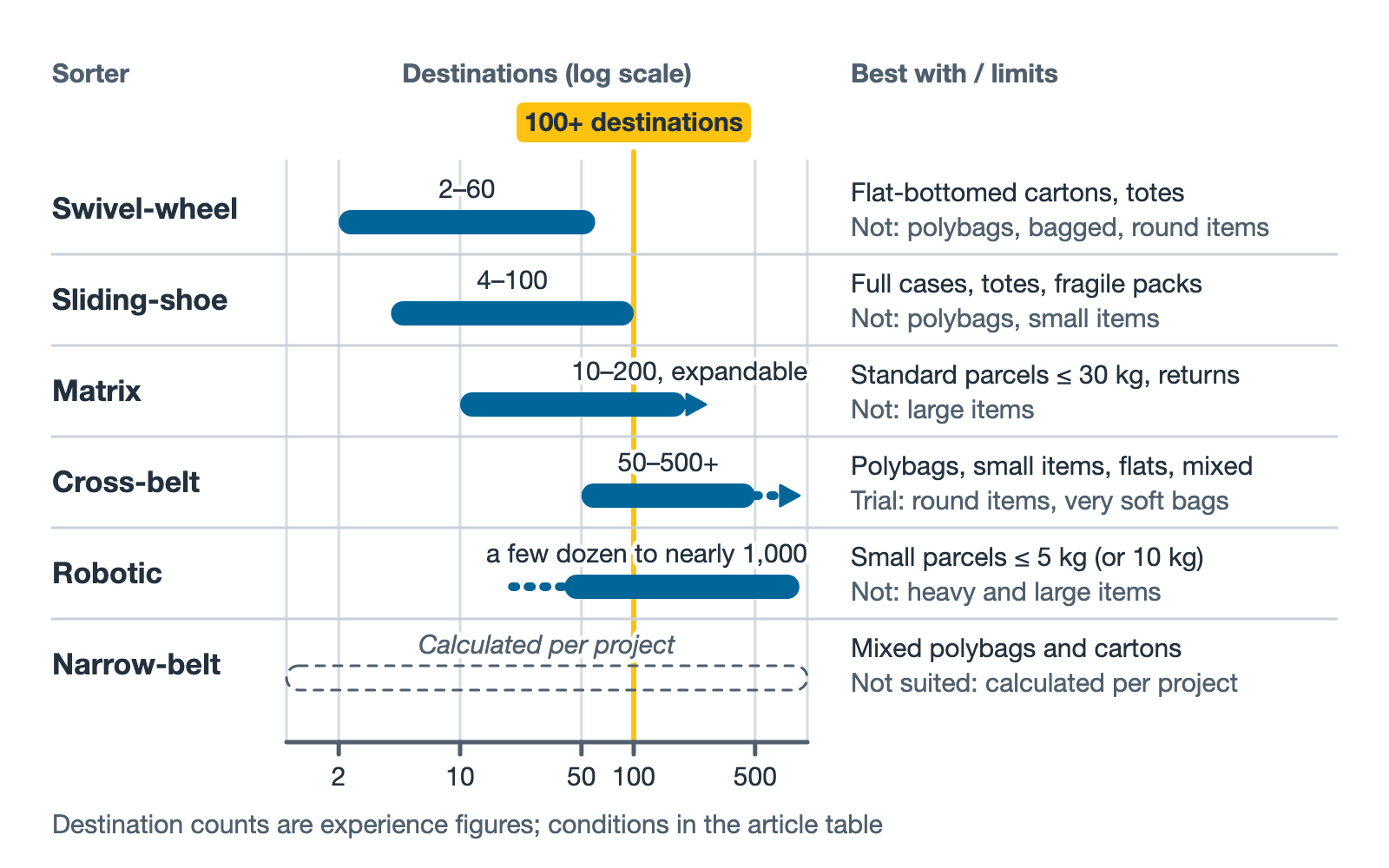
The throughput and destination figures in the table come from our team's past projects and are a first guide only, with the conditions shown in the table; for the same sorter type, real throughput can differ a great deal with parcel mix and induction method. To place a requirement in a speed class, the MHI material is a useful reference: below 100 cartons per minute is low speed, 100–150 is medium and above 200 is high (the source does not class 150–200). That is roughly below 6,000, 6,000–9,000 and above 12,000 cartons/h.
| Sorter type | Throughput (experience figures) | Destinations | Best with | Not suited to | Site notes |
|---|---|---|---|---|---|
| Cross-belt | Loop 8,000–25,000 items/h, calculated from speed, pitch and loadings per lap; linear 4,000–10,000 items/h | 50–500+ | Polybags, small items, flats, mixed parcels | Round items and very soft bags need a trial; above 30 kg needs a heavy-duty model | Loop needs length and width; double-deck chutes need height |
| Swivel-wheel | 1,500–8,000 items/h | 2–60 | Flat-bottomed cartons, totes | Polybags, bagged items, round items | Joined to straight sections; easy retrofit |
| Sliding-shoe | 4,000–12,000 cartons/h, gap ≥ 150 mm | 4–100 | Full cases, totes, fragile packaging | Polybags, small items | Needs enough length and automatic gapping |
| Narrow-belt | Calculated per project | Calculated per project | Mixed polybags and cartons | Calculated per project | Linear layout |
| Matrix | About 2,000–10,000 items/h with clean routing and modules added step by step; lower with many crossings | 10–200, expandable | Standard parcels ≤ 30 kg, returns | Large items | Clear height under beams and outgoing space checked separately; irregular sites possible |
| Robotic | A few thousand to about 20,000 items/h, rising with fleet size, with avoidance losses | Depends on area and chute spacing, up to close to 1,000 | Small parcels ≤ 5 kg (or 10 kg) | Heavy and large items | Platform area, bagging space underneath, floor loading |
Why does a sorter fall short of its rated throughput?
When a sorter does not reach its rated capacity, we look at the front end first, in this order: unloading, singulation, induction, DWS. The single-unit figures below are also ranges from our past projects.
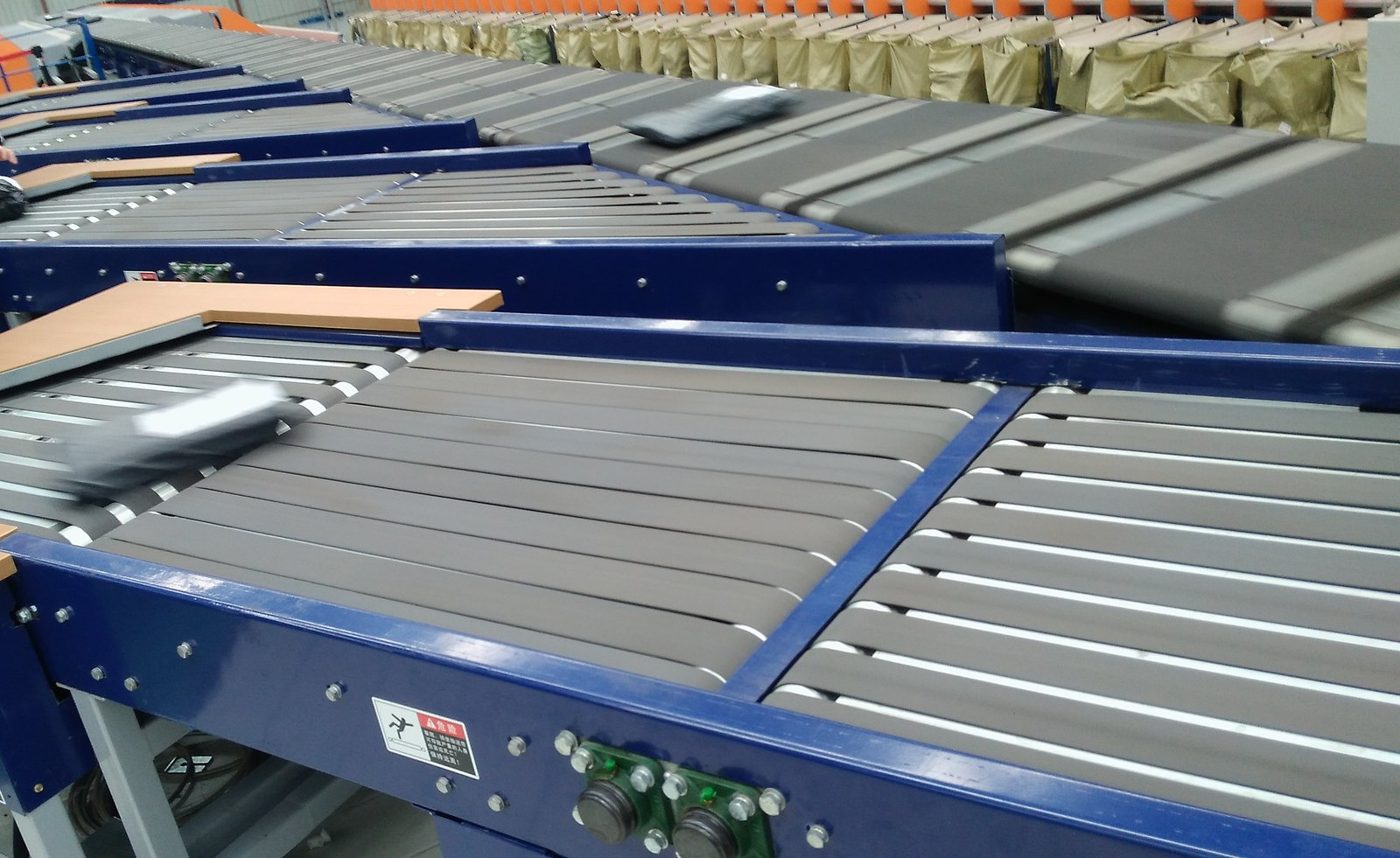
The number of unloading docks and how the telescopic belt conveyors are configured decide how many parcels per hour enter the system at all. With too few docks, everything downstream is waiting for parcels.
Parcels arriving in piles, side by side or stuck together cannot go straight onto a sorter. Placing them one by one by hand takes a lot of people, and night shifts are hard to staff. With singulation and automatic induction, vision plus a matrix of individually speed-controlled belts pulls parcels apart into a single file, at roughly 4,000–10,000 items/h per line, and diverts anything it cannot separate to a manual lane.
The number of induction stations decides directly whether the sorter can run full. On a cross-belt, a manual induction station manages roughly 1,000–1,500 items/h and an automatic one about 1,500–4,000 items/h, depending on parcel mix and operator skill. A design peak of 12,000 items/h with manual induction only needs 8–12 induction stations, and that is counting every station at full rate, so leave extra for shift changes and exceptions. A proposal that quotes the sorter's rated capacity without working back from induction capacity per station ends up with a lot of empty carriers going round.
A DWS (dimensioning, weighing and scanning) unit handles about 3,000–6,000 items/h, provided it is a continuous type and the parcels are already singulated. High-volume lines need several units in parallel, or one on each induction branch rather than on the combined main line. Parcels that are not separated or not gapped enough cannot be measured or read properly.
The chute end needs exits too. No-reads, parcels without a destination, oversize or overweight items and parcels for full chutes need reject chutes and a manual handling area, and DWS exceptions need their own reject lane. Without these, parcels either circulate on the loop taking up carriers or end up in the wrong chute. When we assess a proposal, we work from the unloading docks through to the chutes, write down the capacity of every stage, and take the lowest as the system capacity.
Most Turkish parcels weigh under 2 kg: what does that mean for the sorter?
The Information and Communication Technologies Authority of Türkiye (BTK) reports in its postal sector market data for 2026-1 that about 728 million postal parcels and courier items were handled nationwide in the first half of 2026. By piece count, about 82% weighed 2 kg or less, about 17% weighed 2–20 kg and about 1% weighed more than 20 kg. These are totals across all carriers, broken down by weight only, so they tell you nothing about the split between polybags and cartons, or about sizes.
With a mix dominated by light parcels, our trade-offs look roughly like this. For a hub with many destinations and polybags mixed with small items, a cross-belt is the safest choice; with few heavy items, a standard-duty model is usually enough, and the small number of parcels above 30 kg go on a separate line. For a linear layout with few destinations and mixed polybags and cartons, compare narrow-belt with cross-belt, and trial the narrow-belt with your own parcels.
Be careful with swivel wheels. Light parcels with small or soft undersides give the wheels less friction to work with, so the risk of slipping and incomplete diverts goes up. We only use them on outbound lines or pre-sort stages dominated by cartons and totes, with light, small and soft items on a separate line. By weight, robotic sorting covers most parcels under 2 kg, but the size limit, number of destinations and platform area still need checking, and the 2–20 kg share needs a line of its own.
National figures are only background. Apparel and small-goods e-commerce sites see a lot of polybags, while appliance, home goods and FMCG distribution is mostly cartons, and two warehouses in the same city can look completely different. The most reliable basis is your own outbound data, classified as described above, with the promotion peak looked at separately. If the equipment is going to the EU, the safety design of the sorting line can be checked against EN 619:2022, the edition that brought sorters into its scope; for projects in Türkiye, the requirements of the local authorities apply.
Frequently asked questions
Q: Cross-belt and narrow-belt sorters both handle polybags. How do we pick one?
A: With a hundred or more destinations, high throughput and room for a loop, we choose cross-belt. For a linear layout with few destinations and a mix of polybags and cartons, narrow-belt is worth comparing, but its capacity has to be calculated for the project, and it is best to trial it with your own parcels before deciding.
Q: Should we run trials before the equipment ships, and with which parcels?
A: Yes. Take the softest, thinnest, roundest and heaviest parcel types in your operation, record the rates of mis-sorts, slipping, jams and parcels needing manual handling, and write the results into the FAT acceptance conditions.
Q: If volumes grow, can we add capacity to the sorter later?
A: It depends on the type. A cross-belt's ceiling is set by speed and pitch, and more induction stations only fill the carriers more fully; robotic sorting can take more robots, with avoidance losses, provided destinations were reserved up front; adding matrix modules does not scale linearly either. That is why the design throughput should already include headroom for the next three to five years.
Worked examples in this article are typical cases; experience figures come from our team's past projects and are only a first guide. Each project is calculated on its own data.
References
- Information and Communication Technologies Authority of Türkiye (BTK): Türkiye Posta Sektörü Pazar Verileri Raporu 2026-1 (Turkish Postal Sector Market Data Report; sections 2.2 and 2.2.1, parcel volumes and weight distribution): https://www.btk.gov.tr/posta-sektoru-pazar-verileri-raporu
- VDI 3619:2017-04 Sorting and distribution systems for parcel goods: https://www.vdi.de/richtlinien/details/vdi-3619-sorting-and-distribution-systems-for-parcel-goods
- MHI Conveyor & Sortation Systems industry group (CSS): Handling Applications with Conveyor and Sortation Systems: https://media.videos.mhi.org/wp-content/uploads/2024/04/04115539/Handling-Applications-with-Conveyor-and-Sortation-Systems.pdf
- EN 619:2022 Continuous handling equipment and systems — Safety requirements for equipment for mechanical handling of unit loads (BSI page): https://knowledge.bsigroup.com/products/continuous-handling-equipment-and-systems-safety-requirements-for-equipment-for-mechanical-handling-of-unit-loads
- Boysen, Briskorn, Fedtke, Schmickerath: Automated sortation conveyors: A survey from an operational research perspective, European Journal of Operational Research 276(3), 2019: https://doi.org/10.1016/j.ejor.2018.08.014
- Boysen, Schwerdfeger, Ulmer: Robotized sorting systems: Large-scale scheduling under real-time conditions with limited lookahead, European Journal of Operational Research 310(2), 2023: https://doi.org/10.1016/j.ejor.2023.03.037
If you are planning a sorting hub or an e-commerce warehouse, send the layout, your parcel mix data and peak-hour figures to the EMMANUEL Technical Team via the contact form, and we will work out the sorter type, the number of induction stations and the front-end configuration with you.