Palletizer types and palletizing grippers
Layer palletizers for fast single-product lines, gantry palletizers for long spans and several lines, grippers chosen for bags, cases or drums; grippers are also made to order on their own.
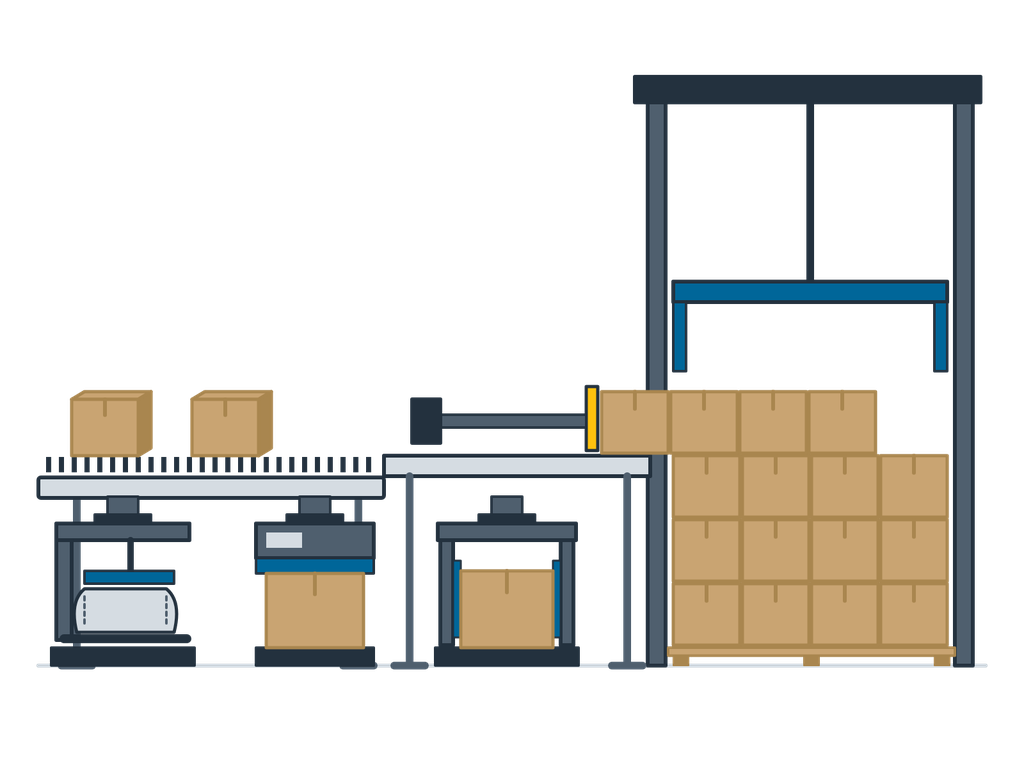
Layer palletizers for fast single-product lines, gantry palletizers for long spans and several lines, grippers chosen for bags, cases or drums; grippers are also made to order on their own.
Layer palletizers for fast single-product lines, gantry palletizers for long spans and several lines, grippers chosen for bags, cases or drums; grippers are also made to order on their own.
Palletizing is not only robots. A layer palletizer forms a complete layer and pushes it onto the pallet, fast and suited to single-product beverage, dairy and building-material lines, in high-level and low-level infeed versions. A gantry palletizer is a Cartesian machine with a long span that can serve several lines. A robot cell is the most flexible. Whatever the machine, the gripper does the handling: finger (fork) grippers for woven and paper sacks, vacuum grippers for cases, clamp or fork-plate grippers for heavy cases and drums, layer grippers for whole layers. Grippers ship with the machine or are made to order for an existing robot.
| Layer palletizer | Published ratings about 280–300 layers/h low-level, up to about 510 high-level; confirm against case size and pattern |
|---|---|
| Gantry palletizer | Built to span, payload and number of lines; reference project: about 150–200 kg payload, axes about 60–90 m/min |
| Four-axis palletizing robot | Payload commonly about 110–450 kg |
| Sack gripper | Finger type supporting from below; sack weight per gripper specification |
| Gripper types | Finger (fork), vacuum, clamp/fork-plate, layer |
| Periphery | Pallet dispenser, slip-sheet placer, pallet conveyors |
Figures are typical configuration ranges; exact specifications are set per project.