End-of-line packaging line
Case erecting, packing, sealing, weighing, labeling, palletizing and wrapping in one line, configured to output and products; or just the one machine that is the bottleneck.
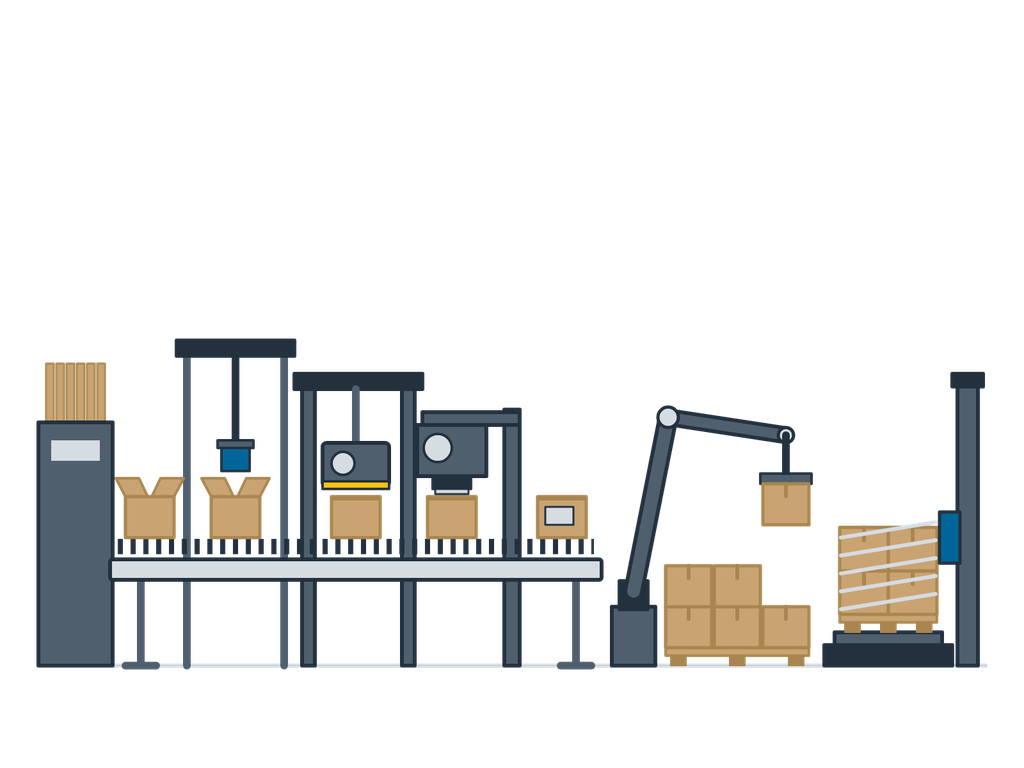
Case erecting, packing, sealing, weighing, labeling, palletizing and wrapping in one line, configured to output and products; or just the one machine that is the bottleneck.
Case erecting, packing, sealing, weighing, labeling, palletizing and wrapping in one line, configured to output and products; or just the one machine that is the bottleneck.
An end-of-line packaging line takes products from the end of production to a pallet ready to ship: the case erector forms the box, people or robots pack it, the sealer closes it, a checkweigher rejects short packs, a labeler applies the logistics label, a robot palletizes, the stretch wrapper wraps, and a pallet label goes on last. The whole line runs at the speed of its slowest machine, so each machine is sized to the cases per minute first, then the buffers and layout are set. Many plants do not need a whole line, only the one machine that has become the bottleneck.
| Line speed | Set by the slowest machine; for reference, published models: erecting about 5–35 cases/min, random sealing about 15–28 cases/min |
|---|---|
| Machines | Erecting, packing, sealing, checkweighing, labeling, strapping, palletizing, wrapping, pallet labeling, as needed |
| Buffers | Accumulation conveyors between machines absorb cycle variation |
| Controls | Line-level controls with MES and WMS interface |
| Compliance | Conformity documents for the equipment and the whole line, the split of responsibilities and the acceptance criteria are set out in the contract according to the project scope (in the EU, Directive 2006/42/EC applies until 19 January 2027 and Regulation (EU) 2023/1230 from 20 January 2027) |
Figures are typical configuration ranges; exact specifications are set per project.